Chimamanda Adichie - Americanah
Здесь есть возможность читать онлайн «Chimamanda Adichie - Americanah» весь текст электронной книги совершенно бесплатно (целиком полную версию без сокращений). В некоторых случаях можно слушать аудио, скачать через торрент в формате fb2 и присутствует краткое содержание. Год выпуска: 2013, Издательство: Knopf, Жанр: Современная проза, на английском языке. Описание произведения, (предисловие) а так же отзывы посетителей доступны на портале библиотеки ЛибКат.
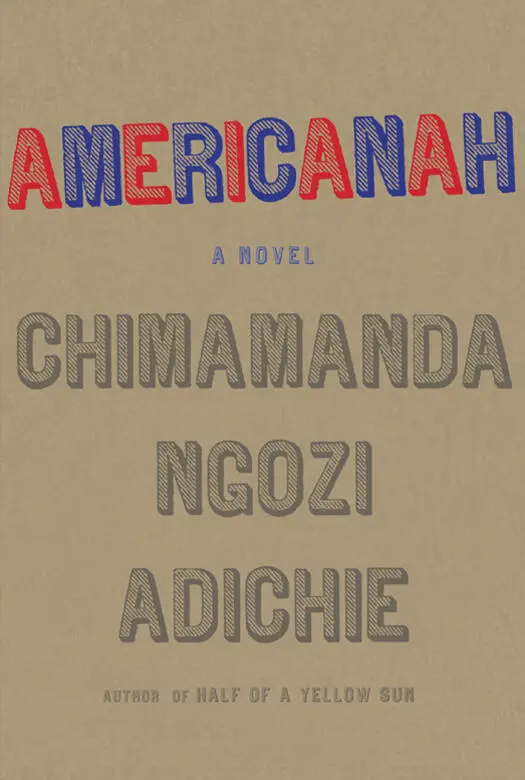
- Название:Americanah
- Автор:
- Издательство:Knopf
- Жанр:
- Год:2013
- ISBN:нет данных
- Рейтинг книги:4 / 5. Голосов: 1
-
Избранное:Добавить в избранное
- Отзывы:
-
Ваша оценка:
Americanah: краткое содержание, описание и аннотация
Предлагаем к чтению аннотацию, описание, краткое содержание или предисловие (зависит от того, что написал сам автор книги «Americanah»). Если вы не нашли необходимую информацию о книге — напишите в комментариях, мы постараемся отыскать её.
, a dazzling new novel: a story of love and race centered around a young man and woman from Nigeria who face difficult choices and challenges in the countries they come to call home.
As teenagers in a Lagos secondary school, Ifemelu and Obinze fall in love. Their Nigeria is under military dictatorship, and people are leaving the country if they can. Ifemelu — beautiful, self-assured — departs for America to study. She suffers defeats and triumphs, finds and loses relationships and friendships, all the while feeling the weight of something she never thought of back home: race. Obinze — the quiet, thoughtful son of a professor — had hoped to join her, but post-9/11 America will not let him in, and he plunges into a dangerous, undocumented life in London.
Years later, Obinze is a wealthy man in a newly democratic Nigeria, while Ifemelu has achieved success as a writer of an eye-opening blog about race in America. But when Ifemelu returns to Nigeria, and she and Obinze reignite their shared passion — for their homeland and for each other — they will face the toughest decisions of their lives.
Fearless, gripping, at once darkly funny and tender, spanning three continents and numerous lives,
is a richly told story set in today’s globalized world: Chimamanda Ngozi Adichie’s most powerful and astonishing novel yet.
Americanah — читать онлайн бесплатно полную книгу (весь текст) целиком
Ниже представлен текст книги, разбитый по страницам. Система сохранения места последней прочитанной страницы, позволяет с удобством читать онлайн бесплатно книгу «Americanah», без необходимости каждый раз заново искать на чём Вы остановились. Поставьте закладку, и сможете в любой момент перейти на страницу, на которой закончили чтение.
Интервал:
Закладка:

ALLISON WAS BANGING on her door again. “Are you there? Phone call! She says it’s an emergency, for God’s sake! I know you’re there, I heard you flush the toilet a minute ago!”
The flat, dulled banging, as though Allison was hitting the door with an open palm rather than a knuckle, unnerved Ifemelu. “She’s not opening,” she heard Allison say, and then, just when she thought Allison had left, the banging resumed. She got up from her bed, where she had been lying and taking turns reading two novels chapter by chapter, and with leaden feet moved to the door. She wanted to walk quickly, normally, but she could not. Her feet had turned into snails. She unlocked the door. With a glare, Allison thrust the phone in her hand.
“Thanks,” she said, limply, and added, in a lower mumble, “Sorry.” Even talking, making words rise up her throat and out of her mouth, exhausted her.
“Hello?” she said into the phone.
“Ifem! What’s going on? What’s happening to you?” Ginika asked.
“Nothing,” she said.
“I’ve been so worried about you. Thank God I found your roommate’s number! Obinze has been calling me. He’s worried out of his mind,” Ginika said. “Even Aunty Uju called to ask if I had seen you.”
“I’ve been busy,” Ifemelu said vaguely.
There was a pause. Ginika’s tone softened. “Ifem, I’m here, you know that, right?”
Ifemelu wanted to hang up and return to her bed. “Yes.”
“I have good news. Kimberly called me to ask for your phone number. The babysitter she hired just left. She wants to hire you. She wants you to start on Monday. She said she wanted you from the beginning but Laura talked her into hiring the other person. So, Ifem, you have a job! Cash! Under the table! Ifemsco, this is great. She’ll pay you two-fifty a week, more than the old babysitter. And pure cash under the table! Kimberly is a really great person. I’m coming tomorrow to take you over there to see her.”
Ifemelu said nothing, struggling to understand. Words took so long to form meaning.
The next day, Ginika knocked and knocked on her door before Ifemelu finally opened, and saw Allison standing on the landing at the back, watching curiously.
“We’re late already, get dressed,” Ginika said, firmly, authoritatively, with no room for dissent. Ifemelu pulled on a pair of jeans. She felt Ginika watching her. In the car, Ginika’s rock music filled the silence between them. They were on Lancaster Avenue, just about to cross over from West Philadelphia, with boarded-up buildings and hamburger wrappers strewn around, and into the spotless, tree-filled suburbs of the Main Line, when Ginika said, “I think you’re suffering from depression.”
Ifemelu shook her head and turned to the window. Depression was what happened to Americans, with their self-absolving need to turn everything into an illness. She was not suffering from depression; she was merely a little tired and a little slow. “I don’t have depression,” she said. Years later, she would blog about this: “On the Subject of Non-American Blacks Suffering from Illnesses Whose Names They Refuse to Know.” A Congolese woman wrote a long comment in response: She had moved to Virginia from Kinshasa and, months into her first semester of college, begun to feel dizzy in the morning, her heart pounding as though in flight from her, her stomach fraught with nausea, her fingers tingling. She went to see a doctor. And even though she checked “yes” to all the symptoms on the card the doctor gave her, she refused to accept the diagnosis of panic attacks because panic attacks happened only to Americans. Nobody in Kinshasa had panic attacks. It was not even that it was called by another name, it was simply not called at all. Did things begin to exist only when they were named?
“Ifem, this is something a lot of people go through, and I know it’s not been easy for you adjusting to a new place and still not having a job. We don’t talk about things like depression in Nigeria but it’s real. You should see somebody at the health center. There’s always therapists.”
Ifemelu kept her face to the window. She felt, again, that crushing desire to cry, and she took a deep breath, hoping it would pass. She wished she had told Ginika about the tennis coach, taken the train to Ginika’s apartment on that day, but now it was too late, her self-loathing had hardened inside her. She would never be able to form the sentences to tell her story.
“Ginika,” she said. “Thank you.” Her voice was hoarse. The tears had come, she could not control them. Ginika stopped at a gas station, gave her a tissue, and waited for her sobs to die down before she started the car and drove to Kimberly’s house.
CHAPTER 16
Kimberly called it a signing bonus. “Ginika told me you’ve had some challenges,” Kimberly said. “Please don’t refuse.”
It would not have occurred to Ifemelu to refuse the check; now she could pay some bills, send something home to her parents. Her mother liked the shoes she sent, tasseled and tapering, the kind she could wear to church. “Thank you,” her mother said, and then sighing heavily over the phone line, she added, “Obinze came to see me.” Ifemelu was silent.
“Whatever problem you have, please discuss it with him,” her mother said.
Ifemelu said, “Okay,” and began to talk about something else. When her mother said there had been no light for two weeks, it seemed suddenly foreign to her, and home itself a distant place. She could no longer remember what it felt like to spend an evening in candlelight. She no longer read the news on Nigeria.com because each headline, even the most unlikely ones, somehow reminded her of Obinze.
At first, she gave herself a month. A month to let her self-loathing seep away, then she would call Obinze. But a month passed and still she kept Obinze sealed in silence, gagged her own mind so that she would think of him as little as possible. She still deleted his e-mails unread. Many times she started to write to him, she crafted e-mails, and then stopped and discarded them. She would have to tell him what happened, and she could not bear the thought of telling him what happened. She felt shamed; she had failed. Ginika kept asking what was wrong, why she had shut out Obinze, and she said it was nothing, she just wanted some space, and Ginika gaped at her in disbelief. You just want some space?
Early in the spring, a letter arrived from Obinze. Deleting his e-mails took a click, and after the first click, the others were easier because she could not imagine reading the second if she had not read the first. But a letter was different. It brought to her the greatest sorrow she had ever felt. She sank to her bed, holding the envelope in her hand; she smelled it, stared at his familiar handwriting. She imagined him at his desk in his boys’ quarters, near his small humming refrigerator, writing in that calm manner of his. She wanted to read the letter, but she could not get herself to open it. She put it on her table. She would read it in a week; she needed a week to gather her strength. She would reply, too, she told herself. She would tell him everything. But a week later, the letter still lay there. She placed a book on top of it, then another book, and one day it was swallowed beneath files and books. She would never read it.
TAYLOR WAS EASY, a childish child, the playful one who was sometimes so naïve that Ifemelu guiltily thought him stupid. But Morgan, only three years older, already wore the mourning demeanor of a teenager. She read many grades above her level, was steeped in enrichment classes, and watched adults with a hooded gaze, as though privy to the darkness that lurked in their lives. At first, Ifemelu disliked Morgan, responding to what she thought was Morgan’s own disturbingly full-grown dislike. She was cool, sometimes even cold, to Morgan during her first weeks with them, determined not to indulge this spoiled silken child with a dusting of burgundy freckles on her nose, but she had come, with the passing months, to care for Morgan, an emotion she was careful not to show to Morgan. Instead she was firm and neutral, staring back when Morgan stared. Perhaps it was why Morgan did what Ifemelu asked. She would do it coldly, indifferently, grudgingly, but she would do it. She routinely ignored her mother. And with her father, her brooding watchfulness sharpened into poison. Don would come home and sweep into the den, expecting that everything would stop because of him. And everything did stop, except for whatever Morgan was doing. Kimberly, fluttery and ardent, would ask how his day was, scrambling to please, as though she could not quite believe that he had again come home to her. Taylor would hurl himself into Don’s arms. And Morgan would look up from the TV or a book or a game to watch him, as though she saw through him, while Don pretended not to squirm under her piercing eyes. Sometimes Ifemelu wondered. Was it Don? Was he cheating and had Morgan found out? Cheating was the first thing anyone would think of with a man like Don, with that lubricious aura of his. But he might be satisfied with suggestiveness alone; he would flirt outrageously but not do more, because an affair would require some effort and he was the kind of man who took but did not give.
Читать дальшеИнтервал:
Закладка:
Похожие книги на «Americanah»
Представляем Вашему вниманию похожие книги на «Americanah» списком для выбора. Мы отобрали схожую по названию и смыслу литературу в надежде предоставить читателям больше вариантов отыскать новые, интересные, ещё непрочитанные произведения.










Обсуждение, отзывы о книге «Americanah» и просто собственные мнения читателей. Оставьте ваши комментарии, напишите, что Вы думаете о произведении, его смысле или главных героях. Укажите что конкретно понравилось, а что нет, и почему Вы так считаете.