Chimamanda Adichie - Americanah
Здесь есть возможность читать онлайн «Chimamanda Adichie - Americanah» весь текст электронной книги совершенно бесплатно (целиком полную версию без сокращений). В некоторых случаях можно слушать аудио, скачать через торрент в формате fb2 и присутствует краткое содержание. Год выпуска: 2013, Издательство: Knopf, Жанр: Современная проза, на английском языке. Описание произведения, (предисловие) а так же отзывы посетителей доступны на портале библиотеки ЛибКат.
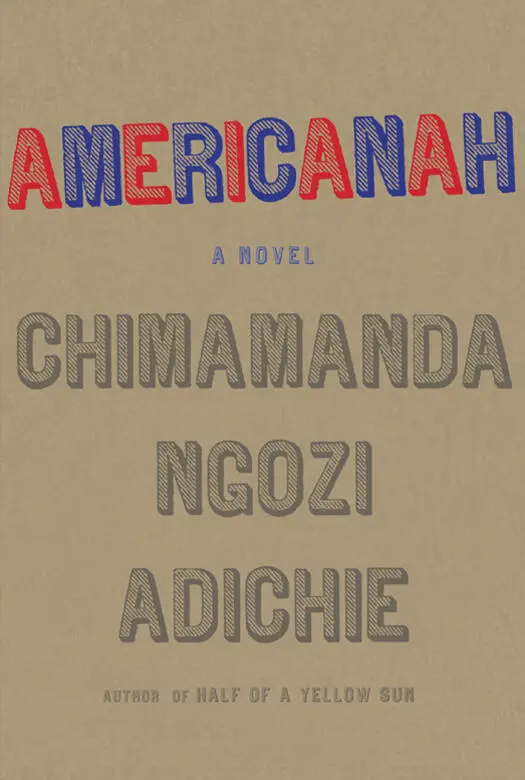
- Название:Americanah
- Автор:
- Издательство:Knopf
- Жанр:
- Год:2013
- ISBN:нет данных
- Рейтинг книги:4 / 5. Голосов: 1
-
Избранное:Добавить в избранное
- Отзывы:
-
Ваша оценка:
Americanah: краткое содержание, описание и аннотация
Предлагаем к чтению аннотацию, описание, краткое содержание или предисловие (зависит от того, что написал сам автор книги «Americanah»). Если вы не нашли необходимую информацию о книге — напишите в комментариях, мы постараемся отыскать её.
, a dazzling new novel: a story of love and race centered around a young man and woman from Nigeria who face difficult choices and challenges in the countries they come to call home.
As teenagers in a Lagos secondary school, Ifemelu and Obinze fall in love. Their Nigeria is under military dictatorship, and people are leaving the country if they can. Ifemelu — beautiful, self-assured — departs for America to study. She suffers defeats and triumphs, finds and loses relationships and friendships, all the while feeling the weight of something she never thought of back home: race. Obinze — the quiet, thoughtful son of a professor — had hoped to join her, but post-9/11 America will not let him in, and he plunges into a dangerous, undocumented life in London.
Years later, Obinze is a wealthy man in a newly democratic Nigeria, while Ifemelu has achieved success as a writer of an eye-opening blog about race in America. But when Ifemelu returns to Nigeria, and she and Obinze reignite their shared passion — for their homeland and for each other — they will face the toughest decisions of their lives.
Fearless, gripping, at once darkly funny and tender, spanning three continents and numerous lives,
is a richly told story set in today’s globalized world: Chimamanda Ngozi Adichie’s most powerful and astonishing novel yet.
Americanah — читать онлайн бесплатно полную книгу (весь текст) целиком
Ниже представлен текст книги, разбитый по страницам. Система сохранения места последней прочитанной страницы, позволяет с удобством читать онлайн бесплатно книгу «Americanah», без необходимости каждый раз заново искать на чём Вы остановились. Поставьте закладку, и сможете в любой момент перейти на страницу, на которой закончили чтение.
Интервал:
Закладка:
CHAPTER 11
Aunty Uju came home dry-faced and tense, the streets dark and Dike already in bed, to ask “Do I have mail? Do I have mail?” the question always repeated, her entire being at a perilous edge, about to tip over. Some nights, she would talk on the phone for a long time, her voice hushed, as though she were protecting something from the world’s prying gaze. Finally, she told Ifemelu about Bartholomew. “He is an accountant, divorced, and he is looking to settle down. He is from Eziowelle, very near us.”
Ifemelu, floored by Aunty Uju’s words, could only say, “Oh, okay,” and nothing else. “What does he do?” and “Where is he from?” were the questions her own mother would ask, but when had it started to matter to Aunty Uju that a man was from a hometown close to theirs?
One Saturday, Bartholomew visited from Massachusetts. Aunty Uju cooked peppered gizzards, powdered her face, and stood by the living room window, waiting to see his car pull in. Dike watched her, playing halfheartedly with his action figures, confused but also excited because he could sense her expectation. When the doorbell rang, she told Dike, urgently, “Behave well!”
Bartholomew wore khaki trousers pulled up high on his belly, and spoke with an American accent filled with holes, mangling words until they were impossible to understand. Ifemelu sensed, from his demeanor, a deprived rural upbringing that he tried to compensate for with his American affectation, his gonnas and wannas.
He glanced at Dike, and said, almost indifferently, “Oh, yes, your boy. How are you doing?”
“Good,” Dike mumbled.
It irked Ifemelu that Bartholomew was not interested in the son of the woman he was courting, and did not bother to pretend that he was. He was jarringly unsuited for, and unworthy of, Aunty Uju. A more intelligent man would have realized this and tempered himself, but not Bartholomew. He behaved grandiosely, like a special prize that Aunty Uju was fortunate to have, and Aunty Uju humored him. Before he tasted the gizzards, he said, “Let me see if this is any good.”
Aunty Uju laughed and in her laughter was a certain assent, because his words “Let me see if this is any good” were about her being a good cook, and therefore a good wife. She had slipped into the rituals, smiling a smile that promised to be demure to him but not to the world, lunging to pick up his fork when it slipped from his hand, serving him more beer. Quietly, Dike watched from the dining table, his toys untouched. Bartholomew ate gizzards and drank beer. He talked about Nigerian politics with the fervid enthusiasm of a person who followed it from afar, who read and reread articles on the Internet. “Kudirat’s death will not be in vain, it will only galvanize the democratic movement in a way that even her life did not! I just wrote an article about this issue online in Nigerian Village .” Aunty Uju nodded while he talked, agreeing with everything he said. Often, silence gaped between them. They watched television, a drama, predictable and filled with brightly shot scenes, one of which featured a young girl in a short dress.
“A girl in Nigeria will never wear that kind of dress,” Bartholomew said. “Look at that. This country has no moral compass.”
Ifemelu should not have spoken, but there was something about Bartholomew that made silence impossible, the exaggerated caricature that he was, with his back-shaft haircut unchanged since he came to America thirty years ago and his false, overheated moralities. He was one of those people who, in his village back home, would be called “lost.” He went to America and got lost , his people would say. He went to America and refused to come back .
“Girls in Nigeria wear dresses much shorter than that o,” Ifemelu said. “In secondary school, some of us changed in our friends’ houses so our parents wouldn’t know.”
Aunty Uju turned to her, eyes narrow with warning. Bartholomew looked at her and shrugged, as though she was not worth responding to. Dislike simmered between them. For the rest of the afternoon, he ignored her. He would, in the future, often ignore her. Later, she read his online posts on Nigerian Village , all of them sour-toned and strident, under the moniker “Igbo Massachusetts Accountant,” and it surprised her how profusely he wrote, how actively he pursued airless arguments.
He had not been back to Nigeria in years and perhaps he needed the consolation of those online groups, where small observations flared and blazed into attacks, personal insults flung back and forth. Ifemelu imagined the writers, Nigerians in bleak houses in America, their lives deadened by work, nursing their careful savings throughout the year so that they could visit home in December for a week, when they would arrive bearing suitcases of shoes and clothes and cheap watches, and see, in the eyes of their relatives, brightly burnished images of themselves. Afterwards they would return to America to fight on the Internet over their mythologies of home, because home was now a blurred place between here and there, and at least online they could ignore the awareness of how inconsequential they had become.
Nigerian women came to America and became wild, Igbo Massachusetts Accountant wrote in one post; it was an unpleasant truth but one that had to be said. What else accounted for the high divorce rates among Nigerians in America and the low rates among Nigerians in Nigeria? Delta Mermaid replied that women simply had laws protecting them in America and the divorce rates would be just as high if those laws were in Nigeria. Igbo Massachusetts Accountant’s rejoinder: “You have been brainwashed by the West. You should be ashamed to call yourself a Nigerian.” In response to Eze Houston, who wrote that Nigerian men were cynical when they went back to Nigeria looking for nurses and doctors to marry, only so that the new wives would earn money for them back in America, Igbo Massachusetts Accountant wrote, “What is wrong with a man wanting financial security from his wife? Don’t women want the same thing?”
After he left that Saturday, Aunty Uju asked Ifemelu, “What did you think?”
“He uses bleaching creams.”
“What?”
“Couldn’t you see? His face is a funny color. He must be using the cheap ones with no sunscreen. What kind of man bleaches his skin, biko ?”
Aunty Uju shrugged, as though she had not noticed the greenish-yellow tone of the man’s face, worse at his temples.
“He’s not bad. He has a good job.” She paused. “I’m not getting any younger. I want Dike to have a brother or a sister.”
“In Nigeria, a man like him would not even have the courage to talk to you.”
“We are not in Nigeria, Ifem.”
Before Aunty Uju went into the bedroom, tottering under her many anxieties, she said, “Please just pray that it will work.”
Ifemelu did not pray, but even if she did, she could not bear praying for Aunty Uju to be with Bartholomew. It saddened her that Aunty Uju had settled merely for what was familiar.

BECAUSE OF OBINZE, Manhattan intimidated Ifemelu. The first time she took the subway from Brooklyn to Manhattan, her palms sweaty, she walked the streets, watching, absorbing. A sylphlike woman running in high heels, her short dress floating behind her, until she tripped and almost fell, a pudgy man coughing and spitting on the curb, a girl dressed all in black raising a hand for the taxis that sliced past. The endless skyscrapers taunted the sky, but there was dirt on the building windows. The dazzling imperfection of it all calmed her. “It’s wonderful but it’s not heaven,” she told Obinze. She could not wait until he, too, saw Manhattan. She imagined them both walking hand in hand, like the American couples she saw, lingering at a shop window, pausing to read menus taped on restaurant doors, stopping at a food cart to buy cold bottles of iced tea. “Soon,” he said in his letter. They said “soon” to each other often, and “soon” gave their plan the weight of something real.
Читать дальшеИнтервал:
Закладка:
Похожие книги на «Americanah»
Представляем Вашему вниманию похожие книги на «Americanah» списком для выбора. Мы отобрали схожую по названию и смыслу литературу в надежде предоставить читателям больше вариантов отыскать новые, интересные, ещё непрочитанные произведения.








Обсуждение, отзывы о книге «Americanah» и просто собственные мнения читателей. Оставьте ваши комментарии, напишите, что Вы думаете о произведении, его смысле или главных героях. Укажите что конкретно понравилось, а что нет, и почему Вы так считаете.