John Wray - The Lost Time Accidents
Здесь есть возможность читать онлайн «John Wray - The Lost Time Accidents» весь текст электронной книги совершенно бесплатно (целиком полную версию без сокращений). В некоторых случаях можно слушать аудио, скачать через торрент в формате fb2 и присутствует краткое содержание. Год выпуска: 2016, ISBN: 2016, Издательство: Farrar, Straus and Giroux, Жанр: Современная проза, Фантастика и фэнтези, на английском языке. Описание произведения, (предисловие) а так же отзывы посетителей доступны на портале библиотеки ЛибКат.
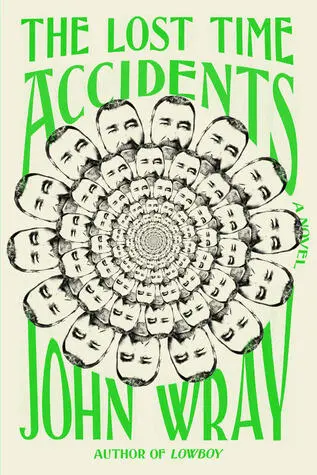
- Название:The Lost Time Accidents
- Автор:
- Издательство:Farrar, Straus and Giroux
- Жанр:
- Год:2016
- ISBN:9781429944526
- Рейтинг книги:4 / 5. Голосов: 1
-
Избранное:Добавить в избранное
- Отзывы:
-
Ваша оценка:
The Lost Time Accidents: краткое содержание, описание и аннотация
Предлагаем к чтению аннотацию, описание, краткое содержание или предисловие (зависит от того, что написал сам автор книги «The Lost Time Accidents»). Если вы не нашли необходимую информацию о книге — напишите в комментариях, мы постараемся отыскать её.
, John Wray takes us from turn-of-the-century Viennese salons buzzing with rumors about Einstein's radical new theory to the death camps of World War Two, from the golden age of postwar pulp science fiction to a startling discovery in a Manhattan apartment packed to the ceiling with artifacts of modern life.
Haunted by a failed love affair and the darkest of family secrets, Waldemar 'Waldy' Tolliver wakes one morning to discover that he has been exiled from the flow of time. The world continues to turn, and Waldy is desperate to find his way back-a journey that forces him to reckon not only with the betrayal at the heart of his doomed romance but also the legacy of his great-grandfather's fatal pursuit of the hidden nature of time itself.
Part madcap adventure, part harrowing family drama, part scientific mystery-and never less than wildly entertaining-
is a bold and epic saga set against the greatest upheavals of the twentieth century.
The Lost Time Accidents — читать онлайн бесплатно полную книгу (весь текст) целиком
Ниже представлен текст книги, разбитый по страницам. Система сохранения места последней прочитанной страницы, позволяет с удобством читать онлайн бесплатно книгу «The Lost Time Accidents», без необходимости каждый раз заново искать на чём Вы остановились. Поставьте закладку, и сможете в любой момент перейти на страницу, на которой закончили чтение.
Интервал:
Закладка:
“It took me seven grueling weeks to reach Vienna. My idea had originally been to find my father and disclose myself to him, as the ultimate proof of his theory; or, barring that, to locate my twenty-one-year-old self and do the same. By the time I crossed into Moravia, however, my objective had changed. I had no memory, after all, of an encounter with my future self, and the dangers of tampering with so-called past events remained unknown. I decided to track Kaspar down instead — if possible at some point after our encounter at Trattner’s, in 1938. This was a great deal harder than you might suppose. I knew he would leave for America, of course; but I was a prisoner of 1908, remember, with no access, temporal or spatial, to his destination there.
“I’d been in Vienna less than three months, however — all praise to chance and fate and Providence! — when my predicament was rendered null and void. I was strolling along the Ringstrasse on a glorious late-October morning, dressed in a suit of saffron-colored twill, when a colorless curtain fell over the sun and the gravel beneath my wingtips turned to tar. No sooner had this occurred than a girl on a bicycle — a student at the university, wearing clothes that would have gotten her instutionalized, frankly, in 1908—clipped me with her handlebars and sent me flying. My twill suit was torn at the crotch and the shoulder; the girl was only slightly harmed in body — poor darling! — but thoroughly shaken in spirit. And her alarm only deepened, needless to say, when I asked politely what the year might be.
“‘Nineteen seventy-three,’ the girl stammered, then spent the better part of an hour trying to coax me to the hospital to test for a concussion. She gave up eventually, but only after I’d allowed her to buy me a new pair of trousers — the very ones I’m wearing now, in fact.
“I’d arrived at the ideal time and place to continue my search, and I went to the municipal archives that same afternoon. I was quickly able to establish that Kaspar had left Europe by a packet steamer, the Comtesse Celeste , bound for New York from Genoa by way of Spain. Sentimental numbskull though he was, I’d nevertheless expected my brother to have made a name for himself in the New World; imagine my surprise and dismay, if you can, when I found no mention of him in any of the papers. I cursed his lack of ambition, Nefflein , I can tell you. There was nothing for it, at that juncture, but to become an immigrant myself.
“I made my way by train to Naples, where the cheapest New York — bound steamers had once docked, and resolved to wait there to be knocked back to the first years of the century, when emigration to America was as simple as paying one’s fare. This took far longer than I’d anticipated: nearly seven years of my innate duration, during which span I completed no fewer than eighty translations. I saw Naples in ruins in 1945, after the brunt of the Allied invasion; I saw it forty-two years later, during a garbage crisis so extreme that it was agony to breathe. I grew to feel more at home in that great city than I had in any other, and would gladly have passed my whole duration there; but when my chance finally came — on May seventeenth, 1903—I seized it at once.
“I made the Atlantic crossing without a single breach — which was fortunate, Nefflein , considering that I was in the middle of the ocean — but I’d no sooner set foot on the pier at South Street than the air cleared of coke dust and a roar smote my ears and the sun disappeared behind a wall of steel and cinder block and glass. Never before had a translation struck so violently: it was as if a cliff had been thrown skyward by an earthquake. I wandered westward from the river in bewilderment, sporting clothing generations out of date. Luckily for me, this was Manhattan at the close of the twentieth century, and no one on the street looked at me twice.
“Somewhere in Chinatown I picked a drunk’s pocket and took the money into a corner shop — a bodega, I should say — for something to eat. My first meal in the United States, I’m pleased to report, was a chicken cutlet sandwich on a roll. I examined that morning’s edition of The New York Times as I ate, and found that I could follow most of the pieces, especially those that dealt with civic matters. The date was still the seventeenth of May — my birth month, as you may recall — which struck me, for some reason, as auspicious. And in this I was not disappointed.
“On page one of the Metro section — page B1 of the paper in toto — I came across an article that led me here, to this very apartment. I remember its headline, Nefflein , word for word. Can you guess what it was?”
* * *
“Can you guess what it was?” my great-uncle repeated.
I sat forward, blinking and rubbing my eyes, as though I’d just been jolted from a trance. “I have no idea.”
He privileged me with an indulgent smile. “Enzian Tolliver, Harlem Recluse, Found Dead at Sixty-Two.”
“So that’s how you got here? The Times gave you the address?” The blood rushed to my head. “Are you telling me you walked up here from South Street?”
“Not at all. I took the M4 bus.”
I stared into his face to see if he was joking. It was no help at all. It was barely a face.
“You never found your brother, then. My grandfather, I mean.”
“On the contrary! I saw him just two weeks ago, innately speaking. And those potty aunts of yours. And your father, of course. And our friend Richard Haven.”
“You’re lying again. How could you have been to all those times, not to mention those places? You’d have been found out by now. You’d have been—”
“There was some danger of that, admittedly.” The smile crept back into his features. “I had to choose my confidants with care.”
“Your confidants ? What do you—”
“I haven’t devoted the last two innate decades of my existence to the pursuit of this family through the chronosphere, Nefflein , for recreational purposes. There remained important work to be done — groundbreaking work.” His voice dropped to a whisper. “There still does.”
“What sort of work?”
He looked up at me fondly. “Even the greatest experiment, as any researcher can tell you, is of value only if its results are reproducible . It had to happen a second time, Waldy. Another excision.” He sighed and took my shaking hand in his. “I had need — to put it bluntly — of an heir.”
“A test subject, you mean. A guinea pig.”
“Call it by whatever name you like.”
My hand prickled strangely in his grip, like a dead limb returning to life, and the tunnel began revolving counterclockwise. He tightened his grip. “You’ve done wonderfully, Nefflein —better than I dared to hope. We’re all of us so very proud of you.”
“More lies,” I managed to sputter. “How could you have found all those people? How could you have known where to go, never mind when to go there? No hall of records could have told you that.”
This question pleased him better, Mrs. Haven, than anything I’d thought to ask him yet.
“Why would I need a hall of records, Nefflein , when I have your book?”
“My book?”
He nodded. The Archive around us was starting to blur. I freed my hand from his and pressed it to the floor.
“So that’s why you come here.” I shook my head slowly. “To read the next installment of the story.”
“And to see you , of course, Waldy. You’re the most important Tolliver of all.”
“Don’t say that to me, Uncle. I’m nothing. I’m a failure.”
“A failure , my boy? You’re a triumph! Didn’t you set down this history — this testament — now virtually complete? Didn’t you emancipate yourself from the chronosphere, using nothing but tenacity of will? Aren’t you the last of us, the best of us, the one whose role it was to close the circle? Without you to remember us — to invoke us — how could we continue to exist?”
Читать дальшеИнтервал:
Закладка:
Похожие книги на «The Lost Time Accidents»
Представляем Вашему вниманию похожие книги на «The Lost Time Accidents» списком для выбора. Мы отобрали схожую по названию и смыслу литературу в надежде предоставить читателям больше вариантов отыскать новые, интересные, ещё непрочитанные произведения.




Обсуждение, отзывы о книге «The Lost Time Accidents» и просто собственные мнения читателей. Оставьте ваши комментарии, напишите, что Вы думаете о произведении, его смысле или главных героях. Укажите что конкретно понравилось, а что нет, и почему Вы так считаете.