John Wray - The Lost Time Accidents
Здесь есть возможность читать онлайн «John Wray - The Lost Time Accidents» весь текст электронной книги совершенно бесплатно (целиком полную версию без сокращений). В некоторых случаях можно слушать аудио, скачать через торрент в формате fb2 и присутствует краткое содержание. Год выпуска: 2016, ISBN: 2016, Издательство: Farrar, Straus and Giroux, Жанр: Современная проза, Фантастика и фэнтези, на английском языке. Описание произведения, (предисловие) а так же отзывы посетителей доступны на портале библиотеки ЛибКат.
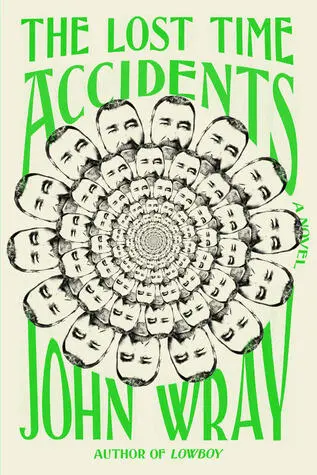
- Название:The Lost Time Accidents
- Автор:
- Издательство:Farrar, Straus and Giroux
- Жанр:
- Год:2016
- ISBN:9781429944526
- Рейтинг книги:4 / 5. Голосов: 1
-
Избранное:Добавить в избранное
- Отзывы:
-
Ваша оценка:
The Lost Time Accidents: краткое содержание, описание и аннотация
Предлагаем к чтению аннотацию, описание, краткое содержание или предисловие (зависит от того, что написал сам автор книги «The Lost Time Accidents»). Если вы не нашли необходимую информацию о книге — напишите в комментариях, мы постараемся отыскать её.
, John Wray takes us from turn-of-the-century Viennese salons buzzing with rumors about Einstein's radical new theory to the death camps of World War Two, from the golden age of postwar pulp science fiction to a startling discovery in a Manhattan apartment packed to the ceiling with artifacts of modern life.
Haunted by a failed love affair and the darkest of family secrets, Waldemar 'Waldy' Tolliver wakes one morning to discover that he has been exiled from the flow of time. The world continues to turn, and Waldy is desperate to find his way back-a journey that forces him to reckon not only with the betrayal at the heart of his doomed romance but also the legacy of his great-grandfather's fatal pursuit of the hidden nature of time itself.
Part madcap adventure, part harrowing family drama, part scientific mystery-and never less than wildly entertaining-
is a bold and epic saga set against the greatest upheavals of the twentieth century.
The Lost Time Accidents — читать онлайн бесплатно полную книгу (весь текст) целиком
Ниже представлен текст книги, разбитый по страницам. Система сохранения места последней прочитанной страницы, позволяет с удобством читать онлайн бесплатно книгу «The Lost Time Accidents», без необходимости каждый раз заново искать на чём Вы остановились. Поставьте закладку, и сможете в любой момент перейти на страницу, на которой закончили чтение.
Интервал:
Закладка:
It meant something — it had to — that the interior of the Iterants’ headquarters was laid out like the Archive, but what it meant was beyond me. I knew no more than this: that the arrangement of Enzie and Genny’s rooms was connected to something secret, or was possibly the expression of that secret; and that this secret was a vital and ominous one, at least in relation to me. If Haven had discovered what that secret was — or had access to someone who did, such as Orson — but I stopped myself there. It was better not to attempt to guess what that might mean.
When I forced myself to round the corner a second time, still shaken and woozy, the white lady was waiting. There had been a door — narrow and knobless and low — and we passed through it, into a kind of winter garden. Its ceiling was of glass, like the roof of a greenhouse, and the space itself was small and shadowless. There were couches arranged in a ring — she led me to one of them, and sat down beside me — but I took in almost nothing, in those first dazed moments, but the mural covering the room’s eight walls.
“Well, Mr. Tolliver? How do you like the decor?”
I opened my mouth and gave a sort of peep. The mural was done in thin washes of paint — so thin that the plaster’s imperfections showed through — with the most delicate of brushes. Running counterclockwise, it depicted all the great theorists of time, from Herodotus to Newton to Stephen J. Hawking. The entire hall of fame and infamy stood assembled on those walls: everyone I’d ever heard Orson disparage or praise. The figures were rendered in one-to-one scale, precise as Audubon engravings, their hands and faces more alive than any photo could have been. They looked so human, in fact, that it took me a moment to see what was wrong about them.
Each figure had the head and the limbs of a man — or a woman, in a handful of cases — and the glossy, reddish body of an insect.
“What is this place?”
“This is the Listening Room. Mr. Haven’s personal retreat.”
“Oh.”
We gazed up at the mural for a time.
“Quite a feast for the eyes, isn’t it? Most people who see it — not that there are many of them, mind you — tend to be rather impressed.” She parted her pale lips and stared at my own, as if in expectation of a kiss. “Are you impressed, Mr. Tolliver?”
“Can I see my father now?”
“Let me ask you a question. Why do you want to see him?”
“I’m his son.”
She patted my knee. “Sons like to visit their fathers now and again. That’s perfectly in order.” She turned back to the mural. “I should tell you, however, that the Prime Mover hasn’t received any visitors in quite some time.”
“If you’re trying to stop me—”
“I have no intention of trying to stop you, Mr. Tolliver.”
She led me back out of the room, moving with a dreamlike lack of effort, and I seemed to follow her in the same way. There were people in the corridor now: young men and women in tweeds and pastels, carrying clipboards and padded manila envelopes and sheaves of yellow paper. We went up a steep flight of stairs, then another, then another, and arrived at a low attic room. The man I found there, reclining in a La-Z-Boy beside a dormer window, bore a remarkable resemblance to my father. He waited for the woman to go, then smiled at me and asked me how I was. I said I was doing okay.
“I knew you’d be coming, Waldy. And now here you are!”
He placed a sly sort of emphasis on the word knew , I remember, as if he’d been informed of my approach by a network of spies, or predicted it by means of calculus, or seen it reflected in a mystic pool.
“My name isn’t Waldy,” I heard myself answer. “I changed it after you ditched us.” I racked my brain for a moment. “It’s Jack.”
His only response was a shrug. He had my father’s blunt features, he smelled like my father, and he was wearing a shirt I must have seen a thousand times — but something was off. He wasn’t as Orson -ish, for want of a better word, as he ought to have been. He sat there so passively, utterly sapped of authority, like a codger in some cut-rate nursing home. He looked a decade older than he was.
“What do you do in this place all day long?”
“Glad you asked, Jack! The answer is simple. Whatever I want.”
I nodded, taking in the dank, untidy room. “What did you do today?”
“That’s easy! I’ve been looking out this window at the trees.”
“At the trees. Okay.”
He heaved a drawn-out sigh and rubbed his belly.
“Okay,” I repeated. “I’m glad that you have — that you’re happy, I mean.” I hesitated. “I wanted to ask—”
“I had a thought!” he announced. “It hit while I was looking at the trees. I’d like to lay it on you, Jack. I’d like to hear your take.”
I said nothing to that. My father cleared his throat and pointed out the window.
“In contemplating the natural world, Jack, we tend to distinguish between objects in motion — squirrels, let’s say, or sparrows — and things that are fixed: flower beds and ginkgo trees and such. It’s simpler that way, and it seems to make sense.” He belched gently into his fist. “But that’s just one way, among many, of perceiving the world. Outside this window right now, the grass is extending itself upward, and the ginkgos and dogwoods are doing the same. The flowers in that bed there — right there, along the patio — are revolving to follow the path of the sun. You get what I’m saying? All this stuff is in motion . Our senses are cued to a rate set at random — one speed out of an infinitude — and we mistake it for the only speed there is.”
I said nothing to this, either. I never should have come. I realized that now.
Orson squinted at me. “Why’d you come here, Jack? Is there something you want?”
“I’m not sure.”
“Don’t shit a shitter.”
“I’m not—” I stopped myself. “To be honest, I need your advice.”
“I suspected as much.” He grabbed a lever on his armrest and winched himself upright. He seemed like Orson to me now, or close enough. “What’s the nature of the problem? Is it money? Is it girls?”
“Neither, actually. I wanted—”
“It isn’t girls? Why the hell not?”
“What I really—”
“You’re not an enculeur , are you? A French pastry baker? A swish?”
“Orson, I’m not even sure what that means.”
“Never mind.” He tugged at his beard. “How’s this for a potential course of action. Why don’t you tell me what the fuck you want.”
“I want to talk about the Timekeeper.”
“The which?”
“Waldemar Gottfriedens von Toula, the Black Timekeeper of Czas.” I waited until his bleary eyes met mine. “I’ve got a feeling that he might still be alive.”
“A feeling , eh?”
Something in his sidelong glance encouraged me. I told him, as quickly as I could, about my revelation in the media lounge at Ogilvy. Hearing the words as I spoke them, I realized they sounded absurd, even childish; but Orson, for once, gave me his full attention. When I’d finished, he wiped his nose and turned back to the window.
“Well, Orson?” I said. “What do you think?”
“I think it’s ridiculous.”
He was right, of course — it was ridiculous. I practically laughed with relief. “You really do?”
“Of course I do.” He shook his head. “I said the same thing to the First Listener yesterday.”
I bit down on my thumb to keep from shouting. Orson stared imperturbably out through the glass.
“Come on over here, Jack. I’ll show you where I get my feelings from.”
Читать дальшеИнтервал:
Закладка:
Похожие книги на «The Lost Time Accidents»
Представляем Вашему вниманию похожие книги на «The Lost Time Accidents» списком для выбора. Мы отобрали схожую по названию и смыслу литературу в надежде предоставить читателям больше вариантов отыскать новые, интересные, ещё непрочитанные произведения.



Обсуждение, отзывы о книге «The Lost Time Accidents» и просто собственные мнения читателей. Оставьте ваши комментарии, напишите, что Вы думаете о произведении, его смысле или главных героях. Укажите что конкретно понравилось, а что нет, и почему Вы так считаете.