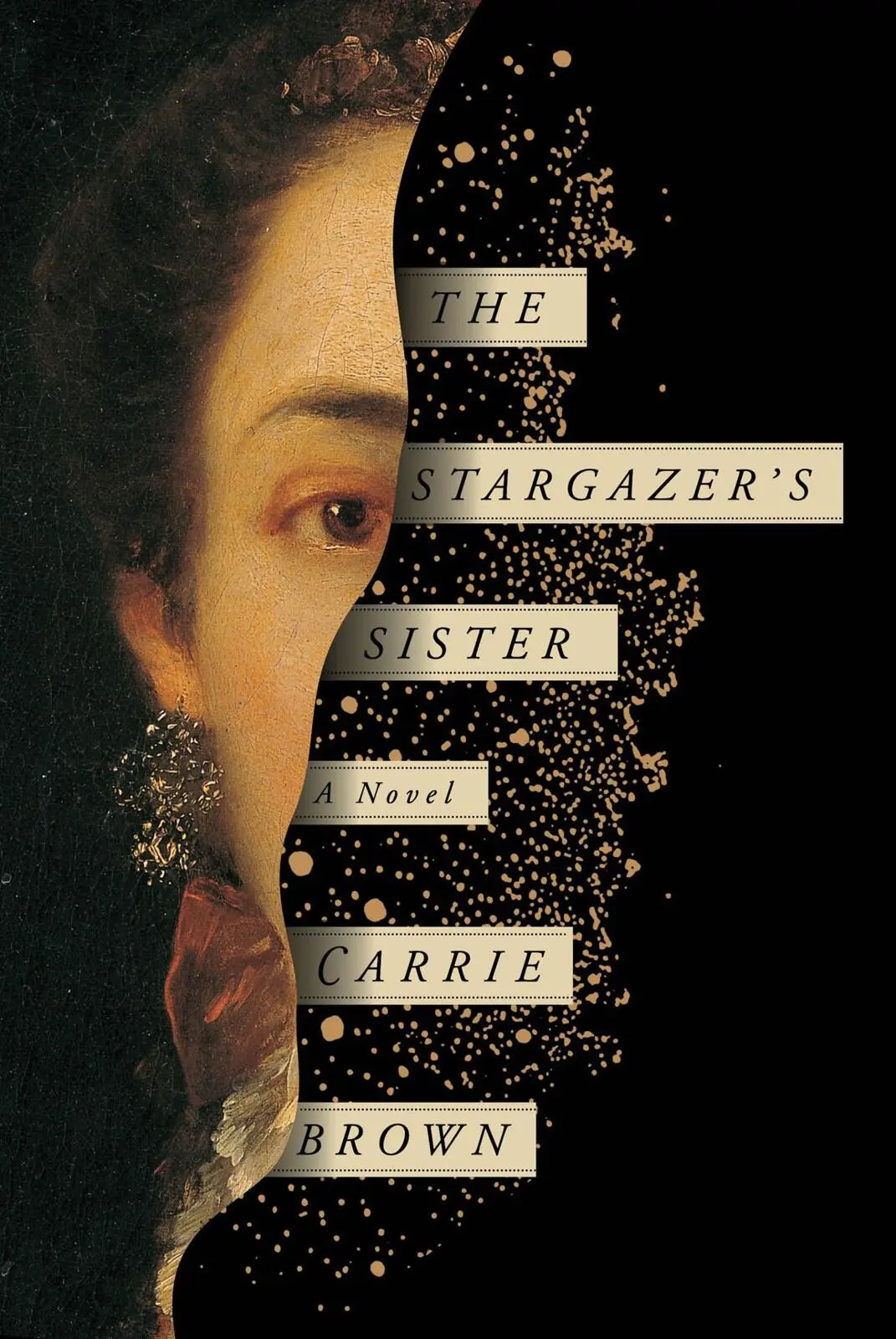
Carrie Brown - The Stargazer's Sister
Здесь есть возможность читать онлайн «Carrie Brown - The Stargazer's Sister» весь текст электронной книги совершенно бесплатно (целиком полную версию без сокращений). В некоторых случаях можно слушать аудио, скачать через торрент в формате fb2 и присутствует краткое содержание. Год выпуска: 2016, Издательство: Knopf Doubleday Publishing Group, Жанр: Современная проза, на английском языке. Описание произведения, (предисловие) а так же отзывы посетителей доступны на портале библиотеки ЛибКат.
- Название:The Stargazer's Sister
- Автор:
- Издательство:Knopf Doubleday Publishing Group
- Жанр:
- Год:2016
- ISBN:нет данных
- Рейтинг книги:5 / 5. Голосов: 1
-
Избранное:Добавить в избранное
- Отзывы:
-
Ваша оценка:
The Stargazer's Sister: краткое содержание, описание и аннотация
Предлагаем к чтению аннотацию, описание, краткое содержание или предисловие (зависит от того, что написал сам автор книги «The Stargazer's Sister»). Если вы не нашли необходимую информацию о книге — напишите в комментариях, мы постараемся отыскать её.
a beautiful new period novel — a nineteenth-century story of female empowerment before its time — based on the life of Caroline Herschel, sister of the great astronomer William Herschel and an astronomer in her own right. This exquisitely imagined novel opens as the great astronomer and composer William Herschel rescues his sister Caroline from a life of drudgery in Germany and brings her to England and a world of music-making and stargazing. Lina, as Caroline is known, serves as William’s assistant and the captain of his exhilaratingly busy household. William is generous, wise, and charismatic, an obsessive genius whom Lina adores and serves with the fervency of a beloved wife. When William suddenly announces that he will be married, Lina watches as her world collapses.
With her characteristically elegant prose, Brown creates from history a compelling story of familial collaboration and conflict, the sublime beauty of astronomy, and the small but essential place we have within a vast and astonishing cosmos. Through Lina’s trials and successes, we witness the dawning of an early feminist consciousness, of a woman struggling to find her own place among the stars.
The Stargazer's Sister — читать онлайн бесплатно полную книгу (весь текст) целиком
Ниже представлен текст книги, разбитый по страницам. Система сохранения места последней прочитанной страницы, позволяет с удобством читать онлайн бесплатно книгу «The Stargazer's Sister», без необходимости каждый раз заново искать на чём Вы остановились. Поставьте закладку, и сможете в любой момент перейти на страницу, на которой закончили чтение.
Интервал:
Закладка:
The child had looked up at her.
“Let whatever shines be noted,” the old lady said. “That is the Royal Astronomical Society’s motto.”
She was quiet. Then she took the child’s hand. “Let us look always toward the light,” she said.
The child gazed up at the old lady for a moment, and then she turned away and tilted back her head to take in the sight of the stars above them. “Our companions,” the old lady had called them, “on the long road.”
“All right,” said the child. “We will.”
ACKNOWLEDGMENTS
Fortunately for the world, brother and sister William and Caroline Herschel left remarkable and detailed records of their lives in the form of letters, lists, catalogs, journals, musings, “day books,” and scientific papers. The habit of such recordkeeping is not unusual, either for the Herschels’ time or in general among people who believe their work holds implications for history, and indeed, the Herschels’, especially William’s, investigations into astronomy were proven to be of great significance to the world’s understanding of the universe, both then and now. History is often recorded in words as well as deeds.
Extraordinary people individually and together, William and Caroline — divided by the twelve years between them and by their different genders but united in so many other ways, including their great affection for each other — were active correspondents and chroniclers of their separate and combined scientific endeavors and achievements, as well as the more prosaic details of their daily domestic experience. A scholar in search of the story of their lives will find no shortage of material, written both by the Herschels themselves and, as the years progressed, by others — scientists and biographers — who understood the significance and scale of their contributions to astronomy, and who worked with diligence and skill to produce narratives that reflect the fullness of the lives of these two singularly fascinating people and their place in scientific history.
I am grateful first for William’s and Caroline’s shared habit of letter writing and of keeping records of their experience, and especially for Caroline’s effort later in her life to fashion a narrative from the deep and rich trove of material left by her brother and contained in her own notebooks. Historians and novelists are fortunate when the subjects of their interest leave behind richly furnished rooms so easily explored and from which a story can be understood.
So it is first to William and Caroline themselves that I owe the greatest debt, not only for the inspiration of the remarkable story of their relationship, one perhaps unparalleled in scientific history, but also for their generosity toward those who would come after them and wish to understand what it had been like for them to work side by side, as William once said, in the “laboratories of the universe.”
A historian seeking to understand the Herschels’ lives would approach their story very differently than I have done, though we might depend on many of the same sources for information. Historical novels hove to varying degrees of factual “truth” about their particular subject or place or time, according to the writers and their concerns. It is Caroline’s life in which I have been chiefly interested for the years of my work on this novel. In telling her story in The Stargazer’s Sister, I have made several deviations — some minor, some dramatic — from the historical record, sometimes for purposes of narrative design and sometimes out of an impulse to shape the material for purposes other than historical accuracy. The character of Dr. Silva and his relationship with Caroline is entirely invented, for instance, and various chronologies and details of the Herschel family or William’s scientific work or his and Caroline’s movements from house to house have been collapsed or altered or compressed. Stanley is an entirely invented character, for instance, as is Sir Henry Spencer, though William in fact had many friends among the British aristocracy.
William Herschel and Mary Pitt had a son, Sir John Herschel, who went on to become an astronomer of great importance in his own right, but the fact of his existence has been omitted from this story. William and Caroline’s brothers played a role in their astronomical endeavors, though to a lesser degree than Caroline or William himself, obviously, but they appear only as minor characters in this novel.
In some cases I have used Caroline’s or William’s words — written or spoken — exactly as they are reported by various sources; in some cases I have changed those words slightly, and for much of the novel, of course, the dialogue is entirely invented. In any case, when I used their actual words I tried to do so in a way that represented circumstances and motivations accurately.
The dates of some historical events have been altered for chronological consistency or compression within the novel (such as the date of the Battle of Hastenbeck, for instance). I likewise made changes to the scene in which the Herschel family views a partial solar eclipse in a tub of water in their courtyard in Hanover. This event occurred, in fact, in 1764, later than I have presented it in the novel, and while in the novel William explains the phenomenon for his family, he was not actually present for it. Likewise, William’s discovery of the sixth and seventh moons of Saturn were separated by nearly a month, but in the novel they occur on the same night.
The epigraph to Penelope Fitzgerald’s extraordinary historical novel The Blue Flower comes from the poet known as Novalis, who is the novel’s protagonist: “Novels arise out of the shortcomings of history.” Writing on The Blue Flower (and other novels) in The Nearest Thing to Life, James Wood argues that it is the specific and extraordinary feat of fiction to “rescue those private moments that history would never have been able to record…when we read historical fiction the characters take on lives of their own, and begin to detach themselves in our minds from the actuality of the historical record. When characters in historical novels die, they die as fictional characters, not as historical personages.” In The Stargazer’s Sister, I have sought to illuminate those “private moments” unrecorded by history. Yet for all the changes — inventions and omissions — to the historical record of William’s and Caroline’s lives, I wanted to capture the truth of what has felt to me from the first most intriguing and most moving about Caroline’s life: that she clearly loved her brother, that she admired him and served him and his endeavors with unquestionable loyalty and intelligence…and that her devotion was not without complexity and perhaps sometimes cost for her. Her life ran alongside his, and their parallel tracks were rarely divided by distance of any significance in terms of time or space, but their lives were not the same life, and for all their closeness, their experiences occurred in very different universes.
In September 1798, Caroline wrote to Dr. Nevil Maskelyne, England’s royal astronomer from 1765 to 1811, from her and William’s home in Slough, England. She wished, she said, to thank Dr. Maskelyne for his support in seeing printed her index to John Flamsteed’s famous star catalog, at the time among the most complete atlases of the night sky since Tycho Brahe’s catalog of the 1500s. The letter contains a paragraph that shows exactly the degree to which Caroline understood that her and her brother’s lives, for all their closeness, were both regarded and influenced and shaped by the conventions of the times and by prevailing notions about men and women. Caroline was born in 1750; if she had been born one hundred or two hundred years later, of course, her life would have been very different indeed.
Читать дальшеИнтервал:
Закладка:
Похожие книги на «The Stargazer's Sister»
Представляем Вашему вниманию похожие книги на «The Stargazer's Sister» списком для выбора. Мы отобрали схожую по названию и смыслу литературу в надежде предоставить читателям больше вариантов отыскать новые, интересные, ещё непрочитанные произведения.







Обсуждение, отзывы о книге «The Stargazer's Sister» и просто собственные мнения читателей. Оставьте ваши комментарии, напишите, что Вы думаете о произведении, его смысле или главных героях. Укажите что конкретно понравилось, а что нет, и почему Вы так считаете.