T. Boyle - Water Music
Здесь есть возможность читать онлайн «T. Boyle - Water Music» весь текст электронной книги совершенно бесплатно (целиком полную версию без сокращений). В некоторых случаях можно слушать аудио, скачать через торрент в формате fb2 и присутствует краткое содержание. Год выпуска: 1983, ISBN: 1983, Издательство: Granta Books, Жанр: Современная проза, на английском языке. Описание произведения, (предисловие) а так же отзывы посетителей доступны на портале библиотеки ЛибКат.
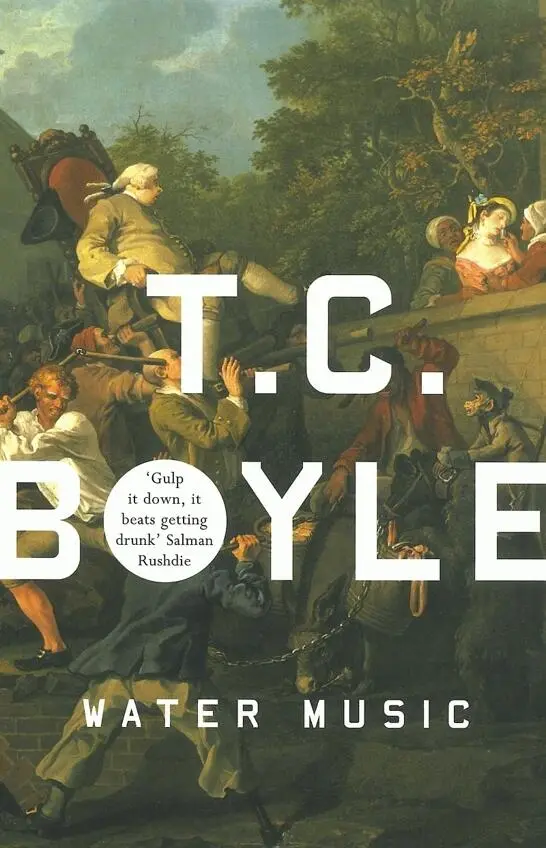
- Название:Water Music
- Автор:
- Издательство:Granta Books
- Жанр:
- Год:1983
- ISBN:9781862071551
- Рейтинг книги:3 / 5. Голосов: 1
-
Избранное:Добавить в избранное
- Отзывы:
-
Ваша оценка:
Water Music: краткое содержание, описание и аннотация
Предлагаем к чтению аннотацию, описание, краткое содержание или предисловие (зависит от того, что написал сам автор книги «Water Music»). Если вы не нашли необходимую информацию о книге — напишите в комментариях, мы постараемся отыскать её.
Water Music — читать онлайн бесплатно полную книгу (весь текст) целиком
Ниже представлен текст книги, разбитый по страницам. Система сохранения места последней прочитанной страницы, позволяет с удобством читать онлайн бесплатно книгу «Water Music», без необходимости каждый раз заново искать на чём Вы остановились. Поставьте закладку, и сможете в любой момент перейти на страницу, на которой закончили чтение.
Интервал:
Закладка:
The government went for it. Camden agreed to underwrite the whole thing and to give the explorer carte blanche in the selection of trade goods, pack animals, equipment and manpower. Mungo was to be assigned the rank of captain, and his brother-in-law commissioned a lieutenant. Georgie Scott, an old school chum and distant relation of the poet, would serve as draftsman and third in command. The explorer would be further authorized to choose four carpenters from among the prisoners confined to the hulks at Portsmouth, and to take one officer and thirty-five soldiers from the garrison at Goree. The carpenters would assemble the longboats in which the explorer planned to cruise down the Niger; the soldiers would protect him from the Moors. As far as beasts of burden were concerned, Mungo planned to stop in the Cape Verde Islands and purchase forty-five asses — this in addition to the fifteen or twenty negroes he would hire at Pisania.
“Fine, fine, fine,” Camden had grinned from beneath his wig of office. “Splendid. Spare no expense, my son, we’re behind you one hundred percent.” He plucked a silver letter knife from his desk and began picking at his fingernails. “There is one small matter, though — how do you propose to get back?”
It was a good question. No one was quite certain where the Niger disembogued — there was even some doubt whether it gave onto the sea at all. One faction, led by Major Rennell, the most distinguished geographer of the day, insisted that the Niger either ran out of steam in the Great Desert or flowed into Lake Chad. If this were so, the entire expedition would be stranded in the middle of the continent, with no possibility of returning against the stream, and faced with a long perilous trek through uncharted territory — a prospect that smacked of death, disaster and a rotten investment. Others, however, felt that the Niger was in reality the upper tributary of the Nile or the Congo, in which case the expedition could safely — perhaps even merrily — float down to the sea. Mungo was certain that the latter was true, and he insisted that on reaching the mouth of the Congo it would be a simple matter to catch a slave boat bound for St. Helena or the West Indies. He looked Camden dead in the eye. “In any case, Sir, I am prepared to do what I must and suffer the consequences. Nothing ventured, nothing gained.”
The Secretary for Colonial Affairs beamed at him like a doting grandfather, and poured out two glasses of claret from the decanter that stood on his desk. “Well,” he grunted. “So be it, then. I’ll just submit your proposal to the P.M., requisition the funds, and you’ll be on your way in no time.”
That was in September. In October the requisition was up for imminent consideration. By November the explorer was distraught. It was the same old story, a repeat of the previous year’s debacle when he’d hurried down from Peebles and hung around with his hands in his pockets while Addington gave way to Pitt, Hobart to Camden, and Sir Joseph, with a face as long as a hound’s, advised him to go back home and study Arabic. Criminal, is what it was. A damned shame, a pity and a waste. But what could he do? He was powerless.
November dripped by. Mungo sat in the darkened room and stared out the window. He pounded his head against the wall, juggled inkwells, shredded paper. Then he got angry. By God, they weren’t going to do this to him again, he shouted, over and over, until the bare walls rang with it and his limbs began to twitch with purpose and determination. Action came like a release. By December the explorer was spending every waking moment lobbying for the expedition: scribbling off petitions, ingratiating himself with influence peddlers and power brokers, sprinting beside the carriages of dukes and earls like a common madman and sharing so many spots of sherry with so many officials that his brain flapped round like a windmill and his liver went into shock. All to no avail. The New Year came and went. Things seemed hopeless.
But the slow mechanism of bureaucratic process — that majestic civil clockwork that formulates what is and shall be through the accretion of accident, greed, intuition and influence — was busily at work, shaping events behind closed doors. Sir Joseph was campaigning vigorously, a nation of shopkeepers was howling for new markets, and Camden, moving with the speed and dispatch of a three-toed sloth, was finally beginning to attract Pitt’s attention. The decisive moment came one night during an intermission at the theater. Camden plopped himself down beside the P.M., offered him a pinch of Araby Spice snuff, and presented his case. Yes, Pitt agreed, the Niger should be opened up to trade — British trade — and yes, gold was highly desirable. A day later the funds were made available, the commissions drawn up and the war sloop Eugenia dispatched to accompany the Crescent to Goree as a discouragement to French privateers. Mungo summoned Zander, packed his bags and set sail, better late than never, on January 29, 1805.
♦ ♦ ♦
As the explorer stands now at the rail of the Crescent , gazing on the coast of Africa for the first time in over seven years and fired up by the cheering of the crew and the exultant braying of the asses, a disquieting thought begins to insinuate itself into the rosy reaches of his optimism. It is a meteorological thought, a thought deriving from his previous long and sorrowful association with the weather patterns in this part of the world. The date is March twenty-eighth. A date which falls very close to the end of March, which is already to say the beginning of April. The explorer thinks of Camden’s whiskered cheeks and powdered handkerchiefs, of the dilatory two-fingered courtesy of all the lords and ladies in London, of the morass of polite society and sententious bureaucracy. He has beaten the system, yes, and here he is on the very stroke of his finest hour. . but the sad fact remains that the long months of battling the government’s inertia have consumed the dry season, day by balmy salubrious day. In May — June at the latest — it will begin to rain. Then what?
But as quickly as the thought enters his head — nasty and insinuating, like those sudden barbed little intimations of one’s own mortality that well up to interrupt the progress of fork to mouth or arrest the ingenuous tapping of one’s foot at the concert hall — he dismisses it. Why dwell on niggling little unpleasantries at a time like this? Here he is, after all, returned to the scene of his greatest triumph. Here he is with a boatload of provisions and trade goods, crates of arms and ammunition, the government behind him, bosom friends at his side. Here he is about to head up an expedition on the grand scale, with porters and armed guards and the rights and prerogatives of a captain in His Royal Majesty’s service. Here he is on the deck of the Crescent , the wind in his hair, with a load of asses.
♦ GIVE ME SOME MEN WHO ARE
STOUT-HEARTED MEN ♦
It is rumored round the backrooms and bunkhouses of the fort that a celebrity has appeared on the premises. Mungo Park, the renowned African explorer and best-selling author, the only European to lay eyes on the Niger and live to tell about it, has come into their midst. The news generates a flurry of excitement.
“ ‘Oo?”
“Mungo ‘oo?”
“Nivir ‘eard o’ the bleeder.”
“Is ‘ee white?”
But as soon as the men lapse back into their customary apathy (a sort of listless downward spiral relieved only by drinking, gambling, whoring and dying), interest flares up anew: this visitor is looking for men. Men! To traipse over hill and dale with him, out in the clean open country — and at double pay! Truth. Jemmie Bird overheard the whole thing while he was waiting table for the Major. But that isn’t the best of it. The explorer carries authorization from the Colonial Department to offer a discharge to any man accompanying him — a discharge that includes a full pardon for those convicted of crimes, and return passage to England. Great God in heaven be praised, here it is, plopped in their laps like the Holy Grail — a chance to get out of this hellhole!
Читать дальшеИнтервал:
Закладка:
Похожие книги на «Water Music»
Представляем Вашему вниманию похожие книги на «Water Music» списком для выбора. Мы отобрали схожую по названию и смыслу литературу в надежде предоставить читателям больше вариантов отыскать новые, интересные, ещё непрочитанные произведения.












Обсуждение, отзывы о книге «Water Music» и просто собственные мнения читателей. Оставьте ваши комментарии, напишите, что Вы думаете о произведении, его смысле или главных героях. Укажите что конкретно понравилось, а что нет, и почему Вы так считаете.