T. Boyle - Water Music
Здесь есть возможность читать онлайн «T. Boyle - Water Music» весь текст электронной книги совершенно бесплатно (целиком полную версию без сокращений). В некоторых случаях можно слушать аудио, скачать через торрент в формате fb2 и присутствует краткое содержание. Год выпуска: 1983, ISBN: 1983, Издательство: Granta Books, Жанр: Современная проза, на английском языке. Описание произведения, (предисловие) а так же отзывы посетителей доступны на портале библиотеки ЛибКат.
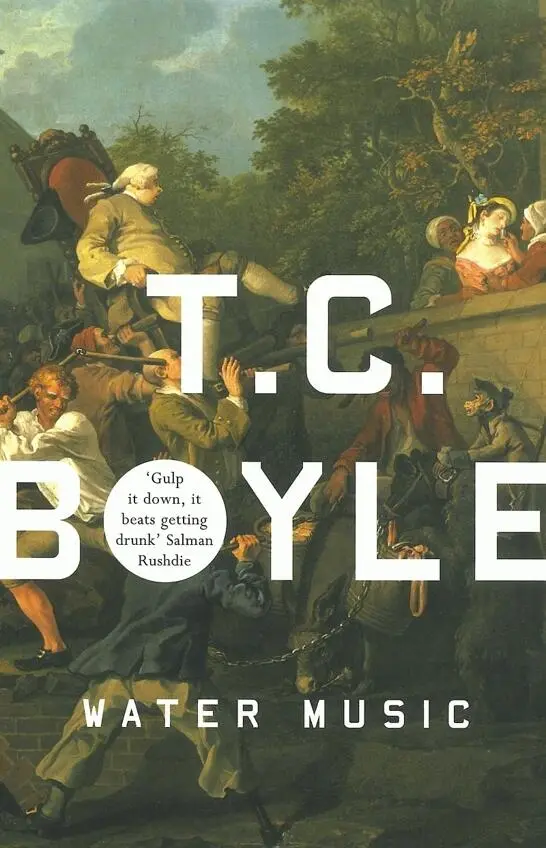
- Название:Water Music
- Автор:
- Издательство:Granta Books
- Жанр:
- Год:1983
- ISBN:9781862071551
- Рейтинг книги:3 / 5. Голосов: 1
-
Избранное:Добавить в избранное
- Отзывы:
-
Ваша оценка:
Water Music: краткое содержание, описание и аннотация
Предлагаем к чтению аннотацию, описание, краткое содержание или предисловие (зависит от того, что написал сам автор книги «Water Music»). Если вы не нашли необходимую информацию о книге — напишите в комментариях, мы постараемся отыскать её.
Water Music — читать онлайн бесплатно полную книгу (весь текст) целиком
Ниже представлен текст книги, разбитый по страницам. Система сохранения места последней прочитанной страницы, позволяет с удобством читать онлайн бесплатно книгу «Water Music», без необходимости каждый раз заново искать на чём Вы остановились. Поставьте закладку, и сможете в любой момент перейти на страницу, на которой закончили чтение.
Интервал:
Закладка:
Ailie was glad of the friendship. Scott was a man of culture and learning, Mungo’s coeval, and he seemed to have the ability to draw her husband out, to cheer and energize him, keep him from mooning about the house all day. But there were limits to everything. Mungo practically shut himself off from the other guests at the party, cloistering in the corner with Scott and Zander, their heads down, voices low. His mother and Archibald had to jerk him by the arms before he would get up, blow out the candles and start the dancing. And then it was right back to his corner, right back to Scott and Zander. Their voices were lost in the skirl of the pipes, and from time to time Ailie would glance across the room to see them mouthing phrases, gesturing, debating something, their faces as flat and serious as the faces of a clutch of ministers at tea.
That night, when they went to bed, Ailie gave him her present. It was a compass, set in cork. “So you can always find your way back to me,” she smiled. “From Edinburgh or Ashestiel — or even London.” She hesitated, her face lit with the glow of some burgeoning secret. “There’s something else,” she whispered, drawing close to him. He looked up at her, his face bland, the blond stubble of his cheeks transparent in the glare of the oil lamp. “We’re going to have another baby,” she said. “In the spring.”
♦ ♦ ♦
Mungo left for Edinburgh the following morning. On business. He’d been in and out of town all summer, consulting with Saltoun, the solicitor, on matters relating to investment and contingency funds for his family.
“Contingency funds?” Ailie had asked.
“One never knows,” he said, solemn as the patriarch of the lost tribes.
“But you’re a young man yet, Mungo — it’s foolishness to think of, of such things at your age.”
“I could be thrown from a horse tomorrow. Or tumble into the Yarrow and hit my head on a rock, or—”
She turned away. “I don’t want to think about it,” she said. “Do whatever you feel is right.”
He kissed her in front of the house before he left. And then pressed her to him and kissed her again, stroking her hair and tracing the line of her jaw with trembling fingers. She was surprised at his passion.
“Give my love to the Macleods and Leasks,” she said, “and to old Saltoun. . You’ll be back in four or five days?”
He was mounted now, looming high over the horse like a bronze statue frozen against the sky. She thought of the military, of the war with France, of Colin Raeburn and Oliphant Graham, dead at Copenhagen. And then suddenly, inexplicably, she thought of her mother. Mungo’s face was impassive. She managed to smile. “Four or five days?” she repeated.
The sun was at his back and she had to squint to get a look at his eyes. They were the color of ice. The horse whinnied and she felt something shift in her stomach. He never answered her. Just drew back on the reins, swung the animal’s head, and cantered off.
♦ ♦ ♦
The letter came two weeks later. From London. There was no return address:
19 September, 1804
My Dear Ailie:
Forgive me. I couldn’t face a scene. As you wil1 have guessed, or gathered from talking with your brother, I am off again for Africa. This time I will be at the head of an expedition financed by the government and consisting of some forty men. The opportunity is enormous. It is my patriotic duty to take it.
I will be in an agony until I return to you and the children, no doubt within the year. Our plan is to launch a boat at Segu and float it down to the sea. If the child is a boy, name him after Archie, could you?
Please try to understand me, Ailie, dearest Ailie. The Yarrow is tame, life is tame. There are wonders out there, wonders waiting for the right man to risk all to reveal them. I am that man, Ailie, I am that man.
Yours in love & Contrition,
Mungo
The letter pierced her like a bone spear flung by some black aborigine, some Seedy, straight from the stink and fear and incomprehensibility of Africa, straight from the black heart itself. She hadn’t spoken a word to Zander: he’d been avoiding her. After the first week had gone by she knew the letter would come, knew what it would say before she opened it. She knew, but prayed to all the saints and archangels and powers in their spheres that she was wrong, that Mungo had been detained in Edinburgh, that he’d had a minor accident or gone out to the country with Robbie Macleod.
But no. He’d deceived her again. The son of a bitch. The cowardly, irresponsible, lying son of a bitch. To desert her like this, to lie to her, make it up, and lie to her again. To tell his innermost secrets to a stranger like Scott, and conceal them from her. Well she was through with him. He was no good, he was a liar and a cheat. He’d taken her love and trust, her faith and confidence, and stolen off under cover of a lie — like a thief.
She read through the letter again, flung it down in disgust. And then, almost as an afterthought, she picked up the envelope, turned it over in her hand and noticed that there was something scribbled inside the leaf — a postscript? The writing was cramped and hurried, so contorted it could almost have come from a different hand. She took the envelope to the window and squinted at the flailing loops and tight squiggles until she could make sense of them: I can hear it in my dreams, hear it in the morning when I wake and the birds are in the trees — a rustling, a tinkling— a sound of music. You know what it is? The Niger. Rushing, falling, heaving toward its hidden mouth, toward the sea. That’s what I hear Ailie, day and night. Music.
The baby cried out. She dropped the envelope in the fireplace.
THREE. NIGER REDUX
“My son, you have now seen the temporal fire,
And that which is eternal; you have reached
A place where I myself can see no farther.
Thus far I have conducted you with skill;
Henceforth your own good sense must be your guide.”
— VIRGIL TO DANTE, The Divine ComedyGOREE (A HYMN TO CONTAGION)
At the turn of the nineteenth century, the West Coast of Africa — from Dakar to the Bight of Benin — had a reputation for pestilence and rot unequaled anywhere in the world. With its heat and humidity, seasonal deluges and galaxies of insects, it was a sort of monumental Petri dish for the culture of exotic and frighteningly destructive diseases. Beware and take care of the Bight of Benin, went a sailor’s ditty of the time. There’s one comes out for forty goes in.
Spotted fever, yaws, typhus and trypanosomiasis throve here. Hookworm, cholera and plague. There was billiarzia and guinea worm in the drinking water, hydrophobia in the sharp incisors of bats and wolves, filariasis in the saliva of mosquitoes and horseflies. Step outside, take a bath, drink the water or put a scrap of food in your mouth and you’ve got them all — bacilli, spirilla and cocci, viruses, fungi, nematodes, trematodes and amoebae — all eating away at your marrow and organs, blurring your vision, sapping your fiber, eradicating your memory as neatly as an eraser moving over the scribbled wisdom of a blackboard.
From a cosmetic standpoint, the filarial diseases — elephantiasis and loiasis (also known as wriggle-eye) — were especially unfortunate. In elephantiasis, a mosquito-borne malady, teeming roundworms dam up the lymphatic system like insidious little beavers, causing the skin to erupt in granulomatous lesions and the legs and testicles to swell up like obscene fruits. Loiasis, on the other hand, focuses its ravages above the neck, and is transmitted by the bite of certain bloodsucking flies so abundant in the area that most mammals wear a sort of dark coat of them from dawn till dusk — when the mosquitoes take over. In its final stages the disease is characterized by the appearance of the adult worms beneath the conjunctiva of the eye. The worms pulse and writhe there, active little ribbons of flesh, quietly going about their business of feeding, mating and eliminating waste.
Читать дальшеИнтервал:
Закладка:
Похожие книги на «Water Music»
Представляем Вашему вниманию похожие книги на «Water Music» списком для выбора. Мы отобрали схожую по названию и смыслу литературу в надежде предоставить читателям больше вариантов отыскать новые, интересные, ещё непрочитанные произведения.









Обсуждение, отзывы о книге «Water Music» и просто собственные мнения читателей. Оставьте ваши комментарии, напишите, что Вы думаете о произведении, его смысле или главных героях. Укажите что конкретно понравилось, а что нет, и почему Вы так считаете.