T. Boyle - Water Music
Здесь есть возможность читать онлайн «T. Boyle - Water Music» весь текст электронной книги совершенно бесплатно (целиком полную версию без сокращений). В некоторых случаях можно слушать аудио, скачать через торрент в формате fb2 и присутствует краткое содержание. Год выпуска: 1983, ISBN: 1983, Издательство: Granta Books, Жанр: Современная проза, на английском языке. Описание произведения, (предисловие) а так же отзывы посетителей доступны на портале библиотеки ЛибКат.
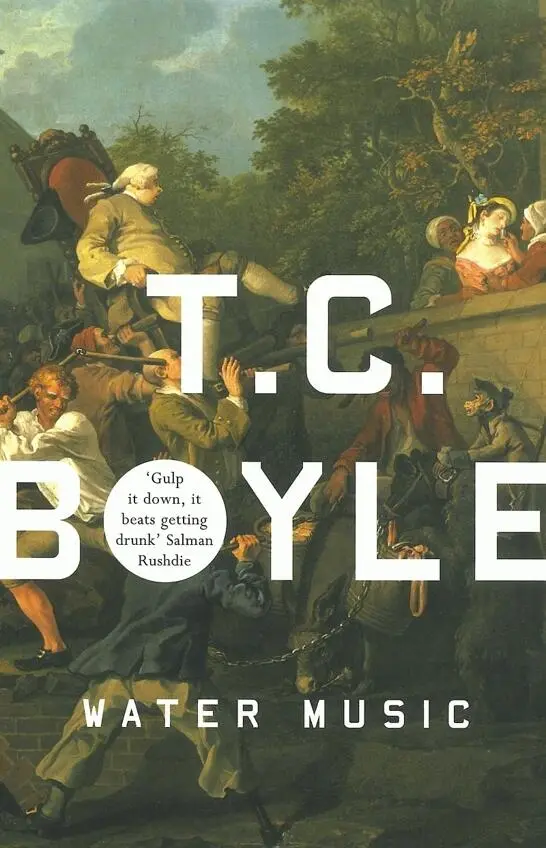
- Название:Water Music
- Автор:
- Издательство:Granta Books
- Жанр:
- Год:1983
- ISBN:9781862071551
- Рейтинг книги:3 / 5. Голосов: 1
-
Избранное:Добавить в избранное
- Отзывы:
-
Ваша оценка:
Water Music: краткое содержание, описание и аннотация
Предлагаем к чтению аннотацию, описание, краткое содержание или предисловие (зависит от того, что написал сам автор книги «Water Music»). Если вы не нашли необходимую информацию о книге — напишите в комментариях, мы постараемся отыскать её.
Water Music — читать онлайн бесплатно полную книгу (весь текст) целиком
Ниже представлен текст книги, разбитый по страницам. Система сохранения места последней прочитанной страницы, позволяет с удобством читать онлайн бесплатно книгу «Water Music», без необходимости каждый раз заново искать на чём Вы остановились. Поставьте закладку, и сможете в любой момент перейти на страницу, на которой закончили чтение.
Интервал:
Закладка:
Sidi flushed to his lip ring on hearing the explorer’s name, rose awkwardly and stretched himself on the floor at his feet. “Oh Mr. Park, sir, I greatly admire your writings,” he sang out in the high nasal whine of a muezzin at prayer, “and I applaud your efforts to open up our poor backward land to the civilizing influence of the Englishmans, I do, I do.” By this time both Mungo and Sir Joseph were on their feet expostulating with the Moor to get up and behave himself, but apparently he hadn’t yet finished what he intended to say. He lay there a full minute, nose buried in the carpet, before very hesitantly continuing. “But oh Mr. Park, Sir,” he mumbled, “how heartily I deplore the shameful treatment you had from my co-religionists in Ludamar. They are sorry dogs.” Apparently satisfied at having got this out, the Moor crept back to his seat on hands and knees, and perched at the edge of his chair, eyes averted, while Sir Joseph outlined his proposition.
Mr. Park, Sir Joseph explained, was in London for the second time in as many months for the purpose of organizing an expedition to the Niger Basin. The expedition was to have left within six weeks, but for an unforeseen reversal. The government of Mr. Addington had fallen, and the Colonial Secretary, Lord Hobart, had been replaced by Lord Camden. The new Secretary had informed Sir Joseph that the government could not possibly arrange for an expedition before September of the following year.
Mungo sipped moodily at his claret throughout this recitation. He was disappointed, disheartened, disgusted. In the fall, after that idyllic afternoon on the Yarrow, he’d spent two hellish days and nights trying to reassure Ailie that he had no intention of leaving her. She clung to him and screamed like a madwoman, threatened to drown herself, set the house afire, throttle the children in their sleep. He wasn’t going to desert her again — she wouldn’t allow it. She’d poison him first. He broke down under the pressure. “All right,” he told her, “I’ll run down to London and tell Hobart he’ll have to find another man.” She kissed his hands. They made love like newlyweds.
He was lying. Lying to buy time. In London he told Hobart: “I’m your man. Give me the supplies and manpower I need and I’ll map the Niger for you, beginning to end.” Hobart asked for two months to make the arrangements, and the explorer returned to Peebles, on edge, impatient, as guilt-racked as a sticky-fingered altar boy. “Did you tell him?” Ailie asked.
Mungo looked away. “Yes, but. . but he’s asked me to act as technical advisor for a new expedition to be headed up by some. . some young Welshman Sir Joseph has dug up.”
That was in October. In December there was another summons from Hobart and the explorer took the first coach for London. He stepped into the Colonial office, prepared to leave on the spot, already mentally drafting a letter to Ailie: Dear Ailie, I love and cherish you and adore the children, but duty to my country and my God must come before even my sacred duty to my family. Africa awaits, the greatest adventure mankind has ever known, and I am the only man alive who —Hobart’s face stopped him cold. “I’m afraid I’ve got some bad news, Park,” the Secretary said.
“Sir?”
“We’re out.”
Mungo stared at the older man in bewilderment. “Out?”
“Addington has resigned.”
And so there he was, sitting in Sir Joseph’s study and looking gloomily out the window when he should have been sailing for Goree. Nine months more. It seemed as if he was doomed to fritter away his talents in Peebles forever, an overworked, underpaid, back-country sawbones. Lord Hobart, Lord Camden, Addington, Pitt — what difference did it make? All he got was excuses.
“Thus,” Sir Joseph was saying, “I am prepared to offer you thirty pounds sterling if you will accompany Mr. Park to Peebles and there tutor him in Arabic in preparation for his forthcoming expedition.”
The Moor looked around him as if he’d just been slapped. “T’irty pound sterling?” he echoed, incredulous. “You give me?” Sir Joseph nodded, and Sidi threw himself on the carpet. ‘‘ Ya galbi galbi!” he sang, ‘‘An’ am Allah ‘alaik!”
♦ ♦ ♦
Ailie is in the kitchen, fussing over a partan pie and boiling down the snout, ears, cheeks, brains and feet of a freshly killed hog, when she is suddenly arrested by a sound from the backyard. It’s been going on for a minute or two now, a sort of dull thumping, but she’s been so absorbed in her work she hasn’t paid it any mind. There it is again. Viscous and muffled, the sound of someone splitting wood in the distance — or leading a horse around the corner of the house. Then it hits her: Mungo! In an instant she’s at the door, apron white with flour, the late sun spreading butter over the stable, her husband, the manes of the horses, the pinched dark stranger staring up at her out of his glittering, red-flecked eyes. Who—? she wonders, a vague unease settling in her stomach, but then she’s caught up in Mungo’s arms and nothing else really matters.
Inside, Mungo and his guest settle down at the edge of the hearth, warming their hands, while Ailie puts the kettle on and turns back to her pie. Mungo had perfunctorily introduced the little man outside the stable door. Seedy something-or-other, she didn’t quite catch his name. Meanwhile, the small talk sifts down like a blizzard. Mungo asks how the children have been, what the weather’s been like, has she got enough wood chopped, is that a cold she’s caught? He expatiates on Sir Joseph’s health, the rigors of the trip, the new government, Dickson, Effie and Edwards, but he hasn’t yet gotten round to explaining Seedy. She takes the little man to be an African, judging from the rag wrapped round his head and the slashes dug into his dark cheeks and brow. A Moor? A Mandingo? And what would Mungo be bringing him up here for?. . Unless—
“So,” she says, kneading her dough with a vengeance, “you’ve come to visit Peebles. . Mr. Seedy?”
The Moor looks up at her, as if surprised to hear his name spoken aloud by such a person in such a place. He is huddled so close to the fire she’s afraid he’ll burst into flame at any moment. “Oh my lady, yes, yes, I am visiting Peebles.” The look in his eye reminds her of Douce Davie when someone sets a ham out on the sideboard.
Mungo sighs, and gets up from the hearth. “God, that smells good,” he says. “What are you fixing — brawn?”
“For Christmas,” she says.
“No goose?”
She has the distinct sensation that he is trying to sidetrack her, that there is something about this Seedy he doesn’t want her to know. “Goose, yes,” she says, impatient, “goose too. But tell me,” turning to the Moor, “will you be with us for the holidays, Mr. Seedy?”
The Moor looks puzzled. “Hollandaise?”
In an undertone, quick as a burst of gunfire, Mungo says something to him in a foreign language. Arabic?
Sidi grins. “I am a Moor, precious lady.”
This is getting her nowhere. She turns to her husband, wiping her hands on her apron. “He’ll be staying?”
But before Mungo can answer, the Moor leaps to his feet, as if by prearrangement. “Oh yes, kind lady. Mistress Park,” he whines, rushing up to her and prostrating himself at her feet. “Wit’ your permission, I am to stay two or t’ree mont’.”
Ailie draws back as if she’s been scorched. “Two or three—?”
“Ailie,” Mungo is saying, his voice low and deprecatory.
“Good lady, good lady,” Sidi chants, pursuing her on all fours and making as if to kiss the hem of her dress. Suddenly he looks up at her and barks, “Tutor, tutor,” with all the exhilaration of a lexicographer who’s been searching out the word for a month.
Читать дальшеИнтервал:
Закладка:
Похожие книги на «Water Music»
Представляем Вашему вниманию похожие книги на «Water Music» списком для выбора. Мы отобрали схожую по названию и смыслу литературу в надежде предоставить читателям больше вариантов отыскать новые, интересные, ещё непрочитанные произведения.










Обсуждение, отзывы о книге «Water Music» и просто собственные мнения читателей. Оставьте ваши комментарии, напишите, что Вы думаете о произведении, его смысле или главных героях. Укажите что конкретно понравилось, а что нет, и почему Вы так считаете.