T. Boyle - Water Music
Здесь есть возможность читать онлайн «T. Boyle - Water Music» весь текст электронной книги совершенно бесплатно (целиком полную версию без сокращений). В некоторых случаях можно слушать аудио, скачать через торрент в формате fb2 и присутствует краткое содержание. Год выпуска: 1983, ISBN: 1983, Издательство: Granta Books, Жанр: Современная проза, на английском языке. Описание произведения, (предисловие) а так же отзывы посетителей доступны на портале библиотеки ЛибКат.
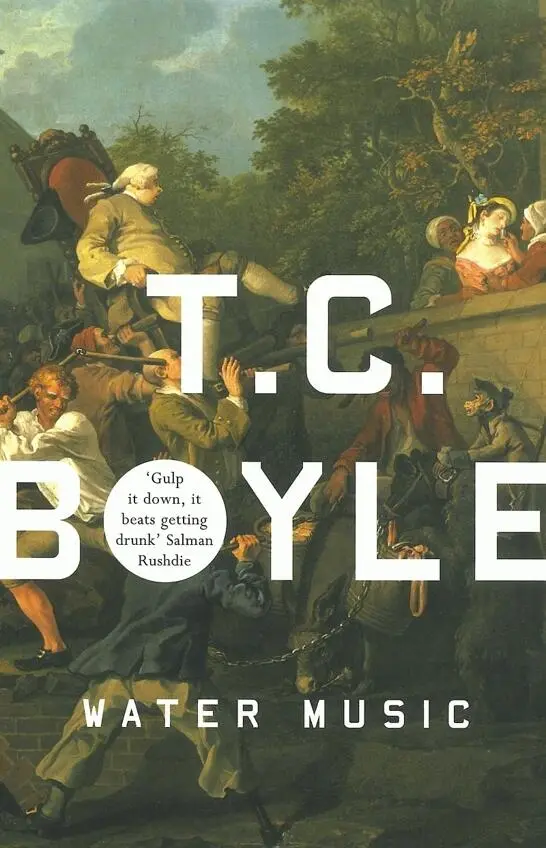
- Название:Water Music
- Автор:
- Издательство:Granta Books
- Жанр:
- Год:1983
- ISBN:9781862071551
- Рейтинг книги:3 / 5. Голосов: 1
-
Избранное:Добавить в избранное
- Отзывы:
-
Ваша оценка:
Water Music: краткое содержание, описание и аннотация
Предлагаем к чтению аннотацию, описание, краткое содержание или предисловие (зависит от того, что написал сам автор книги «Water Music»). Если вы не нашли необходимую информацию о книге — напишите в комментариях, мы постараемся отыскать её.
Water Music — читать онлайн бесплатно полную книгу (весь текст) целиком
Ниже представлен текст книги, разбитый по страницам. Система сохранения места последней прочитанной страницы, позволяет с удобством читать онлайн бесплатно книгу «Water Music», без необходимости каждый раз заново искать на чём Вы остановились. Поставьте закладку, и сможете в любой момент перейти на страницу, на которой закончили чтение.
Интервал:
Закладка:
“So what does Ailie think?”
“You know what she thinks.”
“No Africa.”
“No Africa.”
The explorer tugs indolently at his line for a moment, then shifts his gaze back to Ailie. He watches as she negotiates the current, cutting back against the flow, one arm suspended in a flash of foam, then the other, silver, luminous, clean and precise. She moves like a creature born to water. Moves with an easy fluid athletic grace, moves with a beauty that catches in his throat. He loses her momentarily in a shimmering crescent of reflected sun, only to watch her reemerge in an aureole of light, transfigured in that flashing instant to something beyond flesh and blood, something mythic and eternal. How could he ever leave her?
“Well,” Zander is saying, “maybe there are greater duties than family duty. Maybe you owe something to science and civilization too.”
Mungo turns to look him in the eye. “I got a letter this morning, Zandei. Brought down by special messenger from Peebles. Early. Before she was up.”
The news hits Alexander Anderson like an electric shock. Ten thousand volts. He kicks over the beer, drops the book and leaps to his feet. “From London?”
The explorer nods. “From the government. Lord Hobart. He wants to see me immediately about heading up an expedition to determine the course of the Niger.” The last few words are delivered in an almost reverential whisper.
Zander has been watching him, rapt, his eyes dilated, lips moving in silent accord with his every word. Suddenly he breaks into a grin and begins pumping the explorer’s hand. “This is what we’ve been waiting for — this is it!”
“Shhhhh.” Mungo looks like a weasel with an egg in its mouth. “I haven’t told your sister yet.”
“She won’t like it.”
“No.”
Zander squats down beside him, balancing on toes and fingertips. He is twenty-nine and looks eighteen. “But surely she can see it’s for a higher purpose — she’s got to. She’ll understand. I know she will.”
Mungo snorts. “I wish I could share your optimism.”
“Tell her. Go ahead — maybe you’ll be surprised.”
The explorer looks tentatively over his shoulder. Ailie and Thomas are wrapped in a blanket and roasting bits of meat over a fire. His mother is paring apples and rocking the baby, the two-year-old is screeching like a loon and running naked up and down the bank as if he’d been locked in the closet for a week. “You know, you may be right. Zander,” Mungo says finally, rising to his feet. “I might as well have it out now.” And then, less certain: “Though I hate to spoil the day.”
But before he can take two steps, the whole question of the letter, Africa, ambition and Ailie is suddenly shunted to the back burner — because at that instant the tip of the cane pole begins to twitch. Very gingerly at first, but convincingly enough to catch Zander’s eye. “Mungo!” he shouts, and the explorer, his reactions honed in the wilds of Africa, wheels round to appraise the situation in a flash, perceiving the pieces of the puzzle and its solution almost simultaneously (Zander’s face, the pointed finger, the cane pole trembling along its length from the shock of a solid hit and careering for the water like a pilotless bobsled). He reacts without hesitation. One moment he’s standing there looking down expectantly at his brother-in-law, the next he’s throwing himself at the fast-receding pole, barely managing to catch hold of its last knobby deformation. He fights to his knees, staggers to his feet, the pole bent double in his hands, an incredible slashing force communicating with him at the far end of the line, silver in the depths, beating and rushing with the pulse of the river itself. “He’s got one,” Zander is shouting, “he’s got a keltie!” And now Ailie and the boys are running toward him, excitement slapped across their faces like the first flush of winter.
Mungo strains against this fish with everything he’s got, all his being focused on this thing extending from his fingertips to scrape the rocks and hug its belly to the deepest recesses of the deepest pools. He can feel every pebble, he can read the whole history of the river there, igneous pillars thrust through the surface, the flat scouring hand of the glaciers, the relentless buffeting of the watercourse, stream without end, draining into the sea and rising again in the clouds. Implacable, determined, he pulls at the mystery with every nerve and fiber of his body, with every ounce of blood and pound of flesh, he pulls.
And it pulls him, it pulls him.
♦ SIDI AMBAK BUBI ♦
Mungo returns from London just before Christmas, the fringe of a tartan muffler peeping out from beneath his stovepipe hat, a small dark stranger at his side. If no one pays much attention to the explorer (familiarity breeds familiarity), the stranger is another story. No one in Peebleshire knows quite what to make of him. At first glance he seems ordinary enough — kneeboots, woollen trousers, greatcoat, cravat — but on closer inspection, the good people of Peebles find themselves confronted with a series of anomalies. For one thing, there is the question of the stranger’s complexion, the hue of which seems to fall midway between the dun of barnyard muck and the cheesy yellow of goat’s milk. For another, there is the question of his hat, which isn’t a hat at all but a strip of linen wound round his head. Not to mention his ritually scarred cheeks, waist-length beard and the gold hoop piercing his lip in the most shamelessly barbaric way. All in all, considering that nothing has changed in Peebles in eight hundred years, the stranger’s sudden appearance is every bit as extraordinary as the birth of a two-headed duck or the discovery of a new comet in the night sky.
They ride into Peebles at sunset, Mungo and his dark companion, the evidence of their dialogue hanging in the chill air like smoke. The denizens of Peebles — retiring types, quiet, half-asleep — are bent over their hearths as the horses clop past their windows, the puissant odors of neeps and potatoes, boiled beef and cockyleekie soup commanding their full attention. Even so, half of them are pressed to their windows or edging out into the street before the explorer has reached his front yard. They are in shirtsleeves, aprons, slippers, some are even barefooted. All look as if they’ve just seen some prodigy, some freak of nature, some walking, talking, insidious illusion they can neither accept nor dismiss. “Did ye see what I seen?” says Angus M’Corkle to his neighbor, Mrs. Crimpie.
“Aye,” she says, slowly shaking her head as if to unplug her ears, “and I’ll be blessed if it wasn’t one of the Magi himself come up for the Holy Day.”
“Nay, nay. It’s clear he’s just some itinerant Jew. . or maybe a Chinese Mongol.”
“Ali Baba,” says Festus Baillie, his jaw locked like a judge’s. “Ali Baba himself.”
♦ ♦ ♦
Sidi Ambak Bubi is neither Jew nor Mongol. Nor is he a freak of nature, a prodigy or an Arabian folkhero. He is, quite simply, a Moor: humble, unassuming, a trifle unctuous. A Moor from Mogador, well connected and educated, who originally came to London to serve as interpreter for Elphi Bey, Ambassador from Cairo. But when Elphi Bey expired suddenly after choking on a wedge of mutton and flushing a deep midnight blue, Sidi found himself out of a job. It would be months before Cairo could be informed of the Ambassador’s death and arrange for a replacement. He began to feel concerned. It was at this point that Sir Joseph Banks stepped in. Would Mr. Bubi be so kind as to come round to No. 32, Soho Square? Sir Joseph had a proposition to make him.
When Sidi was shown into the library at Sir Joseph’s townhouse, he found himself standing before two Englishmen: one elderly and squarish, with a cast of jaw that suggested a bulldog, the other young, fair-haired and muscular. The elderly man, as distinguished and formidable as a ship of the line, proved to be Sir Joseph Banks. He greeted Sidi with an outstretched hand, offered him a seat and a glass of claret (which Sidi, a devout Moslem, politely refused). And then turned to introduce him to his companion, Mungo Park.
Читать дальшеИнтервал:
Закладка:
Похожие книги на «Water Music»
Представляем Вашему вниманию похожие книги на «Water Music» списком для выбора. Мы отобрали схожую по названию и смыслу литературу в надежде предоставить читателям больше вариантов отыскать новые, интересные, ещё непрочитанные произведения.







Обсуждение, отзывы о книге «Water Music» и просто собственные мнения читателей. Оставьте ваши комментарии, напишите, что Вы думаете о произведении, его смысле или главных героях. Укажите что конкретно понравилось, а что нет, и почему Вы так считаете.