T. Boyle - Water Music
Здесь есть возможность читать онлайн «T. Boyle - Water Music» весь текст электронной книги совершенно бесплатно (целиком полную версию без сокращений). В некоторых случаях можно слушать аудио, скачать через торрент в формате fb2 и присутствует краткое содержание. Год выпуска: 1983, ISBN: 1983, Издательство: Granta Books, Жанр: Современная проза, на английском языке. Описание произведения, (предисловие) а так же отзывы посетителей доступны на портале библиотеки ЛибКат.
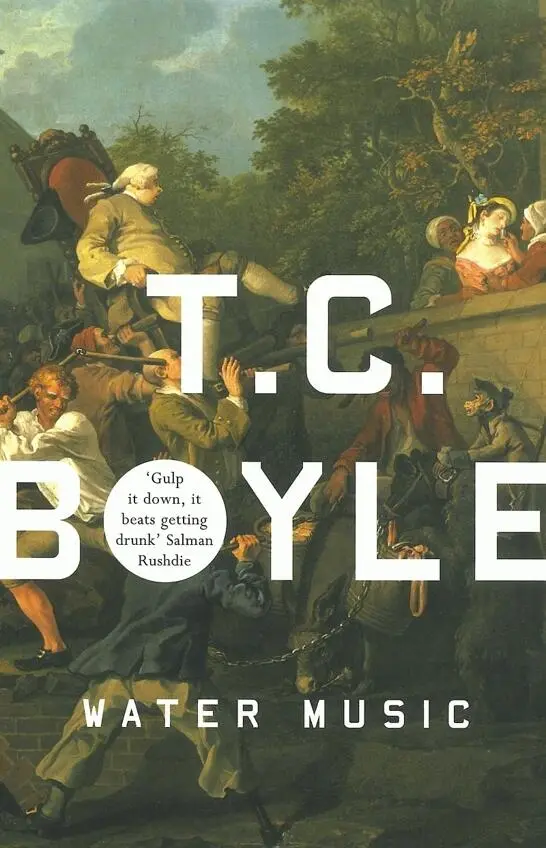
- Название:Water Music
- Автор:
- Издательство:Granta Books
- Жанр:
- Год:1983
- ISBN:9781862071551
- Рейтинг книги:3 / 5. Голосов: 1
-
Избранное:Добавить в избранное
- Отзывы:
-
Ваша оценка:
Water Music: краткое содержание, описание и аннотация
Предлагаем к чтению аннотацию, описание, краткое содержание или предисловие (зависит от того, что написал сам автор книги «Water Music»). Если вы не нашли необходимую информацию о книге — напишите в комментариях, мы постараемся отыскать её.
Water Music — читать онлайн бесплатно полную книгу (весь текст) целиком
Ниже представлен текст книги, разбитый по страницам. Система сохранения места последней прочитанной страницы, позволяет с удобством читать онлайн бесплатно книгу «Water Music», без необходимости каждый раз заново искать на чём Вы остановились. Поставьте закладку, и сможете в любой момент перейти на страницу, на которой закончили чтение.
Интервал:
Закладка:
There was the shriek of rending goat hair— zit! zat! zoot! — and Dassoud leaped into the tent, inflamed with the notion that the Queen was in danger, thirsting to exact a hasty and savage retribution. “Aaarrrr!” he growled, whirling his terrible swift sword — but then he stopped in his tracks. What was going on here? The handmaidens were in hysterics, tent poles shattered, blood spewed and feathers strewn from one end of the place to the other. . and yet there sat Fatima, just as he’d left her, while the Nazarini and his slave lay quailing on the ground, One-Eye and the Nubian standing over them like executioners. “What in the name of Allah is going on here?” he demanded.
The Nubian, who had never spoken a word in his life, said nothing.
The pig sprawled in the corner, still quivering, gouts of blood issuing from its severed throat. Its head lay at the Nubian’s feet.
“Lord have mercy!” whimpered Johnson, addressing the sand.
Finally the handmaidens’ lamentations wound down to an easy gagging mewl, and One-Eye launched a rapid-fire narration of what had transpired, playing down his own involvement as best he could and emphasizing the reckless and irresponsible behavior of the Nazarini and his slave. Dassoud listened impatiently, rocking on his feet, twisting the saber in his hand, until finally he cut the story short and insisted that the transgressors be led out into the dunes and disemboweled. At this point Fatima cleared her throat. Dassoud fell silent. Her tone was firm, her diction spare. The sense of it blew right by the explorer, but the upshot of the whole thing was that he and Johnson were led back to his tent, where a seventh comatose guard was summoned to complement the six men tried and true who were already dozing before the entranceway.
An hour later an unwonted aroma charged the air. It was lingering and piquant, redolent of hearths and basting and relishes. It was the smell of meat. The explorer swallowed twice. “Johnson — do you smell what I smell?”
“Prime rib. I’d know it anywhere.”
Just then the flaps parted and the savory rich aura filled the tent. It was one of the pantaloon girls. In her hand, the haunch of an addax, still hissing from the spit. She gave it to the explorer. “For you,” she said. “From Fatima.” Then she winked and disappeared into the night.
Mungo tore a mouthful from the bone, then passed the joint to his interpreter. He was laughing. “We’re home free now, old fellow — guess I must have done something right after all.”
“Maybe she’s big on slapstick,” Johnson suggested.
“Who knows? But one thing’s for sure: she’s an angel. First the guerba , then the milk and kouskous — and now this!”
“Yeah,” said Johnson, chewing. “It was big of her.”
♦ ♦ ♦
The next morning she sent him a dish of yogurt and bittersweet hoona berries; in the evening it was scrambled brains and rice. He was astonished. After two months of water and mush, here was something he could sink his teeth into. And this was only the beginning. In the ensuing days Fatima’s girls brought him sheep’s liver, camel’s hump (braised), a stew of chickpeas and sweetbreads, buttermilk pudding, three dozen bustard giblets and a whole roast kid. “Soul food,” Johnson called it. “It’s your inner man that’s got her worked up — never mind your disreputable and shit-caked outer man.” Inner man, outer man — what difference did it make? Red meat fed them both. Why, he must have dropped a good four stone since he left Portsmouth. He glanced down at his yellowed toes and drawn ankles, the sticks of his forearms: couldn’t weigh much more than ten right now. But then he grinned, and muttered a little prayer. If this kept up he’d put it back on in no time. And then — who knows? — maybe he’d be strong enough to make a run for it.
There were other changes too. He was allowed to wander round the camp at will (shadowed by his seven keepers, of course), spend as much time as he liked with Johnson, and even have a firsthand look at some of the Moors’ customs and ceremonies. This last, above all else, lifted his spirits. After all, he was an explorer — and here he was, exploring. He witnessed two circumcisions, a funeral, the death of a dog that had lifted its leg against Ali’s tent. He watched the slaves pounding millet, tanning hides, churning butter in a guerba suspended between two sticks; he watched them reciting prayers, defecating, throwing pots, chewing roots, tattooing infants and dogs. It was all very illuminating. But ephemeral. He couldn’t keep track of things from one day to the next.
Then one morning, as he sat watching a slave tie up the nipples of a camel to keep its calf from suckling in the heat of day, an idea hit him like a blow to the back of the head: he’d write a book! He’d write a book and be famous like Marco Polo or Gulliver or Richard Jobson. Why not? Here he was, seeing and smelling and tasting things no white man had ever dreamed of — it would be criminal to miss his chance to document it. He marched back to the tent, tore the leaves from his pocket Bible, and began writing, filling sheet after sheet with his impressions of the climate, the flora, the fauna, the geological formations, the habits and physiognomies of the blackamoors, Mandingoes, Serawoolis and Foulahs. He described Ali’s beard, Dassoud’s scowl, the heat of midday, the solitude of the baobab. Talked of Fatima’s graciousness, the tang of the hoona berry, woodsmoke on the night air. He filled thirty sheets that first day, and secreted them in the crown of his hat.
One evening he witnessed a wedding. It was strikingly similar to the funeral he’d attended: keening hags, howling dogs, a solemn procession. The bride was a walking shroud, veiled from head to foot, even her eyes invisible. He wondered how she was able to see where she was going. The keening women followed her, their stride measured by the beat of a tabala . The groom wore slippers with upturned toes. He was accompanied by a retinue of Mussulmen in embroidered burnooses and a cordon of slaves leading goats and bullocks, and carrying a tent. At an appointed spot the tent was struck, the goats and bullocks slaughtered, a fire ignited in a depression in the earth. There was a feast. Beef and mutton, songbirds, roasted larvae and other delicacies. There was dancing, songs were sung and tales told. And then there was the pièce de résistance: a whole baked camel.
BAKED CAMEL (STUFFED)
Serves 400
500 dates
200 plover eggs
20 two-pound carp
4 bustards, cleaned and plucked
2 sheep
1 large camel
seasonings
Dig trench. Reduce inferno to hot coals, three feet in depth. Separately hard-cook eggs. Scale carp and stuff with shelled eggs and dates. Season bustards and stuff with stuffed carp. Stuff stuffed bustards into sheep and stuffed sheep into camel. Singe camel. Then wrap in leaves of doum palm and bury in pit. Bake two days. Serve with rice.
A regular feature of this expansive period were the explorer’s daily meetings with the Queen. Each afternoon — immediately following the dhuhur or midday prayers — he was summoned to Fatima’s tent for a question-and-answer period. She questioned, he answered. Insatiable, she never tired of quizzing him. She was an anthropologist, a sociologist, a comparative anatomist. She wanted to dissect and absorb his habits, thoughts and beliefs; she wanted to taste his food, wear his clothes, sit at his box in the theater. England, Europe, the vast and uncertain oceans — she wanted them built of words, words supple and evocative, words that would calcify in her imagination. She wanted visions. She wanted the memories behind his eyes. She wanted to digest him. Why had he come to Ludamar? How did his father manage the herds without him? Why did he wear so asinine ( jalab ) a covering on his head? Did all Christians have cat’s eyes? What was the sea like? Had he ever been crucified? The explorer, grinning like a monkey and trying his clumsy best to radiate wit and charm, answered her questions as fully and patiently as he was able.
Читать дальшеИнтервал:
Закладка:
Похожие книги на «Water Music»
Представляем Вашему вниманию похожие книги на «Water Music» списком для выбора. Мы отобрали схожую по названию и смыслу литературу в надежде предоставить читателям больше вариантов отыскать новые, интересные, ещё непрочитанные произведения.










Обсуждение, отзывы о книге «Water Music» и просто собственные мнения читателей. Оставьте ваши комментарии, напишите, что Вы думаете о произведении, его смысле или главных героях. Укажите что конкретно понравилось, а что нет, и почему Вы так считаете.