T. Boyle - Water Music
Здесь есть возможность читать онлайн «T. Boyle - Water Music» весь текст электронной книги совершенно бесплатно (целиком полную версию без сокращений). В некоторых случаях можно слушать аудио, скачать через торрент в формате fb2 и присутствует краткое содержание. Год выпуска: 1983, ISBN: 1983, Издательство: Granta Books, Жанр: Современная проза, на английском языке. Описание произведения, (предисловие) а так же отзывы посетителей доступны на портале библиотеки ЛибКат.
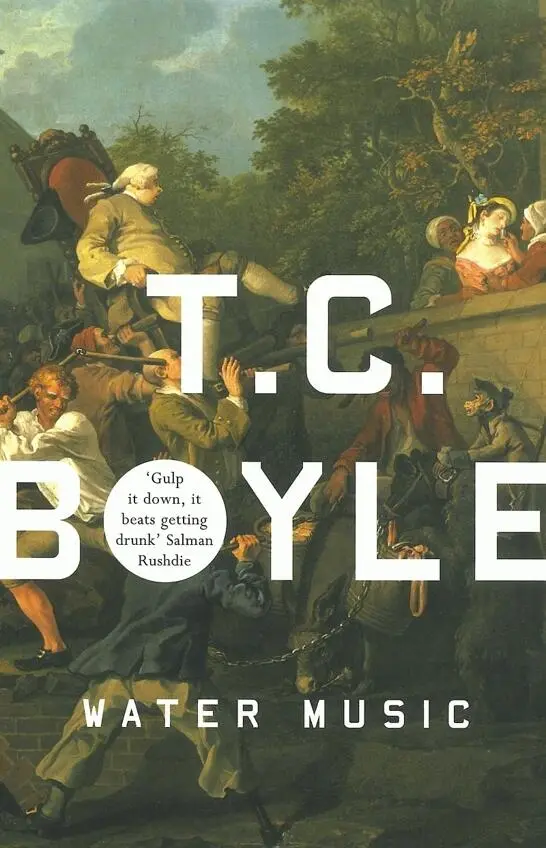
- Название:Water Music
- Автор:
- Издательство:Granta Books
- Жанр:
- Год:1983
- ISBN:9781862071551
- Рейтинг книги:3 / 5. Голосов: 1
-
Избранное:Добавить в избранное
- Отзывы:
-
Ваша оценка:
Water Music: краткое содержание, описание и аннотация
Предлагаем к чтению аннотацию, описание, краткое содержание или предисловие (зависит от того, что написал сам автор книги «Water Music»). Если вы не нашли необходимую информацию о книге — напишите в комментариях, мы постараемся отыскать её.
Water Music — читать онлайн бесплатно полную книгу (весь текст) целиком
Ниже представлен текст книги, разбитый по страницам. Система сохранения места последней прочитанной страницы, позволяет с удобством читать онлайн бесплатно книгу «Water Music», без необходимости каждый раз заново искать на чём Вы остановились. Поставьте закладку, и сможете в любой момент перейти на страницу, на которой закончили чтение.
Интервал:
Закладка:
Suddenly the flaps part and Johnson ducks into the tent. In his hand a goatskin waterbag, known as a guerba in these parts. The explorer lies there, racked with fever, riddled with worms, his stomach shrunken, sphincter open wide, barely able to raise his eyes. He is weak and stinking, tabescent, at the far edge of hope. Johnson kneels beside him and feeds the leather nipple into his mouth. His lips grope, pulse quickens. It is water, cold and clear, water dipped from the shifting porous depths of the earth. It stirs the roots of his hair, firms his toenails, sings to his brittle bones. “I’m saved!” he gasps, and then vomits.
“It’s all right, Mr. Park. Take it easy: you got the whole thing to yourself.”
“Wha?” The explorer’s eyes are crusted and yellow, cheeks drawn, his beard a playground for ticks, fleas, lice and maggots.
“You heard me right. Chief Jackal, he tells me to come in here and give you the waterbag and then a pan of milk and kouskous.”
“Milk? Kouskous?” Johnson might just as well have announced haggis, finnan haddie and sheep’s-head soup. Mungo goes into peristaltic shock, then jerks himself up, clutching at the guerba and ransacking the tent with his eyes. “Where?” he pants, struggling to his feet. “Where? Tell me for God’s sake!”
At that moment a boy enters with a wooden bowl. Milk and kouskous. The boy makes as if to lay it at the explorer’s feet, but Mungo snatches it from him and buries his face in the thick ropy paste with all the desperation of a man stranded on the desert for forty days and forty nights. Which is precisely what he is.
Afterward, he pats his abdomen. “Johnson,” he says. “Oh-ho, Johnson, Johnson, Johnson, how I needed that. .” But wait! What has he done? The bowl’s been scraped clean and here’s his faithful guide and interpreter languishing before his eyes! “Johnson,” he stammers, staring down at the ground, “. . can you ever, can you ever forgive me? I’m afraid I went into a bit of a frenzy there. . I–I forgot all about you.”
Johnson holds up his palm. “Oh they been feedin’ me right along, don’t you worry about that. Got to. Else how am I goin’ to bust my ass for them?
Fetch this, mend that. Scrub this pot, milk them goats, oil up Akbar’s sandals and skim some cream for the horses. Shit. It’s like bein’ back on the plantation again. Sometimes I wish they’d just let me lie here and languish along with you.”
Mungo strokes the soggy grain from his beard and systematically licks the kernels from his fingers, then takes a long pull at the waterbag. Color trickles back into his cheeks. “So what’s up?” he says. “What’s made the bloody camel drivers so charitable all of a sudden?”
“Fatima.”
Fatima. The syllables flow like wind on water. First she’d saved his eyes, and now the rest of him. Hope glimmers. “She wants to see me?”
Johnson nods. “Ali says you got to be fed, washed up and made presentable. He won’t have his wife examinin’ a unwashed Christian. And he gave me this too,” handing the explorer a pale folded garment.
“What is it?”
‘‘ Jubbah . Ali says you got to cover up your legs — he finds your trousers objectionable, high-quality nankeen or no.” Johnson laughs. “You ever get back to London you can sweep all the beaux and noodles under the table, start a craze: skirts for gentlemen.”
Mungo laughs along with him, drunk on food and water. The two chuckle and wheeze, wiping tears from their eyes. Then Johnson looks up, suddenly serious. “She’ll be here tomorrow night,” he says. “Don’t blow it.”
♦ PLANTATION SONG ♦
On this sub-Saharan evening awash with pale light and tapering shadow, Mungo Park, for the first time in nearly three months, finds himself out of the tent and back in the saddle again. His horse has been restored to him (cachectic as ever, looking like one of the gutted nags the Druids used to impale for decoration), his beard, locks and loins cleansed and anointed, his rags exchanged for a spanking white jubbah . On his head, a battered top hat; round his shoulders, the blue velvet jacket he wore while addressing the African Association at St. Alban’s Tavern, Pall Mall. Ali and Dassoud flank him on their chargers. Ali’s mount is white, Dassoud’s so absolutely black it cuts a hole in the horizon (an illusion he enhances by blackening the animal’s hoofs and anus, and staining its teeth). Johnson brings up the rear on an Abyssinian ass.
They are bound for Fatima’s tent at the far edge of the encampment, a distance of perhaps six or seven hundred yards. Ali and Dassoud are silent, while Mungo, sotto voce, rehearses phrases from his Arabic grammar: “I am honored to bask in your presence.” “Allow me to make obeisance to the undersides of your feet.” “Hot, isn’t it?” As they pass through the heart of the camp, dogs dart out to yap at the Christian’s stirrups, children gather to bombard him with nuggets of camel dung, adults step from their tents to squint up at him and denigrate his race, creed and color. “I piss in your mother’s hole!” a man yells. But then Ali holds up his hand and the voices fall silent, the children run to their mothers, the dogs vanish.
“Thanks,” says Mungo. Ali’s face is impassive. His gesture has had nothing whatever to do with compassion or fellow feeling — he just doesn’t want his wife inspecting a washed Christian in a shit-stained jubbah , that’s all.
♦ ♦ ♦
Fatima’s tent is two or three times the size of any of the others in camp, and distinguished by broad bands of color: gray, beige, indigo. Mungo recognizes the huge Nubian out front. The Nubian stands there, on guard, flexing the black bulges between his elbow and shoulder. Off to the right a woman squats in the dust, busily milking four or five she-goats. The explorer observes the pale soles of her feet, the yellow torpedoes of the goats’ teats. A fly lands on the explorer’s nose. The sun touches the horizon.
“Dismount!” shouts Ali, as he and Dassoud spring from their steeds like a pair of Russian tumblers. Johnson, ambling up on his ass, relays the command to his employer, while the Nubian steps forward to take charge of the animals.
It should be said that the explorer’s mind is laboring under a Sisyphean strain at this juncture: he is keyed up, jittery, aquiver with apprehension and doubt. The success of his mission — yea, his life itself — may depend on the impression he makes in his forthcoming interview with the Queen.
His stomach sinks with the same nauseated, socked-in-the-kidney feeling that used to assail him at school before end-of-term exams. Butterflies, they used to call it. Stage fright. Heebie-jeebies. The Choke.
And so, sweating like a marathon runner, he steps down out of the saddle, catches his left foot in the stirrup and slaps to the ground in a storm of dust and goat hair. He lies there a moment, thinking Christ in Heaven what have I done now, while Dassoud and Ali exchange glances and Johnson rushes to his aid. After steadying the horse, loosening the stirrup and finally thinking to remove the explorer’s boot, Johnson succeeds in extricating him. But this is just the beginning. The ground here, it seems, is a mecca for the costive denizens of the Sahel, an unspoiled latrine for Mother Nature and all her feathered, furred and squamate creation. Goat turds lie here, cheek by jowl with hyena ordure; grainy bars of camel dung, dogshit, cowshit and sheepshit coil round the withered ropy leavings of adders and skinks; there’s even a stray ibex turd or two. Mungo rises from this morass, brushing at his jubbah and dusting his hat. “Sorry about that,” he says. Ali shrugs. Then gestures for him to follow, and disappears through the soft contiguous flaps of Fatima’s tent and into the mystery beyond. Mungo, reeking like a zoo, his back an abstract collage of mauves, siennas and dun yellows, the representative of King George III and all of England, follows the Emir of Ludamar into the sanctum of the Queen.
Читать дальшеИнтервал:
Закладка:
Похожие книги на «Water Music»
Представляем Вашему вниманию похожие книги на «Water Music» списком для выбора. Мы отобрали схожую по названию и смыслу литературу в надежде предоставить читателям больше вариантов отыскать новые, интересные, ещё непрочитанные произведения.



Обсуждение, отзывы о книге «Water Music» и просто собственные мнения читателей. Оставьте ваши комментарии, напишите, что Вы думаете о произведении, его смысле или главных героях. Укажите что конкретно понравилось, а что нет, и почему Вы так считаете.