Gary Amdahl - The Daredevils
Здесь есть возможность читать онлайн «Gary Amdahl - The Daredevils» весь текст электронной книги совершенно бесплатно (целиком полную версию без сокращений). В некоторых случаях можно слушать аудио, скачать через торрент в формате fb2 и присутствует краткое содержание. Год выпуска: 2016, Издательство: Soft Skull Press, Жанр: Современная проза, на английском языке. Описание произведения, (предисловие) а так же отзывы посетителей доступны на портале библиотеки ЛибКат.
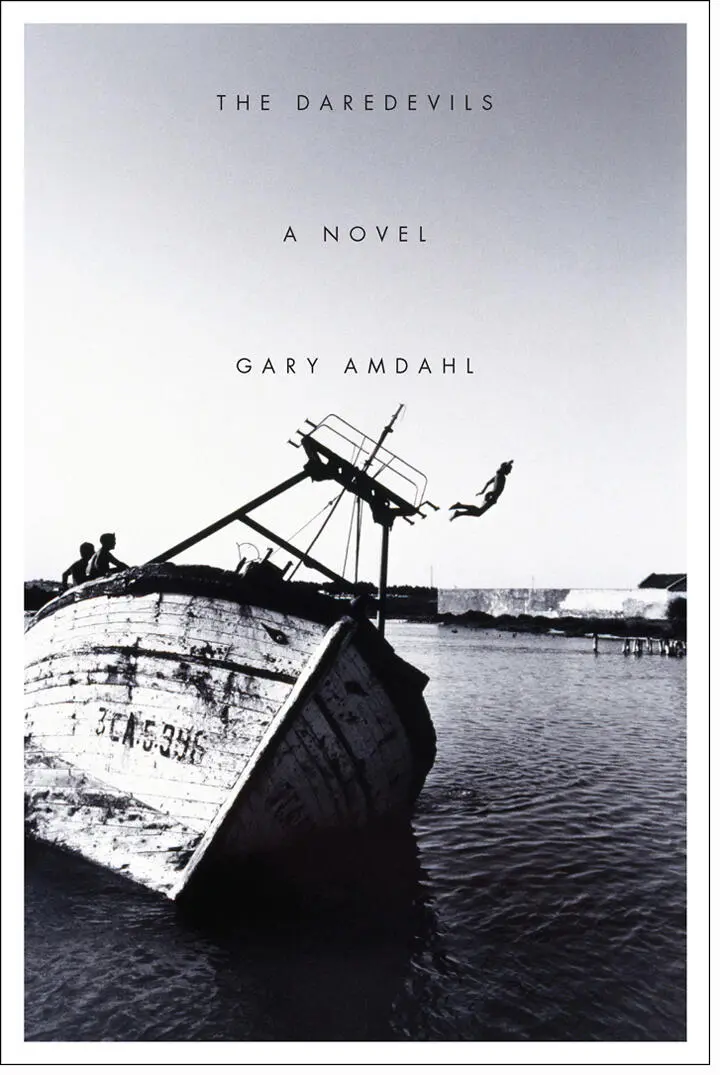
- Название:The Daredevils
- Автор:
- Издательство:Soft Skull Press
- Жанр:
- Год:2016
- ISBN:нет данных
- Рейтинг книги:4 / 5. Голосов: 1
-
Избранное:Добавить в избранное
- Отзывы:
-
Ваша оценка:
The Daredevils: краткое содержание, описание и аннотация
Предлагаем к чтению аннотацию, описание, краткое содержание или предисловие (зависит от того, что написал сам автор книги «The Daredevils»). Если вы не нашли необходимую информацию о книге — напишите в комментариях, мы постараемся отыскать её.
The Daredevils — читать онлайн бесплатно полную книгу (весь текст) целиком
Ниже представлен текст книги, разбитый по страницам. Система сохранения места последней прочитанной страницы, позволяет с удобством читать онлайн бесплатно книгу «The Daredevils», без необходимости каждый раз заново искать на чём Вы остановились. Поставьте закладку, и сможете в любой момент перейти на страницу, на которой закончили чтение.
Интервал:
Закладка:
“Do you mean me or Newman?”
Sir Edwin waved his hands in disgust. “I dun’t care which one. You must be at home in world or we will bore audience to greatest disgust they can endure without throwing rotten vegetables at you. You must be, can only be, who you are. What does Polonius say to you, whoever you are, you ridiculous boy. ‘To thine own self be true. And it must follow as the night the day, thou canst not then be false .’” He had reverted to stage English for this quotation and waved off Charles’s certain question as to why he was talking about Hamlet all of a sudden.
“I understand that,” Charles said, “but I can only play such a man as a cartoon.”
“You can only be self as if you are cartoon.”
“Yes.”
Sir Edwin produced a notebook and asked Charles to read out a marked passage.
“‘He was not given, as a general thing, to anticipating danger, or forecasting disaster, and he had no social tremors. He was not timid and he was not impudent. He felt too kindly toward himself to be the one, and too good-naturedly toward the rest of the world to be the other. But his native shrewdness sometimes placed his ease of temper at its mercy; with every disposition to take things simply, it was obliged to perceive that some things were not so simple as others. He felt as one does in missing a step, in an ascent, where one expected to find it.’”
Sir Edwin clapped his hands and stood up from his favorite seat in the balcony. He suggested loudly that if Charles moved about the stage as if both timid and impudent, such behavior would be tiresome for an audience and finally unendurable. It would be his own fault because he could not or would not get over himself and simply be himself.
“You are actor,” said Sir Edwin. “Act.”
“I do not have this character within me. I would be perpetrating a ridiculous fraud upon our audience if I pretended I did. And whether or not they find my honesty tiresome, as you say, I do not care.”
“Stop whining and fretting and complenning and do what you must do.”
“I am not whining and fretting and—”
Sir Edwin shot an arm out from beneath his cloak and silenced Charles: If he was this certain kind of very particular fraud, why then not simply admit it? Why not accept himself for what he was and have the courage of his convictions? If he was a fraud then why could he not say so to the people who mattered, the ones who were paying good money to hear what he had to say? If he was a fraud he should stand there and defraud them all, not whimper to his fellow infants.
“I am not whimpering.”
“You are whimpering coward, Charles!”
“Do not call me a coward.”
“Why! Iz not truth?”
“Is not hull truth,” Charles mimicked faintly.
“You are coward. You say it many times yourself!”
“When I say that I mean something else entirely.”
Sir Edwin swirled his cloak around himself as if he were waltzing with it. He made a grand gesture suggesting tragedy, then asked Charles if he did not know, could not tell, the difference between someone standing before him and earnestly trying to pass himself off as something he clearly was not, and an actor doing the very same thing.
“If you cannot, you are hupliss.”
Somewhere in the deep backstage, the carpenter who’d been battening a piece of twenty-four-gauge sheet iron to make a thunder sheet, dropped it; the ensuing crash of thunder caused the troupe — most of whom appeared to have been chatting but who were actually practicing the ancient commedia skill of grammelot, or nonsensical speech — to fall silent, just as they would have for the real thing.
“Very WELL!” shouted Charles. “I am HUPLISS!”
Because his Russian accent was funny, and because he had been experimenting with makeup techniques that were supposed to make him look twenty years older but which actually made him look like something halfway between a Minoan god-king and Rigoletto, a court jester with painted wrinkles and a square, curly beard pasted on his jaw, and finally because the conversations that had been interrupted had been intense but meaningless, his temper tantrum triggered a hilarity that was almost unnatural in its duration. But at its close he too was wiping tears of joy from his eyes. He felt he had learned something of great value. He was at least at home in this world, and it was possible that he “loved” it, loved everything about it, including the crazy, stinking Sir Edwin, making believe, and his own stage fright.
They would open in three hours.
He sat slumped and ill in a low broken chair in the green room. His knees rose up before him, so low and broken was this chair, and because they were so prominent, he tapped first one and then the other and then the first again with his diamond-studded walking stick. After a few minutes of this, he rearranged himself, the stick now between his legs, bearded chin and dove-gray gloved hands resting on the pearly knob. He appeared to be listening to something or someone, but no one in the cramped little room was speaking. His knees had brushed his chin when he walked up the smoky staircase the night of the fire — why had he felt so calm then, and so sick now?
There were six others: Teddy Blair, whose demeanor was unassuming but whose voice was both explosively large and exquisitely controlled, got up to look like a portly older man, perched on one arm of my chair, smoking pensively a cigarette in a very long holder; two young women, Vera dressed to suggest a princess of the Second Empire, the other, the shockingly pretty Mary Girdle, a social-climbing bohemian trollop, both staring at, alternately, themselves and each other in a big but cracked mirror framed with electric light bulbs which gave them looks of stark madness; another young man, a dandy from the Philosophy Club, Eugene Woodcock, playing a charming ne’er-do-well, who appeared to be praying, his eyes closed tightly, his hands clasped, and his mouth trembling with the shapes of words; also from Berkeley and the P. Club, a much older man not associated with the university, Leonardo Garagiola, playing a very old man; and a plain, athletic middle-aged woman only recently arrived from Michigan, Margaret Stensrud, playing an ancient dowager, who, with Leonardo, was peering intently at her game of solitaire.
There were others but he had lost track of them. He had never known them and he did not want to know them now.
Suddenly the old man broke away and walked briskly to the doorway of an adjoining room — one of the spaces of the theater that had been burned and only hastily repaired — where the others had silently chosen to sequester themselves. He looked in at them and rubbed his hands together as if in eager glee. Small, distracted chuckles could be heard for a moment from within. Then Vera, very much the princess, Claire de Cintré, suddenly shouted, “No, no, no, you look just right! You look perfect, you really do! It’s the stupid play that looks wrong! You look alluring. You look wonderful .” And the other threw herself into her friend’s arms. They hugged and kissed and withheld makeup-smearing tears with desperate care.
Beyond the little rooms somewhere, the continuo group, augmented for opening night with a wind band, began to play “The Star-Spangled Banner.” Charles laid his cane across his lap and bent forward, pale and sweating now, until his head was between his legs. They could hear the audience now too, singing along lustily. One of the plumber’s surviving little sons stuck his head in the room and called out that the house lights were going to half. Charles dropped his cane with a clatter and vomited.
Little notice was taken. He himself was too exhausted to care. The Marquis de Bellegarde lifted his foot away from the splatter and said, “They start singing the national anthem and Chuckles throws up!” He stood and adjusted his false belly. “I’ll get you a glass of water, bud.”
Читать дальшеИнтервал:
Закладка:
Похожие книги на «The Daredevils»
Представляем Вашему вниманию похожие книги на «The Daredevils» списком для выбора. Мы отобрали схожую по названию и смыслу литературу в надежде предоставить читателям больше вариантов отыскать новые, интересные, ещё непрочитанные произведения.





Обсуждение, отзывы о книге «The Daredevils» и просто собственные мнения читателей. Оставьте ваши комментарии, напишите, что Вы думаете о произведении, его смысле или главных героях. Укажите что конкретно понравилось, а что нет, и почему Вы так считаете.