Peter Carey - Collected Stories
Здесь есть возможность читать онлайн «Peter Carey - Collected Stories» весь текст электронной книги совершенно бесплатно (целиком полную версию без сокращений). В некоторых случаях можно слушать аудио, скачать через торрент в формате fb2 и присутствует краткое содержание. Год выпуска: 1996, Издательство: Faber and Faber, Жанр: Современная проза, на английском языке. Описание произведения, (предисловие) а так же отзывы посетителей доступны на портале библиотеки ЛибКат.
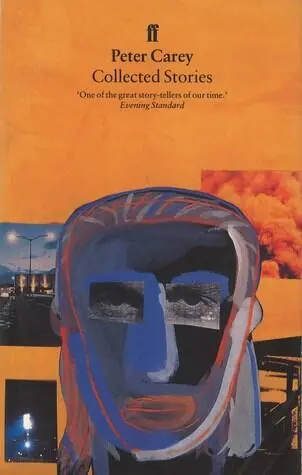
- Название:Collected Stories
- Автор:
- Издательство:Faber and Faber
- Жанр:
- Год:1996
- ISBN:нет данных
- Рейтинг книги:5 / 5. Голосов: 1
-
Избранное:Добавить в избранное
- Отзывы:
-
Ваша оценка:
Collected Stories: краткое содержание, описание и аннотация
Предлагаем к чтению аннотацию, описание, краткое содержание или предисловие (зависит от того, что написал сам автор книги «Collected Stories»). Если вы не нашли необходимую информацию о книге — напишите в комментариях, мы постараемся отыскать её.
Collected Stories — читать онлайн бесплатно полную книгу (весь текст) целиком
Ниже представлен текст книги, разбитый по страницам. Система сохранения места последней прочитанной страницы, позволяет с удобством читать онлайн бесплатно книгу «Collected Stories», без необходимости каждый раз заново искать на чём Вы остановились. Поставьте закладку, и сможете в любой момент перейти на страницу, на которой закончили чтение.
Интервал:
Закладка:
She smiles at me. She says, that sounds …
I say, the pity was it was only thirty-two hours, because after that I had to go home, and I had nothing left to do. There was nothing for years after that. It should be possible to do better than thirty-two hours.
She smiles again. I feel I may drown in a million gallons of milk. She says, we can do better than that.
I say, I know, but I had wished it for later. I had wished to save it up for several Christmases from now.
She says, it seems silly … to wait.
As I guessed, her breasts are large and heavy. I remove the last blouse to reveal them, large and soft with small taut nipples. I transfer my attentions to her skirt, then to a second skirt, and thence to a rather tattered petticoat. Her stockings, I see, are attached to a girdle. I begin to unroll the stocking, unrolling it slowly down the length of her leg. Then the second stocking. And the girdle.
Now she sits, warm and naked, beside me, smiling.
There is only one thing left, an earring on the left ear.
I extend my hand to take it, but she grasps my hand.
She says, leave it.
I say, no.
She says, yes.
I am compelled to use force. I grasp the earring and pull it away. It is not, it would appear, an earring at all, but a zip or catch of some sort. As I pull, her face, then her breasts, peel away. Horrified, I continue to pull, unable to stop until I have stripped her of this unexpected layer.
Standing before me is a male of some twenty odd years. His face is the same as her face, his hair the same. But the breasts have gone, and the hips; they lie in a soft spongy heap on the floor beside the discarded pendant.
She (for I must, from habit, continue to refer to her as “she”) seems as surprised as I am. She takes her penis in her hand, curious, kneading it, watching it grow. I watch fascinated. Then I see, on the right ear, a second earring.
I say, excuse me.
She is too preoccupied with the penis to see me reach for the second earring and give it a sharp pull. She sheds another skin, losing, this time, the new-found penis and revealing, once more, breasts, but smaller and tighter. She is, generally, slimmer, although she was never fat before.
I notice here that she is wearing a suspender belt and stockings. I unroll the first stocking and find the leg is disappearing as I unroll. I have no longer any control over myself. The right leg has disappeared. I begin to unroll the left stocking. The leg, perhaps sensitive to the light, disappears with the rolling.
She sits, legless, on the bed, apparently bemused by the two coats of skin on the floor.
I touch her hair, testing it. A wig. Underneath a bald head.
I take her hand, wishing to reassure her. It removes itself from her body. I am talking to her. Touching her, wishing that she should answer me. But with each touch she is dismembered, slowly, limb by limb. Until, headless, armless, legless, I carelessly lose my grip and she falls to the floor. There is a sharp noise, rather like breaking glass.
Bending down I discover among the fragments a small doll, hairless, eyeless, and white from head to toe.
A Windmill in the West
The soldier has been on the line for two weeks. No one has come. The electrified fence stretches across the desert, north to south, south to north, going as far as the eye can see without bending or altering course. In the heat its distant sections shimmer and float. Only at dusk do they return to their true positions. With the exception of the break at the soldier’s post the ten-foot-high electrified fence is uninterrupted. Although, further up the line, perhaps twenty miles along, there may be another post similar or identical to this one. Perhaps there is not. Perhaps the break at this post is the only entry point, the only exit point — no one has told him. No one has told him anything except that he must not ask questions. The officer who briefed him told the soldier only what was considered necessary: that the area to the west could be considered the United States, although, in fact, it was not; that the area to the east of the line could be considered to be Australia, which it was; that no one, with the exception of U.S. military personnel carrying a special pass from Southern Command, should be permitted to cross the line at this point. They gave him a photostat copy of an old pass, dated two years before, and drove him out to the line in a Ford truck. That was all.
No one in the United States had briefed him about the line — its existence was never mentioned. No one anywhere has told him if the line is part of a large circle, or whether it is straight; no one has taken the trouble to mention the actual length of the line. The line may go straight across Australia, for all the soldier knows, from north to south, cutting the country in half. And, even if this were the case, he would not know where, would not be able to point out the line’s location on a map. He was flown from the United States, together with two cooks, five jeeps, and various other supplies, directly to the base at Yallamby. After they landed there was no orientation brief, no maps — he waited fifteen hours before someone came to claim him.
So, for all he knows, this line could be anywhere in Australia. It is even possible that there are two parallel lines, or perhaps several hundred, each at thirty-mile intervals. It is even possible that some lines are better than others, that not all of them stretch through this desert with its whining silence and singing in the line.
The road crosses the line, roughly, at a right angle. The fact that it is not exactly a right angle has caused him considerable irritation for two weeks. For the first week he was unable to locate the thing that was irritating him, it was something small and hard, like a stone in his boot.
The bitumen road crosses the line at the slightest angle away from a right angle. He has calculated it to be, approximately, eighty-seven degrees. In another month those missing three degrees could become worse.
The soldier, who is standing on double white lines that run the length of the road, kicks a small red rock back into the desert.
The soldier sits inside the door of the caravan, his eyes focused on the dusty screen of his dark glasses, his long body cradled in his armchair. He was informed, three weeks ago, that he would be permitted to bring a crate of specified size containing personal effects. From this he gathered some ill-defined idea of what was ahead of him. He is not a young soldier, and remembering other times in other countries he located an armchair that would fit within the specified dimensions. The remaining space he packed with magazines, thrillers, and a copy of the Bible. The Bible was an afterthought. It puzzled him at the time, but he hasn’t thought of it or looked at it since.
He had expected, while he put the crate together, that he would have a fight on his hands, sooner or later, because of that armchair. Because he had envisaged a camp. But there was no camp, merely this caravan on the line.
The soldier polishes and cleans his dark glasses, which were made to prescription in Dallas, Texas, and stands up inside the caravan. As usual he bumps his head. His natural stoop has become more exaggerated, more protective, because of this caravan. He has hit his head so often that he now has a permanent patch that is red and raw, just at the top, just where the crew cut is thin and worn like an old sandy carpet.
But this is not a caravan, not a real caravan. It resembles an aluminium coffin, an aluminium coffin with a peculiar swivelling base constructed like the base of a heavy gun. The soldier has no idea why anyone should design it that way, but he has taken advantage of it, changing the direction of the caravan so that the front door faces away from the wind. Changing the view is what he calls it, changing the view.
Читать дальшеИнтервал:
Закладка:
Похожие книги на «Collected Stories»
Представляем Вашему вниманию похожие книги на «Collected Stories» списком для выбора. Мы отобрали схожую по названию и смыслу литературу в надежде предоставить читателям больше вариантов отыскать новые, интересные, ещё непрочитанные произведения.







Обсуждение, отзывы о книге «Collected Stories» и просто собственные мнения читателей. Оставьте ваши комментарии, напишите, что Вы думаете о произведении, его смысле или главных героях. Укажите что конкретно понравилось, а что нет, и почему Вы так считаете.