Marie NDiaye - Self-Portrait in Green
Здесь есть возможность читать онлайн «Marie NDiaye - Self-Portrait in Green» весь текст электронной книги совершенно бесплатно (целиком полную версию без сокращений). В некоторых случаях можно слушать аудио, скачать через торрент в формате fb2 и присутствует краткое содержание. Год выпуска: 2014, Издательство: Two Lines Press, Жанр: Современная проза, на английском языке. Описание произведения, (предисловие) а так же отзывы посетителей доступны на портале библиотеки ЛибКат.
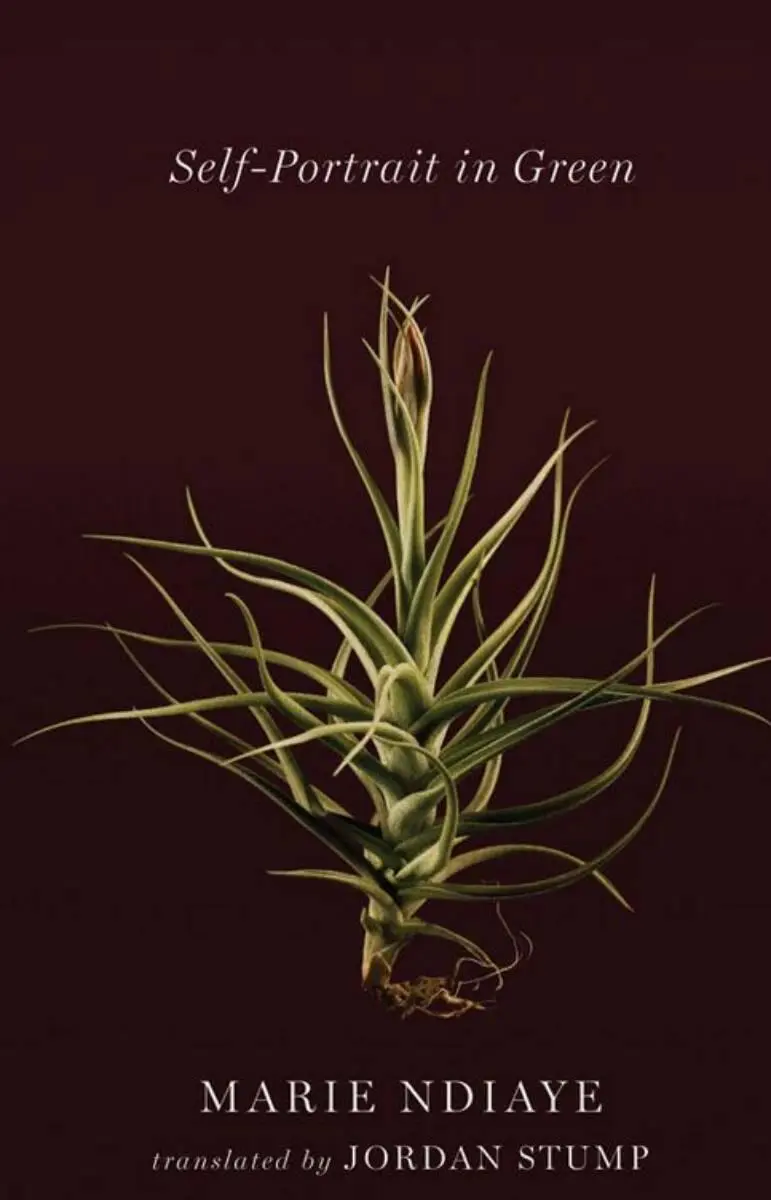
- Название:Self-Portrait in Green
- Автор:
- Издательство:Two Lines Press
- Жанр:
- Год:2014
- ISBN:нет данных
- Рейтинг книги:3 / 5. Голосов: 1
-
Избранное:Добавить в избранное
- Отзывы:
-
Ваша оценка:
Self-Portrait in Green: краткое содержание, описание и аннотация
Предлагаем к чтению аннотацию, описание, краткое содержание или предисловие (зависит от того, что написал сам автор книги «Self-Portrait in Green»). Если вы не нашли необходимую информацию о книге — напишите в комментариях, мы постараемся отыскать её.
Self-Portrait in Green — читать онлайн бесплатно полную книгу (весь текст) целиком
Ниже представлен текст книги, разбитый по страницам. Система сохранения места последней прочитанной страницы, позволяет с удобством читать онлайн бесплатно книгу «Self-Portrait in Green», без необходимости каждый раз заново искать на чём Вы остановились. Поставьте закладку, и сможете в любой момент перейти на страницу, на которой закончили чтение.
Интервал:
Закладка:
“It’s cataracts,” my stepmother tells me later, with a fatalistic shrug.
And when I talk about an operation, she says it’s too late now.
“We would have had to go back to France when it first started,” she says. “We couldn’t, we didn’t have the money. That’s how it is.”
Another shrug, resigned and indifferent, her brown eyes almost as dull as my father’s. She takes next to no notice of Marie. And I’m disappointed that my father can’t make out Marie’s features, having secretly hoped that, finding her so perfectly loveable, he might regret not having raised any of his own daughters, and that this regret might be for him a suffering, an affliction, a thorn lodged in the hide of his egotism. But no, nothing of the sort — to be sure, why come here only to hurt him, but really, what’s the good of coming here only to find nothing and no one in any way changed by my coming? Saying hello to Marie, he pretends to be speaking to her, but it is to a shape with no face and no clear outline that he tosses out two or three formal sentences, in a voice that, given the circumstances, can hardly be full of warmth.
“I hear you’ve gone in for architecture,” I say.
“I designed two or three beautiful houses. But that’s all over now, I got sick of it.”
I will next ask my stepmother:
“Why won’t he admit he can’t see?”
“He’s embarrassed,” she tells me, with the cold indolence that is now hers.
Marie and I are invited to stay for dinner at my father’s. Emerging from various rooms of the house, three or four young men sit down at the table beside us, all of them my father’s children, but all born to different women, none of whom I know. They’re uncomfortable, grim, unsmiling. The house’s dejected atmosphere ends up affecting Marie, who came here so full of sentimental dreams of a reunion, and I see her bury her nose in her plate, of interest to no one, diluted in the flood of descendents.
My father holds forth. He pretends to turn his glassy gaze toward each of us in turn. We’re served nothing but a single dish of semolina with vegetable broth, garnished with a small helping of chickpeas. They have no money, I tell myself. They’re stuck here in Burkina, in a neighborhood my proud father would once never even have deigned to drive through, because they have no money and nowhere to go, in spite of my father’s many children on three continents.
And all alone my father talks on, joyless, practiced. He’s wearing a Western suit, well-tailored but not particularly clean. Around him, his children are downcast. Should I rescue my father and stepmother? Should I help them come back to France? And what will they do then? I deeply regret having come here, and I don’t know what to think of this man. I believe I can glimpse one impervious part of him, one sole part unchanged over decades of a disorderly life, which shelters his exclusive love for himself. I don’t know what to think of him. I find him smug and unsympathetic. Can I rescue my father? Can I even offer my aid to this man who always made it a point of honor to put up a prosperous front? And how can I even think of taking on two supplementary souls, my father and my stepmother, so ill-equipped, how can I think of bringing them into my house, of living with them, even temporarily? Would she then cease to be my stepmother and become my dearest friend once again? And those adult children, anxious and sullen, who my father houses under his roof, what would become of them?
My stepmother chews slowly, staring into the distance. My father pontificates, to the indifference of all, and now he’s moved on to Monsieur Urbain — that bastard, as he calls him — and his house.
“This Urbain thinks very highly of you,” I say, overcome with pity for my father.
“If I dared,” he says, “I’d blow up that house of his, and him along with it.”
“The beautiful house you designed?”
“Yes,” says my father. “The hell with art. The bastard never paid me.”
My father then flies into a terrifying rage. His tone stays steady, but his hands shake, his thighs twitch under the table, his entire face is convulsed by tics. The young men who surround him, his late-life offspring, glum and downhearted, the wretched children of his middle age, his bitter age, are staring at the table, slightly hunched in their chairs, as if long accustomed, I tell myself, to taking these defensive measures when the tempest starts to rage. I’ve spent little time in the company of my father, but I’ve always heard, and always seen for myself, that he was a gentle man — stubborn but peaceable, unconciliatory but clement. And here I see violence radiating from his whole skeletal body. He leaps to his feet, toppling his chair.
“If it was just him, that would be one thing,” he says in his flat voice. “But the others are just as bad, they never paid me either. That’s why we live this way, you understand?”
He picks up his plateful of semolina and chickpeas. He throws it through the open window. We hear the plate break in the courtyard. Dumbstruck, Marie lets out a shocked little giggle.
“He does that at almost every meal,” my stepmother whispers. “It’s only an act, just a new way he’s found to keep himself from eating.”
I ask:
“Is it true no one’s paid him?”
“I think it’s only right,” she says. “They pretend to believe he’s an architect, or at least a competent architect, and he pretends to design houses, I mean he draws up blueprints but they don’t make any sense, and then when it’s all done they pretend to pay him. It’s not for real, no one thinks it’s for real. But now your father pretends to believe it’s for real, and after all that time pretending maybe he thinks it’s the truth. Oh, don’t ask me. I’m so sick of it all, so sick of it all,” my stepmother adds, with a sort of weary intensity.
There’s nothing left in her of the girl she used to be — and what about me? I’d have to ask her to find out, but does she remember our friendship, who we were? I’m not sure she does. Through clenched jaws, her teeth bitterly gnashing, she tells me she’s come up with all sorts of projects since she got to Burkina, but thanks to my father — unhelpful, jealous, sometimes poisonously disloyal — they’ve all come to nothing.
“Oh, I can’t stand it anymore,” says my stepmother. “I mean it, I’m tired, tired, I don’t care what happens next. I have no children, I have nothing. He’s got too many children, and I don’t have any. Now I don’t care anymore.”
Evidently my father has resolved to let himself waste away. He pretends to eat, but actually swallows only a few spoonfuls of semolina every day. So my stepmother tells me, in her cold despair. What can I do? They all need saving — the two of them, the young men in their clutches — but who’s supposed to do it? I wish I hadn’t come here, and hadn’t learned of, hadn’t witnessed such a disaster. I also wish Marie had never witnessed or learned of this ugly, glacial ruin, the fruit of my father’s vanity. Marie is a young French girl of her time: understandably, she was hoping for warm feelings and sensitivity. And now she’s discovering an incomprehensible paralysis of the sentiments, a collective indifference and sabotage: the slow agony of a household revolving around a master whose taste for death is no longer kept under wraps.
The next day, the lecture hall is half empty. At the very back, I can see my stepmother, fortunately alone. She’s chatting with Marie, and she sends me a cheerful little wave that warms my heart. And two days later, she’s the one who comes to say goodbye to us at the airport, again alone.
“I’m going to do whatever it takes to get back to France, as soon as I possibly can,” she says. “If your father wants to stay, he can stay.”
Читать дальшеИнтервал:
Закладка:
Похожие книги на «Self-Portrait in Green»
Представляем Вашему вниманию похожие книги на «Self-Portrait in Green» списком для выбора. Мы отобрали схожую по названию и смыслу литературу в надежде предоставить читателям больше вариантов отыскать новые, интересные, ещё непрочитанные произведения.





Обсуждение, отзывы о книге «Self-Portrait in Green» и просто собственные мнения читателей. Оставьте ваши комментарии, напишите, что Вы думаете о произведении, его смысле или главных героях. Укажите что конкретно понравилось, а что нет, и почему Вы так считаете.