Marie Ndiaye - All My Friends
Здесь есть возможность читать онлайн «Marie Ndiaye - All My Friends» весь текст электронной книги совершенно бесплатно (целиком полную версию без сокращений). В некоторых случаях можно слушать аудио, скачать через торрент в формате fb2 и присутствует краткое содержание. Год выпуска: 2013, Издательство: Two Lines Press, Жанр: Современная проза, на английском языке. Описание произведения, (предисловие) а так же отзывы посетителей доступны на портале библиотеки ЛибКат.
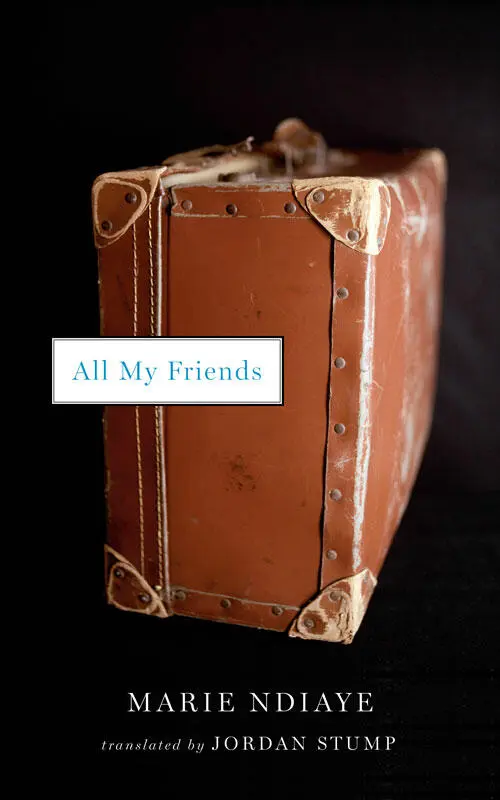
- Название:All My Friends
- Автор:
- Издательство:Two Lines Press
- Жанр:
- Год:2013
- ISBN:нет данных
- Рейтинг книги:3 / 5. Голосов: 1
-
Избранное:Добавить в избранное
- Отзывы:
-
Ваша оценка:
All My Friends: краткое содержание, описание и аннотация
Предлагаем к чтению аннотацию, описание, краткое содержание или предисловие (зависит от того, что написал сам автор книги «All My Friends»). Если вы не нашли необходимую информацию о книге — напишите в комментариях, мы постараемся отыскать её.
delivers five stories that probe the boundaries between individuals to mediate on how well we really know anybody, including ourselves. Written in hypnotic prose with characters both fully fleshed and unfathomable,
opens with the fraught love story of a man who has fallen for his housekeeper, his student of many years ago. Losing his grip as he feels his own family turning against him, he plots romance between the housekeeper and an old friend, whom he thinks is perfect for her. Later NDiaye gives us the harsh tale of a young boy longing to escape his life of poverty by becoming a sex slave — just like the beautiful young man that lived next door. And when a woman takes her mentally challenged son on a bus ride to the city, they both know that she’ll return, but he won’t. Chilling, provocative, and touching, this is an unflinching look at the personal horrors we fight every day to suppress — but in
they’re allowed to roam free.
All My Friends — читать онлайн бесплатно полную книгу (весь текст) целиком
Ниже представлен текст книги, разбитый по страницам. Система сохранения места последней прочитанной страницы, позволяет с удобством читать онлайн бесплатно книгу «All My Friends», без необходимости каждый раз заново искать на чём Вы остановились. Поставьте закладку, и сможете в любой момент перейти на страницу, на которой закончили чтение.
Интервал:
Закладка:
And so what if he did? Brulard asked herself out on the icy sidewalk, so what if the receptionist did notice that. . that what? She didn’t want to seem disreputable. She wanted people to think well of the woman she was, she wanted people to think her prosperous enough to pay for a few nights in a moderately luxurious hotel without troubling herself over it, she wanted to seem unique, casual, and proud. No one here had recognized Brulard. Neither the day clerk’s bored dubiousness nor the night clerk’s placid indifference suggested that they found Brulard’s face in any way familiar.
She told herself none of that mattered to her. Standing between the veranda and the road, shivering but, numbed as she was by fatigue, by a fatigue verging on stupor, not entirely aware that it really was her feeling cold, and not a cardboard cutout of her set up outside the hotel to publicize an exclusive engagement (but never had her unassuming fame propelled her to any such level of visibility, and now it never would), she limply decided to head for the lake. She stamped the ground to warm her feet, shod in brown tassel loafers. That she’d been reduced to wearing such shoes tormented and astonished her at the same time.
She sensed a presence above her, and, raising her eyes to the window of her second-floor room, she found Eve Brulard staring down at her with concern and benevolence, her elbows on the sill. The Eve Brulard at the window was at most twenty years old. What did she have to be concerned about? Irritated and stern, Brulard hissed through her teeth, tss tss, and, with a little cry of terror or derision, a strident plaint that drilled into Brulard’s eardrums, the young Eve Brulard evaporated into the fog that had rolled in from the lake. Thank goodness, she thought, no one but her ever heard the blood-curdling cries emitted by this shrieking snakewoman, who nevertheless always seemed to appear in a context of steadfast understanding and solicitude. Why, then, this look of concern on Eve’s youthful face, since Brulard had, in spite of everything, more reasons to rejoice than to worry? And was it not increasingly wearying to find the young woman she’d once been now showing up in all manner of circumstances and anywhere at all, anytime, never particularly wished for by Brulard, who never received from her any clear revelation on any subject whatever, who couldn’t even escape her by closing her eyes, who was forced to accept this friend’s sporadic company as one mutely endures a mysterious threat, as one passively accepts a message of regrets, of good wishes, of condolence? Brulard wished it would stop. Some days she encountered that figure so often that she forgot that her own face had changed, and, happening onto a mirror, momentarily wondered: who is that no-longer-very-young woman, and what’s she doing in my light?
She circled around the hotel and immediately found herself on the lakeshore. The water was gray that morning, and a thick fog hid the houses on the other side, giving Brulard, numb with fatigue, the disturbing feeling of an endless dawn, a suspended daybreak that would never stop spreading its cottony mists over a leaden lake for the sole purpose of wearing down her vital forces.
Because it was still far too early to seek some sort of escape. Where was there to go, what to do? Not even the cafés were open at this hour. As for the bank, the moment when Brulard could push open the double glazed doors, forcing herself to abandon all hope and pasting a stern, incensed look on her face, that moment still seemed so remote that she refused even to think about it, fearing her thoughts’ dizzying plunge into boredom, and the memory of all the boredom past, and all the wasted hours.
Nevertheless, she had more reasons to rejoice than to. . But how simply to get through these few days of solitude by the lake, Brulard couldn’t imagine.
She walked slowly, feeling the tassels on her shoes jump against the fine leather. Those shoes were an innocent presage of some subtly morbid change in her way of seeing things, for, in all her sometimes tangled and disappointing life, would she ever, at any time, have bought loafers of her own volition? Before last Saturday, when, alighting from the train, she saw lingering patches of muddy snow on the platform, realized she couldn’t stay here with only sandals to wear, entered the first shoe store she came to, and picked out these medium-heel slip-ons, before that April Saturday when she had, in a sense, fled her own house (as Brulard said to herself, not that she’d actually had to flee, not that anyone would have tried to hold her back or even thought of doing so, much less believed holding her back to be possible or desirable), before that Saturday her violent hatred of such shoes, so unmistakably designed for comfort, ease of mobility, and charitable deeds, was like a reflexive surge of free will in the teeth of the dictates of respectable taste. A Catholic lady’s shoes, thought Brulard, bewildered that she’d found it necessary, as punishment for deserting Lulu, to disguise herself in this way. But maybe that’s not what it was. Maybe she herself was becoming. .
Brulard felt the mountain behind her, watching. Still invisible, cloud-draped, the mountain sloped down to the lake. No matter which way she turned, Brulard felt the mountain nearby, and she sensed that this austere presence was only one of the many incarnations chosen by her mother, dead not long before, to weigh on Brulard’s conscience. But, oh, being watched didn’t scare her. She was on her way, resolutely, toward a new happiness.
But, Brulard wondered, why was it so hard, now that she really was alone, to feel that unplanned isolation in all its plenitude and rarity, and to enjoy it in some way, rather than, as she caught herself doing at this very moment, turning her head to avoid the eye of the young Eve Brulard, who now sat on a bench facing the lake, staring at her loafers, wearing an extravagant pink chiffon dress that clearly displayed her pointed, youthful breasts, her little brown shoulders, her narrow, curved pelvis? And rather than, once she’d done that, immediately looking down so as not to glimpse the snow-covered mass of the mountain behind the clouds, now gradually unfurling, mutating into a sort of gauze not unlike the pink fabric of the dress t
Better, with the mountain so hostile and so indiscreet, to fix her gaze on the lake’s tranquil waters, or the bench, now rid of the exhausting presence of the beauteous Eve Brulard, whose eagle eye had not missed those tasseled shoes — and then, on her smooth face, was that the shadow of a surge of pity? Of a reproach, tinged by compassion and alarm? Brulard sat on the bench, her lids heavy. She rested one cheek on her shoulder and wrapped her arms around her knees. She felt the cold numbing her, drawing her toward sleep, toward surrender. She pictured herself in the place of Eve Brulard, possessed of all the self-assurance, the litheness, the punctilious critical sensibility of a twenty-year-old, and tried to see herself through those eyes — leaving the loafers aside, just this once. What did you see when you looked at Brulard? A slight, mild woman with a dark complexion, short black hair, an unsuitable, slightly shiny jacket and trousers, large, timid, obstinate eyes, and on her lips a faint quivering bitterness, increasingly difficult to transmute into joyous surprise? Or some vast, looming personage of ambiguous sex, a fine face, hard and square, a strong jaw hungry for conquest and success? Brulard had no doubt that at times she’d been exactly that, magnified by ambition and self-confidence even more than by her high heels, next to which the modest loafers looked like two runts shrunken into their own virtue, by her thick mane of bleached, champagne-blonde hair, carefully styled to halo her head, by the proud bearing of her shoulders, of her ramrod-straight neck. Which of those two Brulards did you see at this moment? And which was the one who was loved, or preferred? The tall, blonde, almost famous Brulard, or the Brulard of today, slighter, but whose expression, she could see in her every reflection, was that of a grave, discreet ecstasy, of passion without illusions, unbowed even if battered? Was this second one not inevitably the favorite? Of those two possible versions of Eve Brulard between forty and fifty years of age? By the grace of a sincerity that she herself found mysterious (for what her true current face had to do with her she had no idea, and this ignorance left her pensive, perplexed), but which that artificial ambitious blondness and that chin held a little too high professed less convincingly?
Читать дальшеИнтервал:
Закладка:
Похожие книги на «All My Friends»
Представляем Вашему вниманию похожие книги на «All My Friends» списком для выбора. Мы отобрали схожую по названию и смыслу литературу в надежде предоставить читателям больше вариантов отыскать новые, интересные, ещё непрочитанные произведения.








Обсуждение, отзывы о книге «All My Friends» и просто собственные мнения читателей. Оставьте ваши комментарии, напишите, что Вы думаете о произведении, его смысле или главных героях. Укажите что конкретно понравилось, а что нет, и почему Вы так считаете.