Marie Ndiaye - All My Friends
Здесь есть возможность читать онлайн «Marie Ndiaye - All My Friends» весь текст электронной книги совершенно бесплатно (целиком полную версию без сокращений). В некоторых случаях можно слушать аудио, скачать через торрент в формате fb2 и присутствует краткое содержание. Год выпуска: 2013, Издательство: Two Lines Press, Жанр: Современная проза, на английском языке. Описание произведения, (предисловие) а так же отзывы посетителей доступны на портале библиотеки ЛибКат.
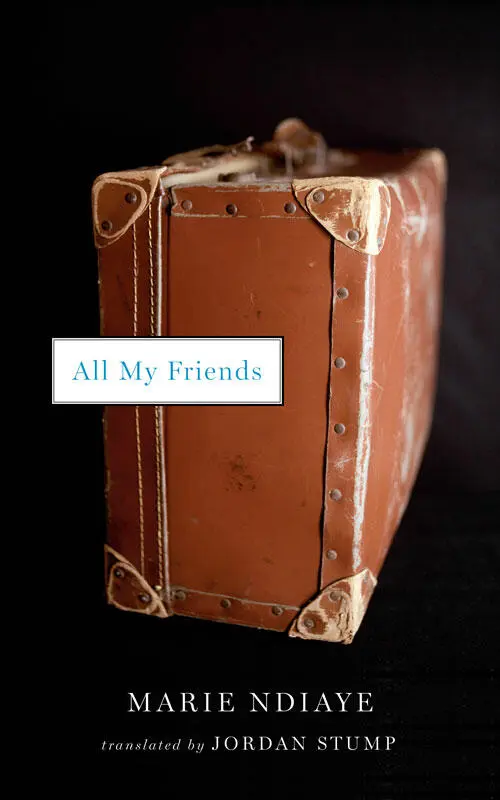
- Название:All My Friends
- Автор:
- Издательство:Two Lines Press
- Жанр:
- Год:2013
- ISBN:нет данных
- Рейтинг книги:3 / 5. Голосов: 1
-
Избранное:Добавить в избранное
- Отзывы:
-
Ваша оценка:
All My Friends: краткое содержание, описание и аннотация
Предлагаем к чтению аннотацию, описание, краткое содержание или предисловие (зависит от того, что написал сам автор книги «All My Friends»). Если вы не нашли необходимую информацию о книге — напишите в комментариях, мы постараемся отыскать её.
delivers five stories that probe the boundaries between individuals to mediate on how well we really know anybody, including ourselves. Written in hypnotic prose with characters both fully fleshed and unfathomable,
opens with the fraught love story of a man who has fallen for his housekeeper, his student of many years ago. Losing his grip as he feels his own family turning against him, he plots romance between the housekeeper and an old friend, whom he thinks is perfect for her. Later NDiaye gives us the harsh tale of a young boy longing to escape his life of poverty by becoming a sex slave — just like the beautiful young man that lived next door. And when a woman takes her mentally challenged son on a bus ride to the city, they both know that she’ll return, but he won’t. Chilling, provocative, and touching, this is an unflinching look at the personal horrors we fight every day to suppress — but in
they’re allowed to roam free.
All My Friends — читать онлайн бесплатно полную книгу (весь текст) целиком
Ниже представлен текст книги, разбитый по страницам. Система сохранения места последней прочитанной страницы, позволяет с удобством читать онлайн бесплатно книгу «All My Friends», без необходимости каждый раз заново искать на чём Вы остановились. Поставьте закладку, и сможете в любой момент перейти на страницу, на которой закончили чтение.
Интервал:
Закладка:
“Well, René? Time to go home!”
And could poor René have told them that he felt a kinship with each of those mouths, so fiercely determined to defend its purity against the perfidious temptations of meat, of any food at all? The Mours didn’t realize that their lips opened only because they were forced to, only René could see that, just as he saw, tilting his head, that the Mours’ consciences sided with their placid, swaying legs. René, on the other hand, knew that his whole body and mind struggled against the desire to eat, that weakness, and then that remorse. He knew more about that than the Mours.
Now the woman was explaining that she’d found the door half-open onto the heat of the farmyard, and thought there was no need to knock. She dropped a calling card onto the table and Madame Mour eagerly snatched it up to read it aloud, thereby, without seeking to, without even thinking of it, informing René that the woman’s name was E. Blaye.
“We weren’t expecting you so early,”said Madame Mour.
“I don’t have much time,” said the woman. “I’ve got to get back to work. Let’s try and make this quick.”
A sort of squeal burst from the lips of the younger, handsomer, cleverer of the two Mour sons, the same age as René. He looked down at his plate and the shadow of his eyelashes veiled his cheeks, which, to his deep surprise, René had seen blushing violently. A heavy pall of discomfort filled the kitchen. But it had no effect on the woman, and René could feel her impatience, her irritation. Her gaze darted from brother to brother. It settled on Anthony, the younger, handsomer one.
“This must be him,” she said, placated.
“Yes, that’s him,” said Madame Mour. “Did you hear? Come on, go get your bag.”
And, as Anthony slowly pushed back his chair and rose without a glance at the others, the lower half of his face still dimmed by the blue shadow of his thick black eyelashes, the woman, pleased to see herself obeyed, absent-mindedly turned her attention to the rest of the room, the Mours’ old-fashioned little kitchen, whose décor and amenities they’d been vowing to update for twenty years, never finding the money to do it, and which, René realized, E. Blaye was now seeing in all its clutter of yellowed furniture, brown housewares, pitiful, valiant utensils.
How Anthony was trembling on his way out of the kitchen, René said to himself.
Young and curly-headed, the Mour father sat perfectly still. He stared at his empty plate, breathing heavily.
The woman had briefly but carefully studied Anthony Mour’s lithe physique, confined in an undersized pair of pants and a tank top bearing the crest of an American basketball team, she’d watched him walk away, dragging his espadrilles with a sort of shambling haste, she’d seen, René told himself, heart pounding, Anthony Mour’s grace through his fear and unease, his languidly supple movements, the nudity of his muscular arms, golden and rippling, she’d shivered with pleasure, René told himself, perhaps with relief (had she feared she might end up with the brother?). And then she’d fixed a cold eye on each of the Mours, and then on René, not seeing him, so perfectly did he blend in with the dim wall, the shabby chiaroscuro of the far end of the room.
Now she was pacing, with measured steps. Eager to be done with all this, she cast a glance out at the white, blazing farmyard each time she came to the open door, as if she needed to fill herself with fresh air or the thought of a hot, dazzling freedom before she could plunge back into the Mours’ dim, rancid kitchen, or as if, René thought, the idea of fleeing crossed her mind whenever her footsteps passed from shadowed to sunlit floor tiles. She paced in her flat sandals, indiscreetly checking her watch. Across the farmyard, René saw the oblong form of a car.
“Hurry up!” Madame Mour shouted irritably.
She was yelling up toward the room Anthony had vanished into. She stood, then sat down again, indecisive, ashamed, her thin face deep crimson. The Mour father’s perfect immobility and reproachful, humiliated silence undermined her assurance. Stumbling over her words, she ordered Anthony’s brother to go get him. When they returned, the homelier brother was walking behind, as if to prevent Anthony from backing out, snickering a little, soundlessly, his face contorted — much like Anthony in the muscular slenderness of his limbs, the swinging indolence of his gait, the grimy old American-sports-star jersey, the espadrilles slapping his feet, the tight pants worn very low on his pelvis, but Anthony’s exact opposite, and almost his antagonist, in the form of his face: shapeless, hesitant, blunt, as if seeking to parody the impeccable sharpness of Anthony’s features, and managing only to make itself pathetic and vindictive.
The brother led Anthony to the woman. He laid Anthony’s bag at his feet, then stood close by, keeping a discreet but vigilant watch.
Poor guy, poor guy, thought René, horrified. For the juxtaposition of those two faces, so comparable in their unlikeness, made it abundantly clear that Anthony had been chosen because he’d turned out well, while the other was an inferior product, deeply and irreparably disgraced. Devoid of commercial value, he seemed of no use, and relegated to lowly and inessential tasks: bringing his brother to the woman, remembering the bag, keeping an eye on his brother. And all this with the insincere simpering of one who strives to anticipate authority’s needs, who seeks only to please that authority, and who knows that it never even sees him.
“All right, off we go,” said E. Blaye, gaily.
And to Madame Mour alone, in a clear but quiet voice:
“I’ll write you to arrange the payments.”
The brother acknowledged this with a snort. Unable to answer, Madame Mour half closed her eyes. But René sat in the clutches of an agonizing jealousy. He looked at the Mour father in hopes of convincing himself that Anthony’s situation was in no way desirable, in no way meritorious, the Mour father who sat petrified with disgust at the dishonor being done to his household, but what’s the use, René asked himself, what’s the use, since he wasn’t the one now disappearing into the sun-drenched farmyard, no doubt leaving forever, putting the Mours’ wretched kitchen behind him, since it wasn’t him but handsome Anthony that a woman named E. Blaye, a woman from the city, the same age as Madame Mour but younger-looking, was closely tailing through the dusty farmyard, surely gazing at his tanned nape, his soft shoulders, enveloping Anthony’s neck with the eager warmth of
“He’s gone,” Madame Mour murmured, coming in from the front step.
“You see how old she was?” said the brother.
And he raised his voice to a scandalized, indignant pitch, but in vain, for, René thought, he had no idea what a true scandal was.
“So?” said Madame Mour. “What difference does that make?”
Neither opening his mouth nor raising his eyes, the Mour father declared:
“You’ll never talk about him again. You’ll never speak his name in my house. He’s dead. He’s gone. We don’t know who he is, where he’s buried, we don’t honor his memory.”
* * *
That evening, René said to his mother:
“The Mours sold Anthony to a lady from town.”
“For how much?”
“They didn’t say.”
“Good for him. He’ll be happier there.”
Slightly eased by the exhausting walk home on a sun-blistered road, that insistent itch of envy and spite now flooded back with new vigor, irritating every fiber of René’s body and soul. He looked at his mother and realized that the mute, outraged question he was asking her (And why shouldn’t you find the same sort of lady for me?) was being answered in kind, by her unhappy, resigned, realistic glance, by a small, dubious shake of the head (What have you got to sell, my son?). He couldn’t help blurting out:
Читать дальшеИнтервал:
Закладка:
Похожие книги на «All My Friends»
Представляем Вашему вниманию похожие книги на «All My Friends» списком для выбора. Мы отобрали схожую по названию и смыслу литературу в надежде предоставить читателям больше вариантов отыскать новые, интересные, ещё непрочитанные произведения.









Обсуждение, отзывы о книге «All My Friends» и просто собственные мнения читателей. Оставьте ваши комментарии, напишите, что Вы думаете о произведении, его смысле или главных героях. Укажите что конкретно понравилось, а что нет, и почему Вы так считаете.