Dimitry Leger - God Loves Haiti
Здесь есть возможность читать онлайн «Dimitry Leger - God Loves Haiti» весь текст электронной книги совершенно бесплатно (целиком полную версию без сокращений). В некоторых случаях можно слушать аудио, скачать через торрент в формате fb2 и присутствует краткое содержание. Год выпуска: 2015, Издательство: Amistad, Жанр: Современная проза, на английском языке. Описание произведения, (предисловие) а так же отзывы посетителей доступны на портале библиотеки ЛибКат.
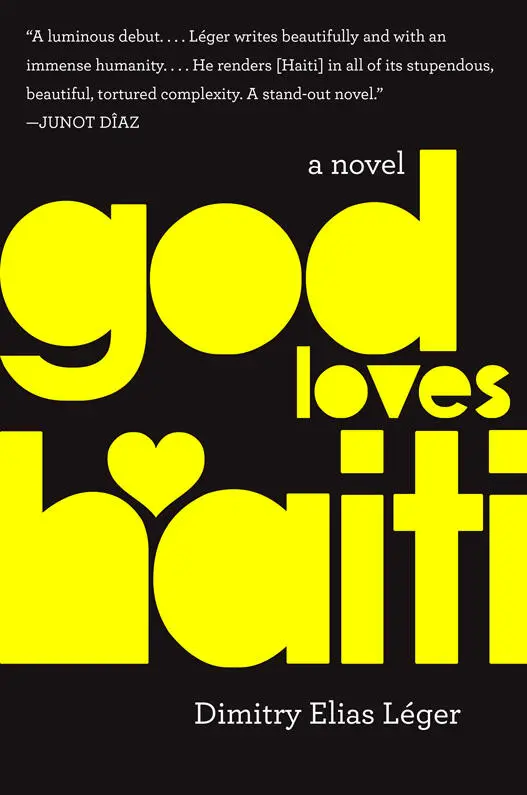
- Название:God Loves Haiti
- Автор:
- Издательство:Amistad
- Жанр:
- Год:2015
- ISBN:нет данных
- Рейтинг книги:5 / 5. Голосов: 1
-
Избранное:Добавить в избранное
- Отзывы:
-
Ваша оценка:
God Loves Haiti: краткое содержание, описание и аннотация
Предлагаем к чтению аннотацию, описание, краткое содержание или предисловие (зависит от того, что написал сам автор книги «God Loves Haiti»). Если вы не нашли необходимую информацию о книге — напишите в комментариях, мы постараемся отыскать её.
Reflecting the chaos of disaster and its aftermath,
switches between time periods and locations, yet always moves closer to solving the driving mystery at its center: Will the artist Natasha Robert reunite with her one true love, the injured Alain Destiné, and live happily ever after? Warm and constantly surprising, told in the incandescent style of José Saramago and Roberto Bolaño, and reminiscent of Gabriel García Márquez’s hauntingly beautiful
is an homage to a lost time and city, and the people who embody it.
God Loves Haiti — читать онлайн бесплатно полную книгу (весь текст) целиком
Ниже представлен текст книги, разбитый по страницам. Система сохранения места последней прочитанной страницы, позволяет с удобством читать онлайн бесплатно книгу «God Loves Haiti», без необходимости каждый раз заново искать на чём Вы остановились. Поставьте закладку, и сможете в любой момент перейти на страницу, на которой закончили чтение.
Интервал:
Закладка:
Are you OK, buddy? he said.
Wait, he is a movie star, Alain realized, though he couldn’t place the man’s most famous film. Something in the eighties. It was the reassuring twinkle of the man’s eye that gave it away. When Alain was in graduate school in Greenwich Village, Hollywood stars were commonplace in the neighborhood. Buying records at Tower, lunching at the coffee shop, even buying weed in Washington Square Park. The girls were occasionally seducible. The men were unapproachable. They all had that twinkle at the ready, though. It functioned like a shield and a dagger of otherworldly charm. Successful politicians and CEOs have a variation of it. Musicians too. The theatrical variation was a tad more delicate and effervescent, which is maybe why it had a longer-lasting effect on most mortals.
What the hell are you doing here? Alain said. I was doing fine.
You were? Really? What was that hands-down, chin-up move? Some form of Haitian jujitsu?
Fuck off.
Naw, I’m too tired from saving your ass.
The guy plopped down on the patch of brown grass next to Alain’s tent. His chest heaved. He was clearly exhausted. Obviously, playing hero against hungry thieves in a park in the middle of the Caribbean night with a baseball bat was not a routine night out for him. He looked to be around fifty, fit, for sure, but gray at the temples. Wiry and lean, probably vegan, all the veins in his bright pink face and arms popped out, throbbing. His heart was probably playing a tambourine in his chest. In front of them, the two marauders lay unconscious, lifeless. Hollywood, as Alain dubbed the white man in his head, avoided looking at them, as if he felt distaste for the violence he’d just practiced. Alain looked at them. Under the light of a piercing silver moon, their lifeless faces made them look younger than he’d expected. Their clothes were threadbare. Their faces just plain bare. Maybe they were just hungry and couldn’t sleep and were looking for help. Maybe they weren’t the leaders at all, just frontline pawns now nursing frontal lobe fractures. Either way they had gone about looking for help the wrong way. The poor bastards. Why they had come out here looking for trouble? In a couple of hours, the first Place Pigeon residents would wake up and see their bodies and feel as though they had come face to face with loups-garous, werewolves, the monsters of the night featured in Haitian bedtime stories. These two boys would serve as a deep reminder about how screwed up and scary people could still be, not just the traitorous earth.
We have to move their bodies, Alain said without taking his eyes off them.
Yeah, Hollywood said.
Hollywood went to work. Under Alain’s jealous eyes, the man from the city of pretend heroes solemnly picked up and dragged each dead stranger’s body with the help only of the bright moonlight over to the camp’s cemetery, then dug a hole and buried them. Alain saw the foreigner tenderly bury his dead compatriots with disbelieving eyes and pangs of guilt from his inability to help. The graves were crude, not that deep. The dirt covering them was thin. A good gust of prehurricane wind in the summer could unmask the dead and their seemingly slumbering faces. People around the world tended to presume the dead were innocent, or that each death, with its complete finality, deserved our pity, even sympathy, because a dead bastard, even though he was a bastard, is, after all, still dead, dealing with the great unknowns of fate, reinforcing our core belief that no one deserves to die, especially us. There had to be something self-serving in this view, Alain had come to think. It must mean that if one accepts that some or most people deserve to die — since until God tells us otherwise, everyone will die, and deservedly so, as far as He seems concerned — the implication is that I deserve to die too, and this idea sucks too much for a lot of people to accept. No one wants to die. Even people who believe in heaven don’t want to die. Even the elderly, reduced to infantilism and practically mute, stunned with constant pain, always feel death is a dish that will be best served to their friends and not them, because, well, they are special, and their friends clearly less special and more deserving to die than they are, though they love their friends and wish them heaven. Those on their deathbeds are probably not unlike most of us in that way too. They believe deep in their bones that a last-minute escape from death will materialize and protect them when they need it most, when death comes calling, whether they expected her or not, and whether they believed they earned heaven or hell.
Alain stopped being one of those people after the earthquake. The second after he woke up on the dirt from the earth’s blow, and for the many days afterward that he spent helplessly watching piles of extinguished human bodies grow and grow around him and be removed from sight like so much trash, he couldn’t for the life of him figure out why he deserved to live and so many people deserved to die during and after those fateful thirty-five seconds. The numbers of dead from the earthquake and aftershocks were estimated to range from a few thousand to a million, according to news reports on Radio Ginen. Knowing full well that the correct number would fall somewhere in the middle, about a half million, if Haiti was lucky, Alain found the blow to his society to be particularly grotesque. He couldn’t find the optimistic muscles to forgive God. He couldn’t question God’s sanity candidly, even to himself, so he did what so many people do when convulsed by divine deception: he put his own faith in question. He wondered whether he deserved another dawn, another dream, more human touch. He found himself wanting. His impulse was to negate his own existence. He accepted a growing belief that life was fleeting and trivial and death could be a respite, and even a reward, from it all. Though the presence of strange little Xavier occasionally pacified his spiritual torment, when the boy slept, Alain felt the misery in the people around him and across the island fall over his head, against his will, like an assault of a thousand jackhammers. He’d sit on his cardboard cushion and stare at his stretched-out wounded leg and zone out. Anything was better than sleep and the recurring nightmare of an avalanche of crippled and dead Haitians asking him, Why? Why? Why? WHY? as he ran away. They were always in a fucking forest. Running and running and running, breathlessly. The dead kept chasing Alain from all angles. Their questions were louder each time. Why? Why? WHY? I don’t know! I don’t know! I don’t know! Alain screamed while running for his life.
That’s pretty good use of the word “fuck,” Hollywood said, ending Alain’s reverie.
The movie star had plopped down on the ground next to him. Thoroughly exhausted, he looked at least fifty years old, about twice Alain’s age. His face was heavily lined and pink and crinkly-eyed handsome. He radiated warmth, not grandiosity, probably to protect Alain’s ego, probably out of habit. He unpacked his duffel bag and seemed to need to connect with Alain to work through the adrenaline high of his extraordinary efforts that evening.
I think I recognize your accent, he said. Brooklyn, right? You’re a New Yorker.
Yeah, Alain said. Some of the time.
I was born there. Parents moved us to California not long after.
I was born here, Alain said, and moved out there soon afterward. California’s nice. Good weather.
Not as nice as the weather here.
You like it here, huh?
What’s not to like? The weather, the women, the music, the art, the food, the dancing, the women, the women. Did I mention the women? I could be very happy here. Say, that leg looks fucked-up. Have you had someone look at it?
Читать дальшеИнтервал:
Закладка:
Похожие книги на «God Loves Haiti»
Представляем Вашему вниманию похожие книги на «God Loves Haiti» списком для выбора. Мы отобрали схожую по названию и смыслу литературу в надежде предоставить читателям больше вариантов отыскать новые, интересные, ещё непрочитанные произведения.










Обсуждение, отзывы о книге «God Loves Haiti» и просто собственные мнения читателей. Оставьте ваши комментарии, напишите, что Вы думаете о произведении, его смысле или главных героях. Укажите что конкретно понравилось, а что нет, и почему Вы так считаете.