Raja Alem - The Dove's Necklace
Здесь есть возможность читать онлайн «Raja Alem - The Dove's Necklace» весь текст электронной книги совершенно бесплатно (целиком полную версию без сокращений). В некоторых случаях можно слушать аудио, скачать через торрент в формате fb2 и присутствует краткое содержание. Год выпуска: 2016, Издательство: The Overlook Press, Жанр: Современная проза, на английском языке. Описание произведения, (предисловие) а так же отзывы посетителей доступны на портале библиотеки ЛибКат.
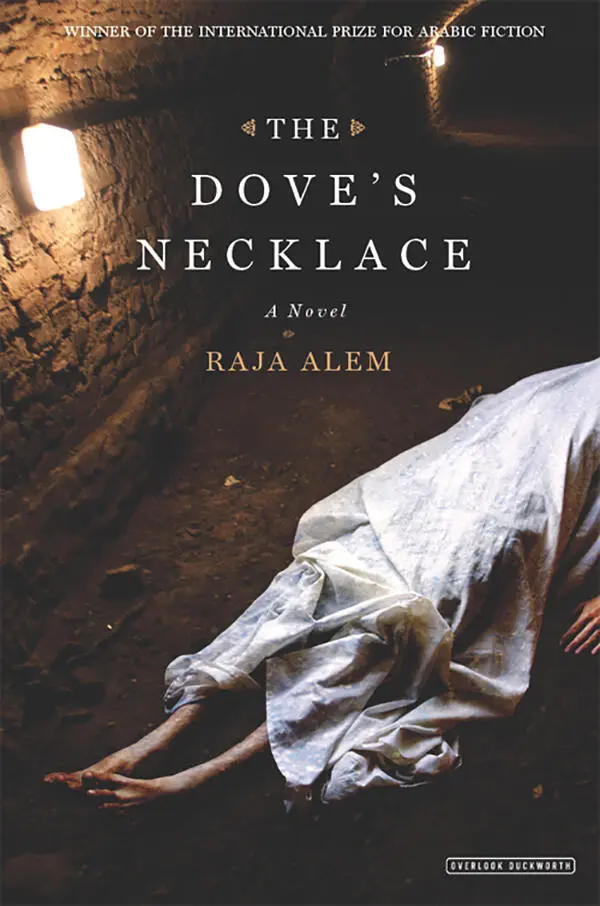
- Название:The Dove's Necklace
- Автор:
- Издательство:The Overlook Press
- Жанр:
- Год:2016
- ISBN:нет данных
- Рейтинг книги:4 / 5. Голосов: 1
-
Избранное:Добавить в избранное
- Отзывы:
-
Ваша оценка:
The Dove's Necklace: краткое содержание, описание и аннотация
Предлагаем к чтению аннотацию, описание, краткое содержание или предисловие (зависит от того, что написал сам автор книги «The Dove's Necklace»). Если вы не нашли необходимую информацию о книге — напишите в комментариях, мы постараемся отыскать её.
Tackling powerful issues with beautiful and evocative writing, Raja Alem reveals a city-and a civilization-at once beholden to brutal customs, and reckoning (uneasily) with new traditions. Told from a variety of perspectives-including that of Abu Al Roos itself-
is a virtuosic work of literature, and an ambitious portrait of a changing city that deserves our attention.
The Dove's Necklace — читать онлайн бесплатно полную книгу (весь текст) целиком
Ниже представлен текст книги, разбитый по страницам. Система сохранения места последней прочитанной страницы, позволяет с удобством читать онлайн бесплатно книгу «The Dove's Necklace», без необходимости каждый раз заново искать на чём Вы остановились. Поставьте закладку, и сможете в любой момент перейти на страницу, на которой закончили чтение.
Интервал:
Закладка:
Brown: the wide, frightened eye that took her by surprise through the crack in the storeroom door that dawn. A look of fear that stripped her body of its previous obedience and launched her away with an illiteracy beyond illiteracy: no suitcase, no name, not even an outline of what might be ahead.
Red: the knee-length socks that her memory had managed to save and were floating in a ball over her complimentary plate of fruit.
Transparent: Zamzam and all those ills of hers for which it had been prescribed: bitterness, sickness, hair between the eyebrows … Her right eye was the prey and the left was the hunter, wall-eyed; everything they looked at dissolved.
Her scent no longer had any hope of drawing her back to what she was before that dawn.
Envious eyes: somewhere in her memory.
Hot flashes: for the heart she left behind under a stone in the alley, a heart crushed beneath a stone, erasing a criminal record in that smashed-up face. She locked it up and left, capable of — anything? Everything.
The pans of a weighing scales: a woman’s eye on one side and another woman’s eye on the other. Which one fell and which one gave up?
The musk of conclusion: darkness, with which she wiped her forehead, erasing her dumb, uncovered face — which didn’t know and didn’t want to know — entirely. She wiped behind her ears, she didn’t want to hear the clink of metal inside herself, she wiped under her chin with the palm of her hand like she was following the water of her prayer ablutions; she bent her head forward and placed her index finger on her lips and silently, silenced, realized what was happening, became aware of the separation in the kernel within the lips closed tight on a secret. Her finger slid upward and touched the point between her nostrils. She threw her head backward and sighed: “Everything becomes flexible when we leave territorial airspace …”
In her head the clock was still showing twelve, the time of takeoff. She felt like the airplane was propelling time before it, pushing that first split second of twelve o’clock forward, leaving open-ended time behind it. On the screen in front of her a diagram showed the direction of the qibla: a miniature airplane linked by a black thread to a miniature black cube representing the Kaaba. She watched the airplane in front of her plow westward, pulling the thread to the black cube tighter and tighter. The airplane tugged and the cube tugged back, until she felt the thread snap and the cube tumbled backward into the void while the airplane shot forward toward its destination.
Vibration
H E OPENED HIS EYES. IT WAS MORNING. SOMEONE HAD PAINTED THE AUTUMN morning bright yellow, and the hot sandstorm wind was blowing, howling across Mecca’s mountains and its high-rise buildings, the migrant laborers’ bitterness seeping out of the fissures in those haphazard, cheaply finished tower blocks. Nasser knew it was the season of palm tree pollination, and the sandy wind made him wonder: are there any palm trees left in Mecca to be pollinated? This was the land that Abraham had made sacred, forbidding that any trees be cut down here or any animals be hunted. All these transformations that were taking place now, did they not deserve God’s curses, and those of the angels and mankind, too?
He started his car and headed over to Mu’az’s studio. He didn’t bother to look to his right or his left. He’d stopped double-guessing and double-checking all the details now.
“Do you have a photo of Azza?” he asked without any preliminaries. It surprised them both.
“Of course not!”
Nasser drove to the Lane of Many Heads for a final visit. When he got there, he hardly recognized the place. Nearly everyone had left and the cafe was the only building still standing. The Sudanese cashier explained to him what had happened:
“The neighborhood didn’t fall silent all at once. The houses were knocked down gradually, one at a time, like teeth falling out. Last week, the last of the residents received notices that they had to move out within a month.”
“What about you?” Nasser fought to keep his guilty feelings at bay. Had that fatal melancholy he’d let out of the morgue begun to slowly spread through Mecca?
“So long as the cafe’s still standing, I’ll be here. It might take a while. The whole neighborhood got rich overnight. They took their compensation money and got out of Mecca.”
“Even Imam Dawoud?”
“He’s lodging with the Imam of al-Malah mosque until they find him another mosque to serve.” Nasser felt like someone had pulled the entire scene out from under his feet, leaving him suspended in a void. The neighborhood had emptied out right under his nose. Maybe the next time he came looking for it, he’d find a big hole instead.
“What about Yusuf’s mother? Where did she go?”
“She came by and told me she was going to stay with Haniya, right after Sheikh Muzahim went to live with his relatives in Ta’if. She left a note for Yusuf in case he came looking for her.”
“Did Yusuf come by to get it? Can I see it?”
No, I can’t give it to you, but she did leave another copy. She said she tied it to her window on the roof.”
Nasser ran over to Sheikh Muzahim’s abandoned house and up the crumbling stairs to where Halima had her room on the rooftop. It was the first time he’d seen the place devoid of Halima’s sunny presence. The window of her bedroom, which looked out over the roof, was directly in front of him. Her prayer shawl was tied to the bars of the window and at one end of it there was a knot in which she’d tucked her note. He undid it and began to read:
Yusuf, I didn’t go to the home. You were right. May God give me the blessing of faith as death draws near, and surround me with people. Tala helped me write this note for you. God bless her. She gave me her time even though she’s really got to study hard to get good grades so she can get a scholarship to study abroad. Life here isn’t the same as in the Lane of Many Heads. Tala writes stories like you. She’s only seventeen and I tell her to dream. I tell her that every girl should write her dreams. Otherwise they’ll just pass her by, or get ground into the dust and chaff …
Tala was the one who suggested I could come live here with her grandmother Haniya. Haniya’s a joy to be around. She loves life and she can get drunk on a single grape. She welcomed me with open arms. When I lived with them, it was the first time I’d ever seen a house without a man, except for their Indonesian driver. She has two unmarried daughters who have no children. They have jobs like you: all papers and trips abroad. I thought that maybe if you traveled, you’d find the world you were looking for. And don’t worry about me, Yusuf. I’ve been to Jeddah and seen the world! Haniya takes me to the seaside every Friday. We eat chili chickpeas and ice cream from snack vans. People put up windbreakers and spend their whole vacations by the sea. They fly plastic kites and pay a little money for pony rides. They swim until sunset and then they pray right on the salty sand. We go to the Pyramid department store, too. The whole world’s there buying their clothes, and everything’s five riyals. No one goes without. Life here is easy. We only knew it was pilgrimage season because she took me for meningitis and flu jabs yesterday. So, your mother is doing just fine. When you settle down, give your address to the Sudanese cashier. Haniya’s going to send her driver once a month to check. You can call me on 0559722147.
I leave you in God’s hands for He never neglects His charges. Please, don’t undo the small knot at the end of the prayer shawl. I made a vow that if you made it back safe, I’d give away coffee and almond sweets.
Читать дальшеИнтервал:
Закладка:
Похожие книги на «The Dove's Necklace»
Представляем Вашему вниманию похожие книги на «The Dove's Necklace» списком для выбора. Мы отобрали схожую по названию и смыслу литературу в надежде предоставить читателям больше вариантов отыскать новые, интересные, ещё непрочитанные произведения.





Обсуждение, отзывы о книге «The Dove's Necklace» и просто собственные мнения читателей. Оставьте ваши комментарии, напишите, что Вы думаете о произведении, его смысле или главных героях. Укажите что конкретно понравилось, а что нет, и почему Вы так считаете.