Raja Alem - The Dove's Necklace
Здесь есть возможность читать онлайн «Raja Alem - The Dove's Necklace» весь текст электронной книги совершенно бесплатно (целиком полную версию без сокращений). В некоторых случаях можно слушать аудио, скачать через торрент в формате fb2 и присутствует краткое содержание. Год выпуска: 2016, Издательство: The Overlook Press, Жанр: Современная проза, на английском языке. Описание произведения, (предисловие) а так же отзывы посетителей доступны на портале библиотеки ЛибКат.
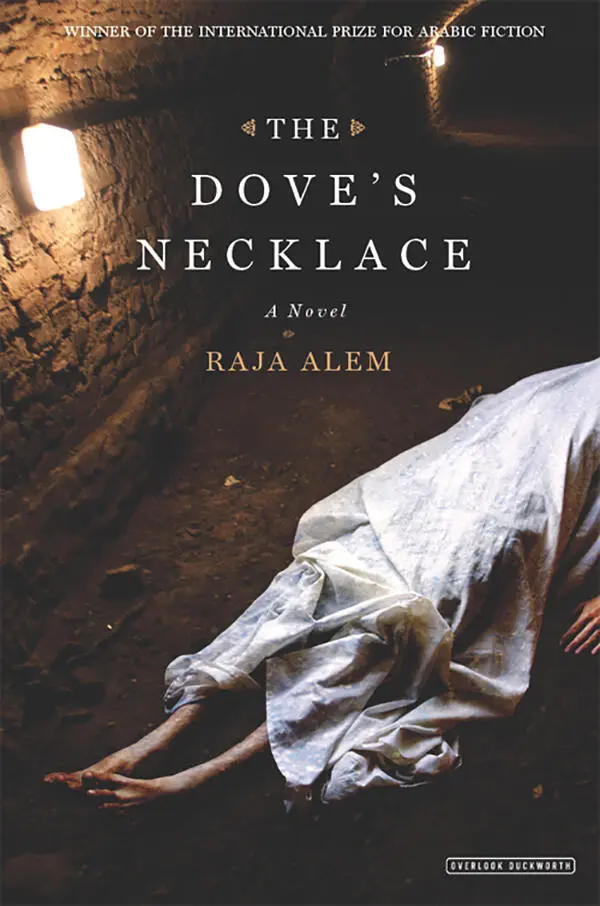
- Название:The Dove's Necklace
- Автор:
- Издательство:The Overlook Press
- Жанр:
- Год:2016
- ISBN:нет данных
- Рейтинг книги:4 / 5. Голосов: 1
-
Избранное:Добавить в избранное
- Отзывы:
-
Ваша оценка:
The Dove's Necklace: краткое содержание, описание и аннотация
Предлагаем к чтению аннотацию, описание, краткое содержание или предисловие (зависит от того, что написал сам автор книги «The Dove's Necklace»). Если вы не нашли необходимую информацию о книге — напишите в комментариях, мы постараемся отыскать её.
Tackling powerful issues with beautiful and evocative writing, Raja Alem reveals a city-and a civilization-at once beholden to brutal customs, and reckoning (uneasily) with new traditions. Told from a variety of perspectives-including that of Abu Al Roos itself-
is a virtuosic work of literature, and an ambitious portrait of a changing city that deserves our attention.
The Dove's Necklace — читать онлайн бесплатно полную книгу (весь текст) целиком
Ниже представлен текст книги, разбитый по страницам. Система сохранения места последней прочитанной страницы, позволяет с удобством читать онлайн бесплатно книгу «The Dove's Necklace», без необходимости каждый раз заново искать на чём Вы остановились. Поставьте закладку, и сможете в любой момент перейти на страницу, на которой закончили чтение.
Интервал:
Закладка:
Even Yusuf’s heart quieted in the presence of those women. The light of the moon kindled the scent of the bed Yusuf was lying on — a mixture of blood and rancid cheap food. Yusuf had abandoned his books and begun working as an errand boy for the nearby kitchens, before submitting to depression, withdrawn and alone in that room. He himself smelled of food; he was too drowning in the intoxication of having discovered that world to bother feeling any guilt for having taken on the personality of his friend the Eunuchs’ Goat and invaded his plastic and cork harem. He was switching roles in my web of despair. That Mu’az always turns the pupils of my eyes back at me, to make me look inside my many heads, exposing faults that I wouldn’t allow one of my heads even a glimpse of. Mu’az was the first to notice that the Eunuchs’ Goat had possessed Yusuf when he interrupted prayers in the mosque and Imam Dawoud confronted him with the Verse of the Throne, which drives away the devil. That dawn, the Imam ordered the devil that had taken over Yusuf’s body to make himself known:
“Which devil are you? What is your name?”
A Satanic voice deep in Yusuf’s chest replied, “I am Salih.” The name literally meant “good.”
“Salih son of whom?”
“Salih till the end …” The answer frustrated them; the imam and the other sheikhs didn’t have a list of devils without expiration dates. Nor did they know what immortal devils like this one were capable of, nor how they could be resisted.
IT WAS PAST MIDNIGHT BY THE TIME NASSER GAVE UP IN DESPAIR AT THE LANE OF Many Heads’ red herrings, the diary’s hallucinations, and Aisha’s schizophrenic emails. Their predestined fates — no, the life decisions they’d made themselves — were an affront to a conservative man like him. He’d never even heard of this job of “DJ” that the boys of the Lane of Many Heads dreamed of becoming; when he Googled it he discovered it was a man who manipulated women’s bodies through music. It was basically like being a pimp. Nasser sensed the mocking eye that had been toying with him and directing his movements since the very beginning of the case. He pushed Aisha’s sleeve deeper underneath his pillow. His anger dissipated and he got up to look in his dresser, not for anything specific, but for any sign that he belonged. What did he know about this world around him? He went through all the trinkets he’d carried with him since he was a child, such as the bullet-adorned leather belt with a dagger sheath on one side. The leather smelled of his grandmother, the scent of banquets on nights gone by. When he looked through his dresser, there was no sign of Nasser, who like his father used to be smart enough to snatch kohl off an eyelid, but just a bunch of his uniforms: six, seven, eight, ten, forty uniforms, two for each year he’d served. He spread them out on the floor of his room. The uniforms started out as thin as the ghosts of a famine and got progressively wider. There was no mistaking the pot-belly that had filled out over the years. The jacket shoulders had begun to slacken around his shoulders like they belonged to someone else. He’d spent more on dry-cleaning these uniforms than he’d spent on his own body. These uniforms were lord of this room, and he was their servant. The bedroom floor looked like a graveyard of soldiers, for forty men in one.
That night the room looked bigger with its wide-open window which paid no attention to the graveyard inside, its corpses each paler than the next. Nasser slept soundly amidst the clamor of the traffic below. He had no idea how many nights he spent in that cemetery of his; he’d lost all sensation. He was conscious only of Aisha’s eyelids stamping their silence over his entire body, and though time passed, he wasn’t aware how many times the sun had risen or set.
He was rescued from between her eyelids by the smell of grilling meat from next door. He realized he was famished; he couldn’t remember when he’d eaten his last meal.
“The wolves of this hunger are howling inside your mind, and it’s making you delirious.” He got up, dragging his feet over to the refrigerator and stood there, completely at a loss. Ever since he’d gone to the morgue, he’d been unable to stand the sight of the refrigerator or the thought of a morsel of food going down his throat. With a shudder, he reached for the tub of date biscuits beside the stove and started robotically stuffing them one after the other into his empty belly. The sugar rushed to his brain, waking him up. Through the haze over his eyes and the windows, he couldn’t tell what time it was, whether night or gloomy dawn. He took out his five bottles of Dunhill cologne, the last five remaining of a dozen he’d bought heavily discounted a year ago from a friend of his who smuggled goods into the country in a suitcase. He poured them down the toilet and flushed, and left the door closed until the sweaty, rank-smelling cloud had faded away.
FROM: Aisha
Message not numbered
Don’t search, ^, for message number 1; we mustn’t write it yet. We’ll leave it for when we’ve stopped speaking and fallen silent so that our words can go on imagining us and waiting for us, impatiently, at the edge of every sigh, so that they can say what we’re not able to express in any language.
I also skipped all the tens when numbering my messages. We’ve left them for the unknown, because we won’t consume everything — we’ll leave something secret. The important thing in our correspondence isn’t the search for freedom or love, but the puzzle. We lean toward it unaware, not translating, not even thinking. We don’t allow our consciousness to break it open, so we can stay clinging to the rope of its amazement, which could be severed at any time by anything, which relinquishes the reins so we can enter. There I find the dream that keeps me awake with thoughts of you, that keeps your dream company, and shares with it this sadness charged by us.
The most beautiful sadness is this moon.
You’re the most beautiful moon.
When the nurse was distracted, you seized the opportunity to whisper to me, “This is our secret …” Of course, you and I have to have a secret. Some kind of feverish sadness, so that we can cling to it.
“Do you give yourself to me in marriage?”
“I give myself to you in marriage.”
I made sure my words could be heard by the two witnesses, who for their part broke out in grins, rather taken aback and desperate not to miss a detail, when I surprised them by adding, “On the condition that I have the right to initiate divorce proceedings.” They applauded in delight, thinking themselves extras in a rehearsal for some comedy on that bright morning.
“Bear witness to this contract before God …” They shook our hands enthusiastically as the sunny garden paths fell silent, and signed our verbal marriage contract with an impromptu violin duet, making the morning seem even more gilded.
“This is my second wife. I’m still married to my other wife as well and she lives in the same city. I’m Harun al-Rashid, the Caliph,” you said, laughing, to shock them and make their performance even friskier.
All along, you were performing that ceremony as a joke. You never did believe me when I told you “all it takes to get married is an offer and an answer in front of two witnesses. A divorced woman like me doesn’t even need a male guardian to be present.”
“God, life is so wonderful without papers! May God strike me dead if I violate this ethereal contract.”
All the people enjoying themselves in the park turned to look when you started shouting, and then you grabbed me and held me so tightly you might have broken a rib, or three, and they grinned encouragingly. I soared on those smiles; even though you didn’t sense any change, I felt like a mountain of sin had been lifted off my neck.
Читать дальшеИнтервал:
Закладка:
Похожие книги на «The Dove's Necklace»
Представляем Вашему вниманию похожие книги на «The Dove's Necklace» списком для выбора. Мы отобрали схожую по названию и смыслу литературу в надежде предоставить читателям больше вариантов отыскать новые, интересные, ещё непрочитанные произведения.









Обсуждение, отзывы о книге «The Dove's Necklace» и просто собственные мнения читателей. Оставьте ваши комментарии, напишите, что Вы думаете о произведении, его смысле или главных героях. Укажите что конкретно понравилось, а что нет, и почему Вы так считаете.