Raja Alem - The Dove's Necklace
Здесь есть возможность читать онлайн «Raja Alem - The Dove's Necklace» весь текст электронной книги совершенно бесплатно (целиком полную версию без сокращений). В некоторых случаях можно слушать аудио, скачать через торрент в формате fb2 и присутствует краткое содержание. Год выпуска: 2016, Издательство: The Overlook Press, Жанр: Современная проза, на английском языке. Описание произведения, (предисловие) а так же отзывы посетителей доступны на портале библиотеки ЛибКат.
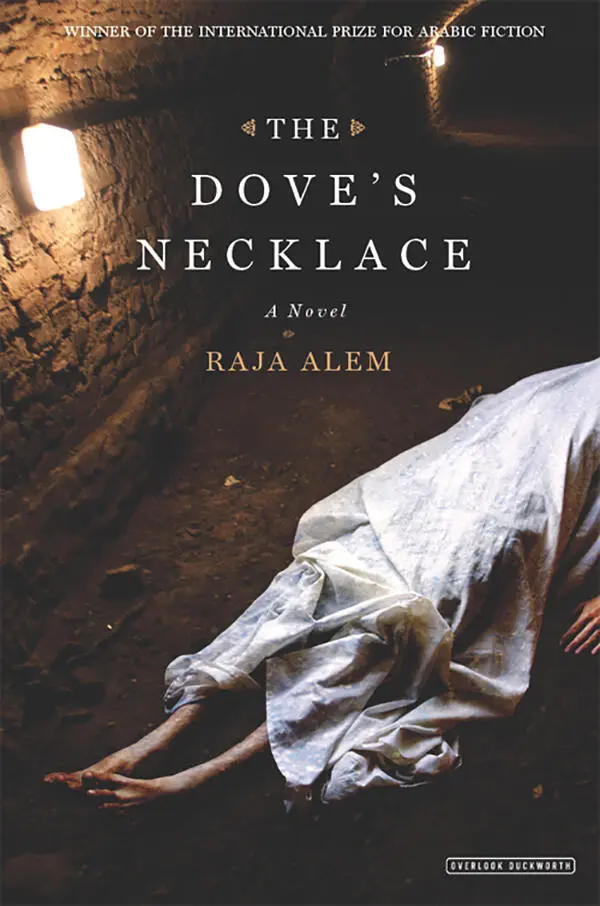
- Название:The Dove's Necklace
- Автор:
- Издательство:The Overlook Press
- Жанр:
- Год:2016
- ISBN:нет данных
- Рейтинг книги:4 / 5. Голосов: 1
-
Избранное:Добавить в избранное
- Отзывы:
-
Ваша оценка:
The Dove's Necklace: краткое содержание, описание и аннотация
Предлагаем к чтению аннотацию, описание, краткое содержание или предисловие (зависит от того, что написал сам автор книги «The Dove's Necklace»). Если вы не нашли необходимую информацию о книге — напишите в комментариях, мы постараемся отыскать её.
Tackling powerful issues with beautiful and evocative writing, Raja Alem reveals a city-and a civilization-at once beholden to brutal customs, and reckoning (uneasily) with new traditions. Told from a variety of perspectives-including that of Abu Al Roos itself-
is a virtuosic work of literature, and an ambitious portrait of a changing city that deserves our attention.
The Dove's Necklace — читать онлайн бесплатно полную книгу (весь текст) целиком
Ниже представлен текст книги, разбитый по страницам. Система сохранения места последней прочитанной страницы, позволяет с удобством читать онлайн бесплатно книгу «The Dove's Necklace», без необходимости каждый раз заново искать на чём Вы остановились. Поставьте закладку, и сможете в любой момент перейти на страницу, на которой закончили чтение.
Интервал:
Закладка:
“Al-Ghatafani’s car!” He drove back down the bridge, into the oncoming traffic, toward the Jeddah exit. He parked his car and got out, zigzagging through the lines of cars. There was no sign of life in the crushed blue metal; the bag of possessions and medicine lay at the man’s feet. The truck driver wasn’t injured but was sitting stunned at the edge of the highway.
Whiteness spread over Nasser’s skull. This was the death or the gloom that had driven him out of the morgue the day before, piling up everywhere around this case, streaming out icily from Aisha’s fingertips.
Roundabout
N ASSER WAS LOOKING THROUGH YUSUF’S DIARY FOR ANYTHING LEADING BACK to Muflih al-Ghatafani when he came across overwrought, preposterous words:
June 5, 2006
I died today.
Without any warning, lighting flashed over the neighborhood and a sandstorm covered the sky when Sheikh Muzahim took Azza over to Mushabbab’s orchard. They married her to him then and there. The registrar and Sheikh Muzahim took their leave as the angels pelted us all with dust.
Damn this diary. Damn this place.
Yusuf
FROM: Aisha.
SUBJECT: Urgent
O God, what’s awaiting Azza in Mushabbab’s beautiful garden? Her father handed her straight over to the son of the Sharifs’ slaves when he saw the colossal amount of money he’d made in the stock market.
Azza followed Sheikh Muzahim without blinking. Or maybe her eyes just got wider. Remember that day you told me, “Don’t pluck your eyebrows. It’ll make your eyes bigger and then they’ll swallow me.”
Without any plucking, and despite the darkness of her eyebrows, Azza’s eyes were wider than all our eyes.
Yusuf limps like a madman up and down the Lane of Many Heads.
Aisha
It was like a bomb had exploded inside Nasser’s head. He couldn’t believe it: Azza had been handed over to marry Mushabbab. Why hadn’t anyone from the neighborhood told him? Something as big as this, why would the neighborhood try to cover it up? Halima, Muzahim, Mu’az, Khalil — none of them had spelled it out for him: Muzahim had agreed to marry Azza to the son of the slaves of the Sharifs. It was a secret. They’d hidden this major event from him, here in these papers, left him to crawl around looking for it all this time, and only told him when they felt like it?
Nasser was gripped by panic. Something had changed, there was no doubt about it. All he had to do was take another look at the case for all the masks to fall, right before his eyes. But right now they were clouded by a comfortable white noise; he wasn’t prepared for this game of pulling off masks.
There was a bitter taste in the back of Nasser’s throat. He took Azza’s marriage as a personal betrayal. He rummaged through letters and diary entries to find out anything else he could about the story.
June 8, 2006
You say, “He covers me.
Not with words, but with my abaya.”
I don’t hear you.
Starting from the bottom of your feet,
the silk of your abaya flutters, brushes against your belly
shivers against the tips of your breasts, the gap between your lips,
finally the silk relaxes over the hair that’s come loose
from your braids.
A naked demon, that’s who Mushabbab is when he lays the silk of the abaya over your nakedness to cover you. The moment your face is covered up, every last drop of my strength and the voice that tortures me with that scene, both dry up.
You’re cursed, Azza. I’m not writing you any more. Go die, and good riddance, from your face to your feet. God has no mercy for you.
Yusuf
Yusuf’s words tumbled over one another in rage:
June 9, 2006
That trivial speck of nothingness of a woman lies and says things like this:
(“At dawn, lying in his arms, I woke up suddenly, burning for you, Yusuf.
If, while sleepwalking, I’d rushed to the doorway of my bedroom, to our old radio, a note waiting for me would have woken me up.
In your old handwriting. But didn’t you say, ‘the handwriting of Zayd ibn Thabit?’
You’d be crazy to stop writing.
Yusuf, if you were to write to me about lying here with him,
‘I read it and then re-read. To bring it to life …’ That’s from the lines you wrote, among whose capers I grew up; they lived for me more than I’ve lived myself.
Who was it who said, ‘Nothing has any taste unless it’s written with your saliva’? Can’t you see my engine runs on your confused, impassioned words? My lips mutter with the pleasure of reading what you’ve written.
At dawn, in his arms, I saw that you, Yusuf, were writing me more than you were writing the world or yourself. I was the page on which you would scrawl out your being. Drafting and revising your attempts, failures, and retries.
I’m your ink, your scribblings.
No matter how hard I tried, Yusuf, Mushabbab wouldn’t be written. This night is bigger than me. You’d have been better off writing it. If it had been you writing me, I’d at least feel pleasure.”)
I’ve put the lies between parentheses.
Yusuf or Azza
Next were some huge scrawls that had been erased:
June 12, 2006
The fourth night.
Should I write her or not?
I can’t decide.
I’ll stop writing so she can die in her sleep.
Yusuf.
This outpouring of naive sentimentality annoyed Nasser. He wanted to know what crime had been cooked up in that disastrous marriage. Nasser could find no other option but to race breathlessly between Aisha and Yusuf, who’d both fallen into a funk. Nasser sensed that Azza’s fall had happened at the same time as the loss of morale that came across in Aisha’s letters; Azza had taken a leap toward Mushabbab while Aisha was planning a cold end.
The alliance between Azza and Mushabbab was the breaking point in this case and any detective worth their salt would have been skeptical about Nasser’s capabilities after seeing how late in the game he’d discovered it. Nasser began to read the diary entries and the letter as one, unbroken text. He came across this page in the diary in a strange hand:
June 15, 2006
Like a falling stone,
It wasn’t in her, but in the well
Lying between the three springs that feed it
And he drinks, not just like a dove a cat or a beast, but also like a plant. Like a stone, with all its pores, with its skin and its heart all at the same time.
It drinks saltiness and the taste of metal, from the ankles upward. Who’s that who can’t be in two places at once?
Crowned with saltiness all the way down to his ankles,
When he was inside her mud, all the jars in his bathroom fell, spilling their mud all over this cosmic flesh.
In this volcanic landscape.
The earth became salty, metallic, centered on his lap whenever he wanted to penetrate to her core.
His body could only respond by collapsing. O God, how they’ve colluded against him: desire and its collapses!
There was no one left in the Lane of Many Heads that didn’t celebrate the news: the devil in the orchard was impotent!
I die and he’s reborn in the same lap. Where whatever’s watered dies.
The Lane of Many Heads had no entertainment so it amused itself with Sheikh Muzahim’s beard, which was led to a Mercedes that took him out of the neighborhood on shady errands, dropping him at offices where men showed him statements from his bank accounts and those of his son-in-law, the descendant of the Sharifs’ slaves, alluding to possible solutions and get-outs; but these meetings soon ended definitively with the nullification of the invalid, impotent contract he’d concluded in the shack in the orchard between his daughter and Mushabbab. They produced a notarized document for him laying it all out.
Читать дальшеИнтервал:
Закладка:
Похожие книги на «The Dove's Necklace»
Представляем Вашему вниманию похожие книги на «The Dove's Necklace» списком для выбора. Мы отобрали схожую по названию и смыслу литературу в надежде предоставить читателям больше вариантов отыскать новые, интересные, ещё непрочитанные произведения.




Обсуждение, отзывы о книге «The Dove's Necklace» и просто собственные мнения читателей. Оставьте ваши комментарии, напишите, что Вы думаете о произведении, его смысле или главных героях. Укажите что конкретно понравилось, а что нет, и почему Вы так считаете.