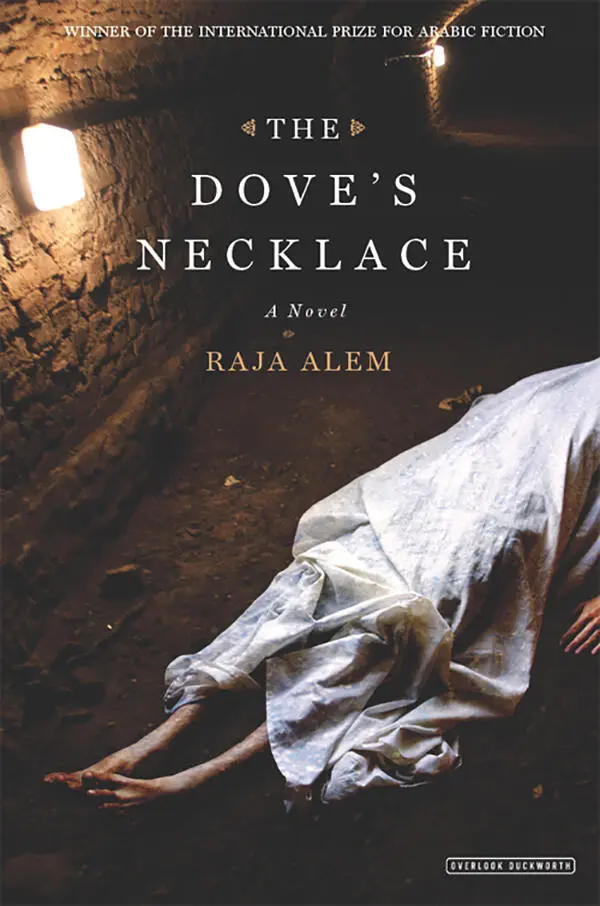
Raja Alem - The Dove's Necklace
Здесь есть возможность читать онлайн «Raja Alem - The Dove's Necklace» весь текст электронной книги совершенно бесплатно (целиком полную версию без сокращений). В некоторых случаях можно слушать аудио, скачать через торрент в формате fb2 и присутствует краткое содержание. Год выпуска: 2016, Издательство: The Overlook Press, Жанр: Современная проза, на английском языке. Описание произведения, (предисловие) а так же отзывы посетителей доступны на портале библиотеки ЛибКат.
- Название:The Dove's Necklace
- Автор:
- Издательство:The Overlook Press
- Жанр:
- Год:2016
- ISBN:нет данных
- Рейтинг книги:4 / 5. Голосов: 1
-
Избранное:Добавить в избранное
- Отзывы:
-
Ваша оценка:
The Dove's Necklace: краткое содержание, описание и аннотация
Предлагаем к чтению аннотацию, описание, краткое содержание или предисловие (зависит от того, что написал сам автор книги «The Dove's Necklace»). Если вы не нашли необходимую информацию о книге — напишите в комментариях, мы постараемся отыскать её.
Tackling powerful issues with beautiful and evocative writing, Raja Alem reveals a city-and a civilization-at once beholden to brutal customs, and reckoning (uneasily) with new traditions. Told from a variety of perspectives-including that of Abu Al Roos itself-
is a virtuosic work of literature, and an ambitious portrait of a changing city that deserves our attention.
The Dove's Necklace — читать онлайн бесплатно полную книгу (весь текст) целиком
Ниже представлен текст книги, разбитый по страницам. Система сохранения места последней прочитанной страницы, позволяет с удобством читать онлайн бесплатно книгу «The Dove's Necklace», без необходимости каждый раз заново искать на чём Вы остановились. Поставьте закладку, и сможете в любой момент перейти на страницу, на которой закончили чтение.
Интервал:
Закладка:
“I’m a child.
Yeah, a child. And I want to play. What do you expect of someone who was born into a little container? Someone who was nursed on her mother’s post-partum depression?
Mushabbab isn’t depraved or evil. He’s a child like me. Yusuf wrote about Mushabbab. He wrote about him until the slave of the sharifs appeared in the flesh like a genie when I was lonely and heavy-hearted. I sleepwalked that night all the way to his garden.
Don’t laugh. Girls were always getting abducted in the stories they told us when we were children. Why do you think that is?
Because the girls of the Lane of Many Heads are born into little containers. The only way they can get out, the only way they can stand in the doorway of their houses and get some fresh air, is magic.
There were times when the secret of my sleepwalking was close to being exposed. At that moment, I’d see fear in the form of agitated camels. Real-life black camels coming toward me, blocking the alley. But I wouldn’t shut my eyes, wouldn’t shield myself. I run straight toward the center of the herd and at the moment of impact everything disappears. My brow sweats and my throat bleeds. The herd grows larger every time and the houses join in, collapsing as I walk past, and I know that one day they will crushme without mercy.
I ignored the rush of blood and sweat until I made it to the orchard gate and pushed it open with both hands.
As soon as I took off my shoes and buried my feet in the sand, I opened up on the inside like a rose. Even my scent changed. There was a burning down the length of my back and between my breasts. I don’t know how to describe it to you. Mushabbab calls it “the smell of water breaking.” Like all men, Mushabbab is naive. How would he know what it smells like? I, on the other hand, can sense the chemical effects it has. It’s still there when I wake up and for days after. It’s like a combination of genie hair and the scent of Arabian jasmine.
Do you know how thin and cottony pollen can be? If one were to take hold of me, I’d turn into dust.
I walk around in circles in the orchard while Mushabbab laughs. Aisha, you don’t know the Azza I discovered in the orchard. My limbs are longer and more flexible. My smile is wider, my eyes are bigger. The Azza whose eye broke her out of the little container knows how to flirt and talk in ways that you won’t even find in those books of yours that scare me so.
The orchard was always full of small things. It’s as if they’ve known you since you were born, as if you can travel backward through time with them. Whenever I went there in the evenings, I found little treasures worth stopping for. One time there was an instrument from Basra, a hammered dulcimer inlaid with mother of pearl. It had precision tuning pins that gave the notes a deeper tone and a longer resonance, one string for each note. When I tried playing it with the two hammers, the smooth, ringing sound that rose up came from those passions that I don’t dare to face.
One time, I went in and found the sitting area covered in piles of books that Mushabbab was in the middle of organizing, dividing them up between the shelves on the wall and the shelves beneath the seats. He hid the copies that were nicer and older, and replaced them with copies that were more run of the mill. Mushabbab’s passion for hiding things drove me insane. I always made fun of him for it, but he didn’t care. For nights on end, the amulet that I’d spied lay there stuck between books in the shelf beneath his stand. I examined it stealthily: it was in the shape of a half moon and it was made of pure silver. It was engraved with intersecting pleas for help shaped like little amulets, which reminded me of my mother Halima’s one and only bracelet. She never wore it, of course, rather she hung it proudly on her bed; it was the only gift her husband had given her. The Jews of Yemen had them made to mimic the moon-shaped birthmark on the palms of Solomon’s daughters, which symbolized the moon under which they’d been born.
The amulet didn’t hold our attention for long. Spring brought the inescapable pandemonium of clogs: some decorated with shells, others with pearls, still others with brocaded Indian fabric, and there were even some made out of fragrant sandalwood. The women of Mecca wore their clogs in their bathrooms and on the roofs of their houses, clicking and clacking wherever they went. The night they arrived, we moved the Persian carpet in the sitting area out of the way so Mushabbab and I could dance on the bare floor. We experimented with every type of tap-dancing imaginable. Dawn snuck up on us that night, as we tap-danced lightly on our feet, until I finally realized just how long I’d been gone and knew that I was in deep trouble. Whoever goes to Mushabbab’s orchard is transported into a dream-state; it’s as though it’s one of the dreaming stations par excellence.
Things were always appearing and disappearing there, but I never asked any questions. He didn’t used to rescue me with any answers either. Where does he get all this detritus? Where does he go when he leaves? Sometimes I would come across patches in the dirt in the orchard where bodies had lain recently, and I could never imagine the orchard in deepest night, full of people who’d taken shelter there, waiting for sunrise so they could earn their living. At dawn, one time, I’ll hide on one of their collars and see where it is they go.
Those faces crop up and disappear as if by magic; Mushabbab and I are the only ones who hang out there. Aisha, if only you could see the place. From the outside, the orchard looks constrained by the fence and time, but on the inside, there’s no fence, no time. You get lost whether you’re going forward or backward. It looks to me like a piece of silver that’s fallen from the sky. I knew that my game had to end where the trees began; one step farther and the game would no longer be a game. I didn’t dare cross over alone. Mushabbab had to wait for me at the entrance to one of the paths or he had to escort me somewhere and bring me back as well. He would always come fetch me in time so I could get back home before dawn. And there was always that same smell. Smelling like the blood of a slaughtered animal, sacrificed there by an old man on the old ground that was still there in the orchard. A scream I still can’t perceive.
Tonight I went to the orchard unexpectedly, where I encountered the guest, who looked dangerous, what with the bodyguards he had waiting for him at the end of the alley. I darted past, but they spotted me and were about to follow after me before I reached Mushabbab. He was in a state. He hid me off to the side of the orchard as he said goodbye to his visitor.
I waited before I headed back to him. Gathering my courage, I headed for an alleyway that led northeast; at the end of it there was a thicket, dried up, growing wild. At one point, I was stopped by a hand that stretched to cover my entire face. I could feel the hand even if I couldn’t see it. But I didn’t resist. I peeked through the branches to see three white bodies, naked, talking in a huddle. I felt my vitality goad me as I stood there. I was worried that if I moved backward or forward, they would be on to me. I let out a sudden gasp when I felt Mushabbab’s lips rub against my braids.
You think I’m overdoing it? I could feel hot lips against the end of my braids; I smelled fire. Mushabbab led me back. When we got to the sitting room, he sat me down in a Louis XIV armchair he’d chosen for me at an antiques auction, which he always kept in the same exact place in the courtyard facing the sitting area. Only then did he settle my curiosity. “What a wild imagination you’ve got! What you saw was nothing more than three column capitals. The same columns that were left forgotten in the colonnades of the Great Mosque after they were removed from the Hanafi corner and the Well of Zamzam. They disappeared completely, and we had no idea where to look for them even. Then one day a friend of mine who’s got some pull brought them here.” To assuage my doubts even further, he said, “The most complete one is the columnthat loomed over the Well of Zamzam, its oil lamp lighting the pilgrimage rituals for centuries. Memories of the faces of believers and a faith unlike any humans can conceive of are alive inside that column’s memory.”
Читать дальшеИнтервал:
Закладка:
Похожие книги на «The Dove's Necklace»
Представляем Вашему вниманию похожие книги на «The Dove's Necklace» списком для выбора. Мы отобрали схожую по названию и смыслу литературу в надежде предоставить читателям больше вариантов отыскать новые, интересные, ещё непрочитанные произведения.



Обсуждение, отзывы о книге «The Dove's Necklace» и просто собственные мнения читателей. Оставьте ваши комментарии, напишите, что Вы думаете о произведении, его смысле или главных героях. Укажите что конкретно понравилось, а что нет, и почему Вы так считаете.