Raja Alem - The Dove's Necklace
Здесь есть возможность читать онлайн «Raja Alem - The Dove's Necklace» весь текст электронной книги совершенно бесплатно (целиком полную версию без сокращений). В некоторых случаях можно слушать аудио, скачать через торрент в формате fb2 и присутствует краткое содержание. Год выпуска: 2016, Издательство: The Overlook Press, Жанр: Современная проза, на английском языке. Описание произведения, (предисловие) а так же отзывы посетителей доступны на портале библиотеки ЛибКат.
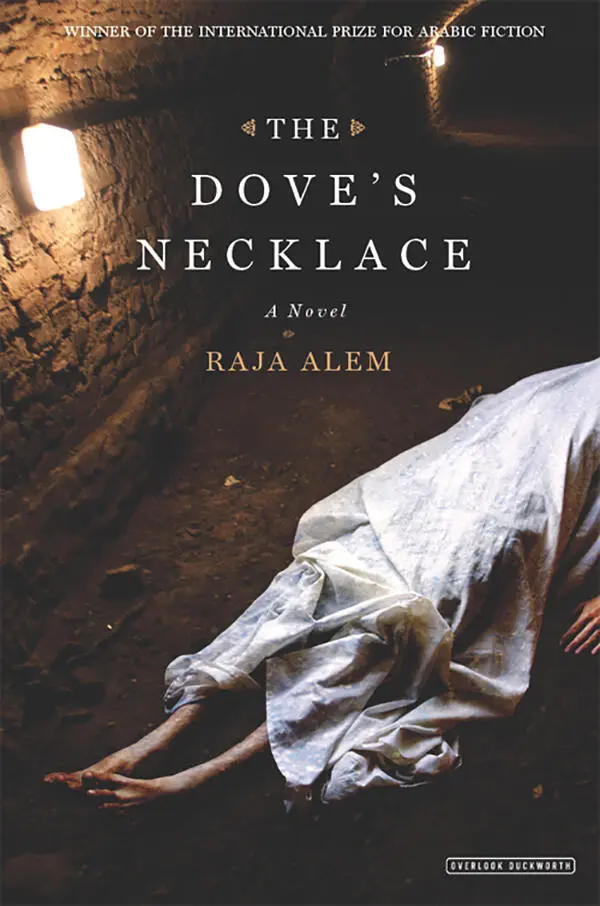
- Название:The Dove's Necklace
- Автор:
- Издательство:The Overlook Press
- Жанр:
- Год:2016
- ISBN:нет данных
- Рейтинг книги:4 / 5. Голосов: 1
-
Избранное:Добавить в избранное
- Отзывы:
-
Ваша оценка:
The Dove's Necklace: краткое содержание, описание и аннотация
Предлагаем к чтению аннотацию, описание, краткое содержание или предисловие (зависит от того, что написал сам автор книги «The Dove's Necklace»). Если вы не нашли необходимую информацию о книге — напишите в комментариях, мы постараемся отыскать её.
Tackling powerful issues with beautiful and evocative writing, Raja Alem reveals a city-and a civilization-at once beholden to brutal customs, and reckoning (uneasily) with new traditions. Told from a variety of perspectives-including that of Abu Al Roos itself-
is a virtuosic work of literature, and an ambitious portrait of a changing city that deserves our attention.
The Dove's Necklace — читать онлайн бесплатно полную книгу (весь текст) целиком
Ниже представлен текст книги, разбитый по страницам. Система сохранения места последней прочитанной страницы, позволяет с удобством читать онлайн бесплатно книгу «The Dove's Necklace», без необходимости каждый раз заново искать на чём Вы остановились. Поставьте закладку, и сможете в любой момент перейти на страницу, на которой закончили чтение.
Интервал:
Закладка:
Mu’az stopped Yusuf there, under the canopy where the stairs led up to the roof, as the second call to noon prayer exploded like a fountain from dozens of minarets below them. It was as if the roof was being lifted aloft by the voices. Mu’az wished Yusuf could see Marie as he’d seen her that day, when he and Mushabbab had followed the young Pakistani to the rooftop. Standing there at the top of the staircase, he was bewitched by the woman reclining with her legs crossed. She was perhaps in her sixties, though she could easily have been in her forties, and the adolescent Mu’az didn’t notice the flabbiness around her knees — only the shimmer of the silk stockings hugging her bare calves, which stood like two of heaven’s white-sugar columns. He had been startled for a moment, astonished to see a woman like her within the circle of the Haram Mosque. At the end of the roof the half-open door caught his eye; a washing line hung inside the darkroom beyond. He made out freshly developed photographs pegged up to dry on the line, but he couldn’t tell when or where they were taken.
He stood with Yusuf in front of a portrait of the lady of the house and introduced him to her, as Mushabbab had done with him. “Marie,” he said, with the same mix of deference and embarrassment that a real, living woman would occasion. “Mr. Lababidi’s wife. Al-Lababidi was the first Meccan photographer. He was taking photos from the beginning of the twentieth century right up until God took him away when he was nearly a hundred. That was in 1979, the year Juhayman al-Otaybi seized the Haram Mosque. Al-Lababidi left his photographic archive of Mecca to his wife.” Yusuf had no idea why Mushabbab should have been visiting this lady — Mu’az hadn’t understood either — an interloper among the women of Mecca with her Christian name and religion, which she gave up in exchange for the right to accompany her husband into the Muslim-only Haram compound. In fact, the only way she had actually entered was through the telescopic lens of the tripod-mounted camera that stood on their lofty rooftop next to the citadel, shaded by the minaret of the Turkish baths.
Al-Lababidi had met the fifteen-year-old Marie in Beirut when he was in his sixties. The girl born to a soundtrack of Hiroshima’s echoes had fallen inevitably, definitively in love with this Meccan born at the dawn of the twentieth century who had spent years moving back and forth with his merchant-fighter father between Syria and the Hijaz, his plans put on hold by two world wars that ended up turning him into a pro at photography, life, and faith in a soon-to-appear Hidden Imam who would end all wars and turn the deserts into Eden.
Mu’az was lost a while in the memories of his infatuation with the Marie he had seen the very first time he stood in this spot. He was fresh from the neighborhood back then, and his adolescent gaze just couldn’t put together all the contradictions, all the strokes of passion, struggle, and transformation that had gone into sculpting this female idol. He trembled involuntarily when she stood up in a single fluid movement, thinking to himself that if he’d taken her photo just then she would have appeared as a droplet of water falling from her bijou ruched muslin hat.
Marie walked ahead of them to lead the way downstairs into her vast old house, taking them into sitting room after splendid sitting room, hidden store rooms and cozy parlors. Every time she led them down to the next floor, the servant scurried ahead, unlocking high-ceilinged reception rooms where sculpted doves crowned each arch and flanked tall mirrors that shunned reflection of the present and instead revealed a hundred years of the Holy City. Having stood empty since the beginning of this century, the three-hundred-year-old house was now inhabited not by people but by black-and-white photographs of all shapes and sizes that covered every wall, from the floor right up to the gilded cornicing of calligraphied poetry.
Mu’az wished he could draw Marie for Yusuf, not merely as she was but how she looked in motion; wished he could create a film so that she could walk before Yusuf, leading him as she’d once led Mu’az. On the upper floors he and Mushabbab had walked, as Yusuf was doing now, past photo after photo of the courtyard of the Holy Mosque where the pilgrims walked circles around the Kaaba: scenes of the whirlpool of human movement circumambulating the courtyard taken throughout the decades, showing infinite numbers of tiny dots sinking to kiss the black stone or prostrating en masse against the Hateem Wall or swaying, supplicating in front of the multazam or washing in foaming buckets of water from the Well of Zamzam or reciting their night prayers. The pattern was repeated and varied endlessly across the years. The thrill of seeing the old courtyard like this, when he’d thought it had been lost forever, had shaken him violently, just as it shook Yusuf now.
On the next floor down, Mu’az waited at the door of a parlor, as he remembered Mushabbab had done, to allow Yusuf a few moments alone with some rare photographs of the architecture of the Haram Mosque taken at the beginning of the twentieth century, long before all the expansion and demolition projects. They showed the green-domed Well of Zamzam, the Gate of the Shayba Tribe, the spot where Abraham had stood, where Imam al-Shafi’i delivered his classes, the Hateem Wall around the Hijr of Ishmael, the outposts of the Hanafi, Maliki, and Hanbali schools of law, and the surrounding buildings that jostled for a view across the mosque’s central courtyard: the Ottoman governmental palace known as the Hamidiya, the triple-terraced Ajyad Fortress with its rear towers, and the Vali’s office with its twin minarets and three domes.
On the next floor down, Yusuf found photographs of Mecca and stepped forward to mingle with the people walking through its ancient neighborhoods: Mount Turk, Mount Hindi, the Sulaymaniya quarter where the Afghans lived, the Moroccans’ Alley, the Bukharans’ Alley, and the settlements of the Africans, the Jawanese, the Kurds, the Sindhis, the Syrians, the Yemenis and the Hadramawtis. A whole maze of alleys like the Lane of Many Heads, overflowing with faces with which Yusuf and Mu’az no longer crossed paths as they went about their daily business: black, white, and narrow-eyed children playing barefoot in the street, slave musicians beating drums and dancing with rattles, hoof castanets, and wood blocks, Indian merchants in black cloaks over white robes haggling with Turkish officers whose belts held inlaid swords and whose pedigree camels were adorned with silver brocade sashes, and madly grinning Sharif children — those descended from the Prophet, peace be upon him — in short gold- and silver-belted jubbahs that showed their booted feet and wrapped cloth turbans, similar to Ottoman fezzes, studded with starry pearls. The sons of the Vali and other dignitaries were more serious, wearing cloaks cinched with cartridge belts bearing jeweled daggers. Then there were the children of the Shayba Tribe, the custodians of the Kaaba, who exuded nobility and splendor in their brocade-trimmed robes, leaf-embroidered jubbahs, and gold egals. There were muezzins who traced their ancestry back to Ibn Zubayr, merchants with their Circassian slaves, women reclining in their gardens smoking hookahs or hurrying down dusty streets, wearing brocade-striped belts and airy, white embroidered burkas that framed their eyes with gleaming gold coins. There were Meccan brides drowning in layer after layer of pearls, and pilgrims from India, Baghdad, Kabul, Bahrain, Melaka, the Bacan Islands, Sambas, Jawa, Sumatra, and Zanzibar. Bukharan dervishes, in their wide-belted short coats and the fur-trimmed conical hats they wore even in the sweltering Meccan summer, held staffs and jangled bunches of keys that — so they claimed — unlocked paths and destinies before them wherever they went. Knowledge seekers busked their way from Yemen to the Great Mosque, drumming and dancing to earn their keep while they stayed in Mecca and were educated in religion.
Читать дальшеИнтервал:
Закладка:
Похожие книги на «The Dove's Necklace»
Представляем Вашему вниманию похожие книги на «The Dove's Necklace» списком для выбора. Мы отобрали схожую по названию и смыслу литературу в надежде предоставить читателям больше вариантов отыскать новые, интересные, ещё непрочитанные произведения.







Обсуждение, отзывы о книге «The Dove's Necklace» и просто собственные мнения читателей. Оставьте ваши комментарии, напишите, что Вы думаете о произведении, его смысле или главных героях. Укажите что конкретно понравилось, а что нет, и почему Вы так считаете.