Rupert Thomson - Dreams of Leaving
Здесь есть возможность читать онлайн «Rupert Thomson - Dreams of Leaving» весь текст электронной книги совершенно бесплатно (целиком полную версию без сокращений). В некоторых случаях можно слушать аудио, скачать через торрент в формате fb2 и присутствует краткое содержание. Год выпуска: 2012, Издательство: Bloomsbury Paperbacks, Жанр: Современная проза, на английском языке. Описание произведения, (предисловие) а так же отзывы посетителей доступны на портале библиотеки ЛибКат.
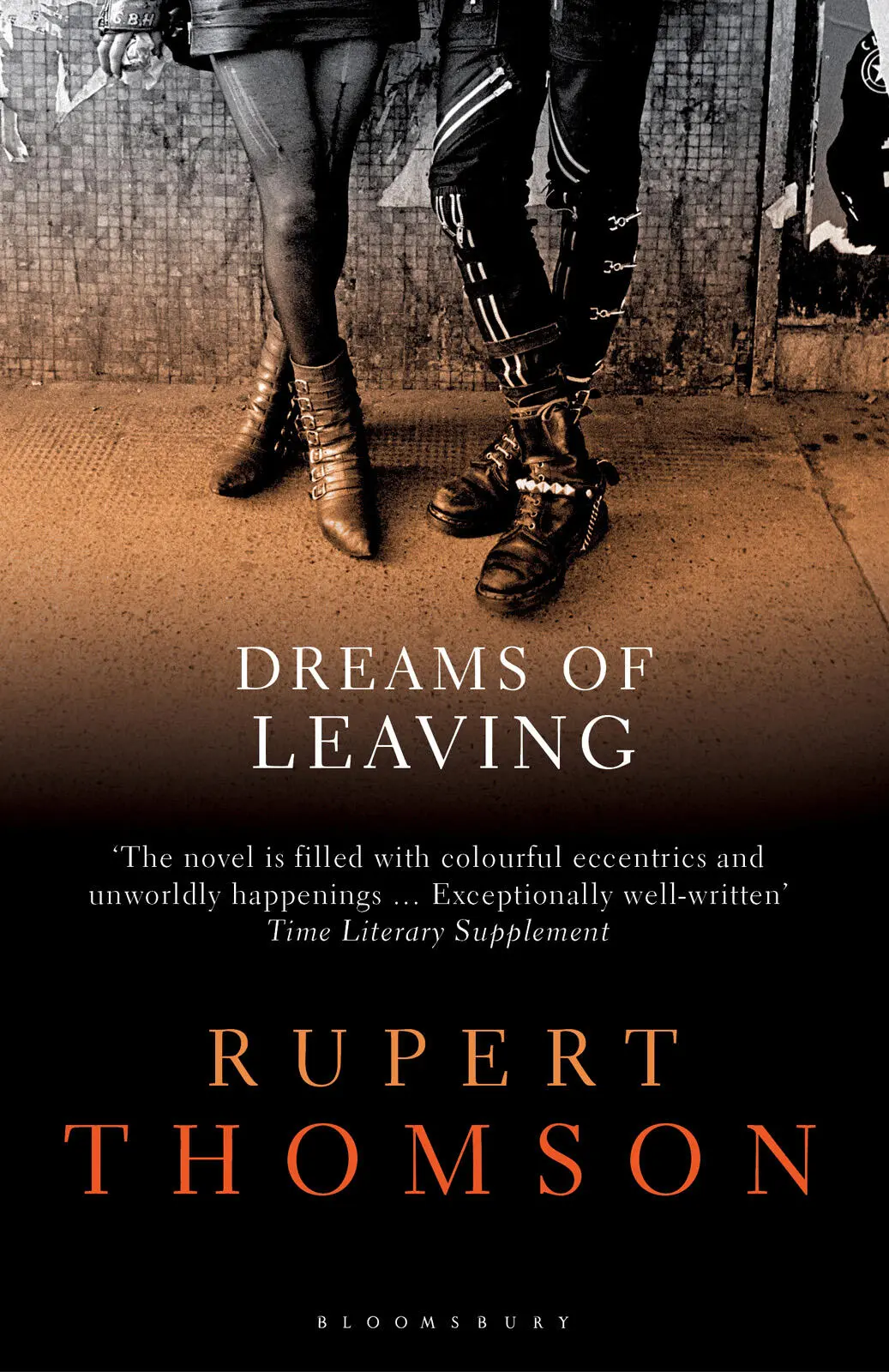
- Название:Dreams of Leaving
- Автор:
- Издательство:Bloomsbury Paperbacks
- Жанр:
- Год:2012
- ISBN:нет данных
- Рейтинг книги:4 / 5. Голосов: 1
-
Избранное:Добавить в избранное
- Отзывы:
-
Ваша оценка:
Dreams of Leaving: краткое содержание, описание и аннотация
Предлагаем к чтению аннотацию, описание, краткое содержание или предисловие (зависит от того, что написал сам автор книги «Dreams of Leaving»). Если вы не нашли необходимую информацию о книге — напишите в комментариях, мы постараемся отыскать её.
Dreams of Leaving — читать онлайн бесплатно полную книгу (весь текст) целиком
Ниже представлен текст книги, разбитый по страницам. Система сохранения места последней прочитанной страницы, позволяет с удобством читать онлайн бесплатно книгу «Dreams of Leaving», без необходимости каждый раз заново искать на чём Вы остановились. Поставьте закладку, и сможете в любой момент перейти на страницу, на которой закончили чтение.
Интервал:
Закладка:
‘Cheers, guv.’ The driver leaned across and looked up at Peach. Light skated off the thick lenses of his glasses. His teeth angled back into his mouth like a shark’s. ‘You ought to slow down a bit, man your age. You’ll kill yourself. Take my word for it.’
Peach promised to take things easier in the future. It was a promise he intended to keep.
He caught the train with two minutes to spare.
He shared the carriage with a soldier, unshaven, hollow-cheeked, smoking. Just the two of them. Saturday night, Peach remembered. Not many people left the city on Saturday night.
The train shifted tracks on its way out of the station. A sound like knives being ground. Once over the bridge it gathered speed, shedding the lights of the city the way a meteor sheds sparks. The soldier slept, using his kit-bag as a pillow.
At Haywards Heath Peach climbed out. He had to wait twenty-five minutes on the draughty platform.
He sat on a bench and gazed at the initials, the messages, the obscenities, that had been carved into the thick green paint.
He stared into the darkness where the silver rails met. Sometimes the coloured lights of the fun-fair whirled through his mind like bright cars in a nightmare.
The local train stopped at every station on the line. This time he was alone in the carriage.
At 11.22 he handed his ticket to a yawning guard and walked down a long flight of wooden steps to the car-park. A breeze lifted and dropped the leaves of a tree, and he thought of the girl with the blonde hair. His bicycle lay where he had left it. He hauled it back up the mud bank, a twig twanging in the spokes. He switched on the front and rear lights, swung himself on to the saddle, and rode away.
Trees built a dark cathedral over the road. The moon slid out from behind a cloud and the gaps between branches turned into windows. Hedges rustled like a priest’s vestments. Birds mumbled in the undergrowth. The air was cool, peaceful, sharp with sap. Peach pedalled slowly, his left leg aching. It was almost as if the day had never happened. He was conscious of moving from a garish dream into calm familiar reality.
He approached the village from the south-west. He caught a glimpse of the lights of Bunt across the fields to the right. He passed the phone-box the brigadier had used in 1945 after Tommy Dane’s bomb blew up. Shortly after crossing the boundary into New Egypt he was blinded by the beam of a torch.
‘Oh, sorry, Chief Inspector,’ came a woman’s voice. ‘I didn’t realise it was you.’
When his eyes readjusted Peach recognised PC Wilmott and, behind her, helmet askew, the excitable Marlpit.
‘Not at all,’ he said, dismounting, ‘not at all. Very glad to see you operating with such efficiency at this time of night.’
Wilmott, a modest woman, ducked her head. Marlpit sucked in a string of saliva.
Peach smiled down. ‘Anything to report?’
‘Nothing, sir.’ Wilmott tilted the shallow dish of her face so that it filled with moonlight. ‘A very quiet night.’
Peach inhaled a deep lungful of village air. ‘A glorious night too, if I may say so.’
The two constables murmured their agreement.
‘Well,’ and Peach climbed astride his bicycle, ‘I should be off home. Mrs Peach will be getting worried, no doubt.’ He smiled again. ‘Good night to you both.’
‘Good night,’ the constables chorused.
Peach had hoped to slip back into the village unseen, but now he thought about it he realised it really didn’t matter. As Chief Inspector he was above the law, beyond suspicion. He explained his movements to no one. Like God he moved in mysterious ways. There were any number of reasons why he might have been riding a bicycle along the boundary at midnight. He might have been putting in a surprise appearance, as generals do, to boost morale. He might have been testing the alertness of his night patrols. He might simply have been taking the air. Rather pleased with his improvisations, he rode on into New Egypt. He forked right at the village green and in less than five minutes he was opening the front door of the old vicarage.
‘Hilda, I’m home.’
There was no reply.
‘Hilda?’
He walked into the lounge and found his wife asleep in front of a flickering television. He rested a hand on her shoulder. ‘I’m back.’
Hilda’s eyelids slid upwards as if she had only pretended to be dozing. ‘I was worried about you,’ she said.
‘There’s nothing to worry about.’
‘But your trousers — ’
He glanced down. His trouser-leg had torn just below the knee. Blood had soaked through. ‘Oh, yes. I fell off my bicycle. Stupid of me.’ He looked appropriately sheepish.
‘Oh, John. But how did everything go?’
‘Very well. Very well indeed, actually. I’m feeling rather tired, though.’
‘Poor dear. I don’t know why you take it into your head to do these things. It’s quite unnecessary, I’m sure. And you know it only exhausts you.’ In humouring her husband without ever quite understanding him, in her light-hearted approach to his incomprehensibility, in her ignorance, Hilda sometimes touched on the truth.
He smiled down at her. He wished he could describe his adventures to her — the cafés and hotels, the trains, the famous buildings. He wished he could tell her about Madame Zola, the world’s smallest man, the Asian boy, the blonde girl (on second thoughts, no, not the blonde girl), Terence the landlord, the black nightclub-owner and his seven-foot sidekick. But these were stories he could share with no one. Not even his wife.
‘You’re right,’ he sighed. ‘I’m going to have a hot bath and go straight to bed.’
He kissed the top of her head where the grey curls were beginning to wear thin, then limped across the room, pausing by the door to say, ‘It’s nice to be home, dear.’
Injury Time
The shot orange of the street-lamps bled through the fog, stained the rain on the pavement, died in the white neon arms that reached out from the nightclub as Moses walked up, but the size of the man blocking the open doorway was no trick of the light. The man had rolled the sleeves of his white shirt back to his elbows, and skulls and anacondas tangled on his forearms. Moses had never seen such big tattoos, mainly because he had never seen such big arms. And the face. Its swollen pallor stopped him cold. The man had drinker’s eyelids, puffy and hard, as if pumped full of silicon; they reduced the eyes beneath to mean glittery slits. His hair, scraped back from his forehead, slithered down over his collar in dark greasy coils. His sideburns bristled like wire wool. A giant gold hoop earring about three inches in diameter swung from his left ear. It was his one visible affectation. Moses thought it very unlikely that anyone had ever teased him about his earring. He knew from his own experience that big people sometimes get picked on by smaller people who want to prove something, but big was too small a word for this man, and nobody in their right mind would have picked on him. He was so big that there wasn’t a word big enough to describe how big he was. So when he told Moses to hold it, Moses held it.
‘I’m,’ he gulped, ‘I’m looking for Elliot. I’m a friend of his. I live up there.’
He pointed to his kitchen window on the fourth floor, but the man just stared at his hand.
Disconcerting.
After a long moment, the man’s stare shifted from his hand to his face. So heavy, this stare, that it almost had to be winched. Then the massive head tipped sideways and he bellowed, ‘Mr Frazer?’
So that was Elliot’s surname. Probably an alias, though, knowing (not knowing) Elliot. Elliot appeared in the doorway. His head barely reached the man’s shoulder.
Читать дальшеИнтервал:
Закладка:
Похожие книги на «Dreams of Leaving»
Представляем Вашему вниманию похожие книги на «Dreams of Leaving» списком для выбора. Мы отобрали схожую по названию и смыслу литературу в надежде предоставить читателям больше вариантов отыскать новые, интересные, ещё непрочитанные произведения.







Обсуждение, отзывы о книге «Dreams of Leaving» и просто собственные мнения читателей. Оставьте ваши комментарии, напишите, что Вы думаете о произведении, его смысле или главных героях. Укажите что конкретно понравилось, а что нет, и почему Вы так считаете.