Stephen Dixon - His Wife Leaves Him
Здесь есть возможность читать онлайн «Stephen Dixon - His Wife Leaves Him» весь текст электронной книги совершенно бесплатно (целиком полную версию без сокращений). В некоторых случаях можно слушать аудио, скачать через торрент в формате fb2 и присутствует краткое содержание. Год выпуска: 2013, Издательство: Fantagraphics, Жанр: Современная проза, на английском языке. Описание произведения, (предисловие) а так же отзывы посетителей доступны на портале библиотеки ЛибКат.
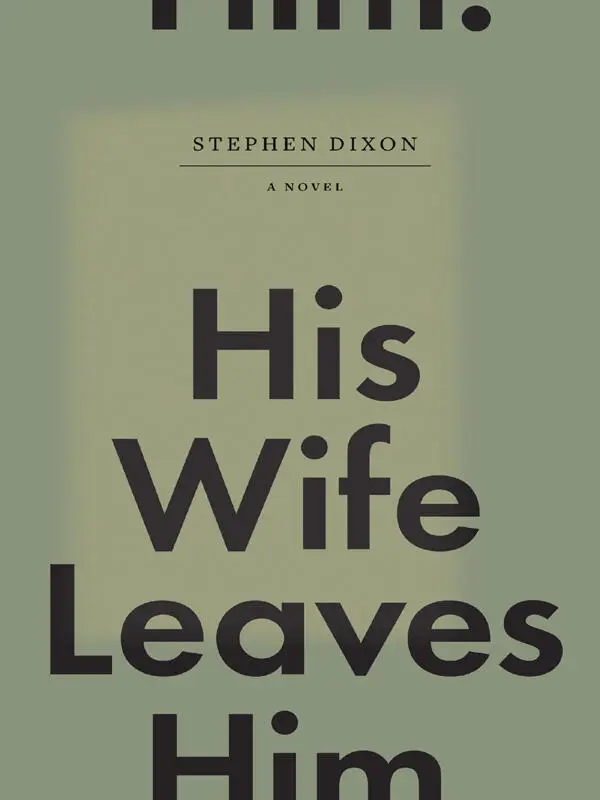
- Название:His Wife Leaves Him
- Автор:
- Издательство:Fantagraphics
- Жанр:
- Год:2013
- ISBN:нет данных
- Рейтинг книги:4 / 5. Голосов: 1
-
Избранное:Добавить в избранное
- Отзывы:
-
Ваша оценка:
His Wife Leaves Him: краткое содержание, описание и аннотация
Предлагаем к чтению аннотацию, описание, краткое содержание или предисловие (зависит от того, что написал сам автор книги «His Wife Leaves Him»). Если вы не нашли необходимую информацию о книге — напишите в комментариях, мы постараемся отыскать её.
, a long, intimate exploration of the interior life of a husband who has lost his wife.
is as achingly simple as its title: A man, Martin, thinks about the loss of his wife, Gwen. In Dixon’s hands, however, this straightforward premise becomes a work of such complexity that it no longer appears to be words on pages so much as life itself. Dixon, like all great writers, captures consciousness. Stories matter here, and the writer understands how people tell them and why they go on retelling them, for stories, finally, may be all that Martin has of Gwen. Reminders of their shared past, some painful, some hilarious, others blissful and sensual, appear and reappear in the present. Stories made from memories merge with dreams of an impossible future they’ll never get to share. Memories and details grow fuzzy, get corrected, and then wriggle away, out of reach again. Martin holds all these stories dear. They leaven grief so that he may again experience some joy. Story by story then, he accounts for himself, good and bad, moments of grace, occasions for disappointment, promises and arguments. From these things are their lives made. In
, Stephen Dixon has achieved nothing short of the resurrection of a life through words. When asked to describe his latest work, the author said that “it’s about a bunch of nouns: love, guilt, sickness, death, remorse, loss, family, matrimony, sex, children, parenting, aging, mistakes, incidents, minutiae, birth, music, writing, jobs, affairs, memory, remembering, reminiscences, forgetting, repression, dreams, reverie, nightmares, meeting, dating, conceiving, imagining, delaying, loving.”
is Dixon’s most important and ambitious novel, his tenderest and funniest writing to date, and the stylistic and thematic summation of his writing life.
His Wife Leaves Him — читать онлайн бесплатно полную книгу (весь текст) целиком
Ниже представлен текст книги, разбитый по страницам. Система сохранения места последней прочитанной страницы, позволяет с удобством читать онлайн бесплатно книгу «His Wife Leaves Him», без необходимости каждый раз заново искать на чём Вы остановились. Поставьте закладку, и сможете в любой момент перейти на страницу, на которой закончили чтение.
Интервал:
Закладка:
He was in his study in their Baltimore apartment. They also used it as a storage room. It had no door, just a door-sized space to walk through. He’s not being clear because it’s not easy to picture. To get in and out of this small room, which once could have been the maid’s room in this big apartment — three bedrooms, separate living and dining rooms, large kitchen leading to his study — you walked through an opening the size and shape of a door. There was probably once a real door there — in fact, he knows it, since the marks where its hinges and screws had been were still on the jamb — but there wasn’t one now to open and close; just an open space. Oh, he gives up. Why can’t he come even close to describing it? Maybe not enough sleep. Gwen knocked on the wall outside his room, or maybe the jamb. He was typing, his back to her, and was startled by the noise. “I’m sorry,” she said; “didn’t mean to scare you. I have some good news that I don’t think you’ll entirely like. I just got a call—” “The phone rang?” he said. “I was so absorbed in my work I didn’t even hear it.” “Am I disturbing you then? I can tell you later,” and he said “No, go on. You got a call from whom?” “Someone at the NEA. She said I got a fellowship in translation.” “Oh, my goodness,” he said, “that’s great,” and stood up, almost knocking over his chair as he did, and went over to her and hugged her. “Jesus, you really did it. I’m so happy for you. But why would you think—” “Because you didn’t get the one you applied for.” “How do you know?” and she said “I asked the person who called me — an official there — if my husband, who also applied for one this year, got it in fiction. She checked the list of this year’s winners in everything, said she didn’t think she was supposed to be doing this — revealing other names — and your name wasn’t on it.” “So what?” he said. “I love it that you got one. You deserve it.” “You deserve one to. And you’ve applied five years straight, or something, while I only applied this once and mostly because you urged me to. I’m sure I got it because so few translators apply. And it could be they don’t give it the same year to husband and wife applicants, even if they’re in different fields, and if I hadn’t got mine, you would have got one,” and he said “Nonsense. How would they even know we’re married? We’ve different surnames.” “But the same address and apartment number.” “I’m sure they don’t look at the addresses very carefully,” and she said “They do. What state the applicant’s from and what city. I heard they try to spread the fellowships around the country so no state or city seems favored.” “Please,” he said, “you got it because you earned it, and the panel of judges for translations was probably the most selective one, since they really had to know what they were doing.” “I wanted you to get it more than I,” and he said “Same for me with you. But I get lots of things. Nothing as big as an NEA yet, but I’m in a field where more things are given for it than for translation. I’ll just apply again, that’s all. My sweetheart, I’m so proud of you, and it’s so much money. Baby asleep?” and she said “Yes.” “Let’s get her up and tell her.” “No, let her sleep.” “You’re so modest.” “And you can be so silly sometimes.” “Should we celebrate with a glass of wine?” and she said “Too early. I’m still working.” “The news of the fellowship doesn’t stop you for even a few hours?” and she said “This is for school.” “Then dinner tonight at a good restaurant and with good wine.” “No, I’ve already prepared dinner. You’re being very nice about it, Martin.” “You still don’t know how happy I am for you?” “You’re not even a little bit jealous or bitter?” and he said “What a thing to say.”
~ ~ ~
Then there was the time — he might even have put it in one of his fictions — when he and Gwen and the kids and his in-laws were walking on the south side of 72nd Street toward Broadway. He was carrying Maureen, so she must have been one or two. Gwen was pushing Rosalind in the stroller. If Maureen wanted to be in the stroller, or he got tired carrying her, then Rosalind would have to walk. They’d just had an early dinner at a Jewish restaurant-deli a little ways up the street. Moscowitz and Lupkowitz, he thinks it was called. No, that was the restaurant-deli his father used to speak about going to, on the Lower East Side, he thinks. He knows Moscowitz was the first name but he’s not sure if Lupkowitz was the second. Fine and Shapiro. That’s what the name of the restaurant they went to was. Had been in the same location for about forty years, and for all he knows, is still there. “They bought the building they’re in,” his father-in-law once told him, “which means they’ll never have to go out of business because of the landlord tripling the rent.” When a car pulled up and double-parked in front of a grocery they were passing. Two men jumped out, the driver stayed, and ran into the store. It was owned by Koreans. They sold mostly produce. Before he moved to Baltimore, he bought some fruit and vegetables there a few times. They were more expensive than the Korean grocery on Columbus and 73rd, but both stores had some of the best produce in the neighborhood and were convenient because they were so small. The store was completely open to the street, its glass front folding all the way in to both sides. In winter, thick plastic sheets covered the outside of the store. One man had a gun — maybe the other did too, but wasn’t showing his — and said something to a Korean man sitting on a milk crate, who’d been taking green peppers out of a cardboard box and arranging them on a display stand. The Korean man went to the cash register, opened it and began filling a brown paper bag with cash. “Robbery,” Gwen’s father had already said. “Let’s get out of here,” and pulled the stroller with one hand and grabbed his wife by the arm with the other, and said “Martin; quick what’re you looking at? Come with us,” and they all walked quickly toward Broadway, Gwen pushing the stroller. “Wait a minute,” he said to Gwen. “They can’t do this on the street, in broad daylight.” He handed Maureen to her and started back. “Martin; don’t,” she said. He didn’t know how far he’d go or what he was going to do, but he’d at least get the license-plate number. The rear plate was covered with mud, or something brown — even the state it was from, and he didn’t want to go around to the front because the driver would see him. A Korean woman was filling a second paper bag with money from a metal box under the cash register. The gunman was making motions with his hand for the woman and man to go faster. Nobody else on the street seemed to notice what was going on. They walked past without looking at the store, or if they did look, didn’t think anything was unusual. The gun was now hidden by the man’s leg. His father-in-law grabbed his shoulder. “Are you crazy? It’s not your business. You’re a family man now; with responsibilities. I know all about your past heroics, but this time you’ll get us both killed.” Gwen and the rest were at the corner. His mother-in-law was waving frantically for them to come. Just then the two men walked out of the store to the car, the gunman carrying a plastic shopping bag, and they drove off. The Korean man ran to the sidewalk and screamed “Police. Please, police, police.” “Don’t even say you’ll be a witness,” his father-in-law said. “They’ll never catch the thieves. And if they do, you’ll have to come back to New York at your own expense and identify them and later testify against them, and that could take days out of your time. Your place is with your wife and children and job. Let’s get home. Do you have the doggy bag?” and he said “It’s hanging on the back of the stroller.” They went to the corner. “This the newsstand where you once stopped a robbery?” his father-in-law said, and he said “They just wanted to steal a few magazines, and I sided with the newsstand owner.” “You got a cracked head from it, no?” and he said “The city’s Board of Estimate gave me a Good Samaritan citation, which meant the city reimbursed me for all my medical expenses.” Gwen handed him Maureen and said “What were you thinking?” and he said “I’m not sure. To yell at the robbers and then get out of the way.” “I don’t know what you’re going to think of me for saying this, but I can guess what my father told you and I agree with him a hundred percent.” His mother-in-law said “Grisha just told me what you wanted to do, Martin. You’re very brave and normally quite smart, but you can also be incredibly foolish. You have to think of the consequences more.” “Okay, okay,” he said, “I’ve been outnumbered. You kids have anything to say about it?” and Maureen rested her head on his shoulder and Rosalind said “About what, Daddy?” There was a commotion now in front of the grocery. A police or ambulance siren could be heard getting closer. Maybe it was for this. “Come,” his father-in-law said, “before we get in even more trouble,” and they waited for the light and crossed Broadway and went to his in-laws’ apartment.
Читать дальшеИнтервал:
Закладка:
Похожие книги на «His Wife Leaves Him»
Представляем Вашему вниманию похожие книги на «His Wife Leaves Him» списком для выбора. Мы отобрали схожую по названию и смыслу литературу в надежде предоставить читателям больше вариантов отыскать новые, интересные, ещё непрочитанные произведения.







Обсуждение, отзывы о книге «His Wife Leaves Him» и просто собственные мнения читателей. Оставьте ваши комментарии, напишите, что Вы думаете о произведении, его смысле или главных героях. Укажите что конкретно понравилось, а что нет, и почему Вы так считаете.