Stephen Dixon - His Wife Leaves Him
Здесь есть возможность читать онлайн «Stephen Dixon - His Wife Leaves Him» весь текст электронной книги совершенно бесплатно (целиком полную версию без сокращений). В некоторых случаях можно слушать аудио, скачать через торрент в формате fb2 и присутствует краткое содержание. Год выпуска: 2013, Издательство: Fantagraphics, Жанр: Современная проза, на английском языке. Описание произведения, (предисловие) а так же отзывы посетителей доступны на портале библиотеки ЛибКат.
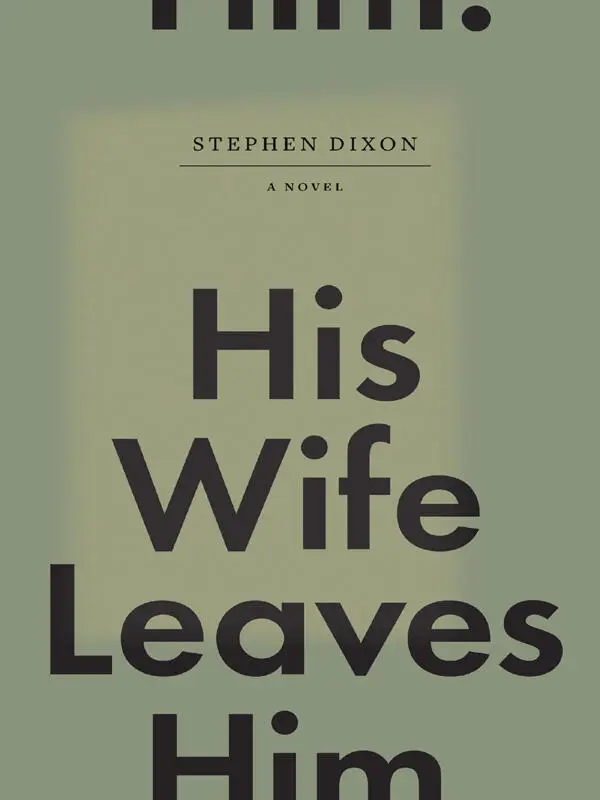
- Название:His Wife Leaves Him
- Автор:
- Издательство:Fantagraphics
- Жанр:
- Год:2013
- ISBN:нет данных
- Рейтинг книги:4 / 5. Голосов: 1
-
Избранное:Добавить в избранное
- Отзывы:
-
Ваша оценка:
His Wife Leaves Him: краткое содержание, описание и аннотация
Предлагаем к чтению аннотацию, описание, краткое содержание или предисловие (зависит от того, что написал сам автор книги «His Wife Leaves Him»). Если вы не нашли необходимую информацию о книге — напишите в комментариях, мы постараемся отыскать её.
, a long, intimate exploration of the interior life of a husband who has lost his wife.
is as achingly simple as its title: A man, Martin, thinks about the loss of his wife, Gwen. In Dixon’s hands, however, this straightforward premise becomes a work of such complexity that it no longer appears to be words on pages so much as life itself. Dixon, like all great writers, captures consciousness. Stories matter here, and the writer understands how people tell them and why they go on retelling them, for stories, finally, may be all that Martin has of Gwen. Reminders of their shared past, some painful, some hilarious, others blissful and sensual, appear and reappear in the present. Stories made from memories merge with dreams of an impossible future they’ll never get to share. Memories and details grow fuzzy, get corrected, and then wriggle away, out of reach again. Martin holds all these stories dear. They leaven grief so that he may again experience some joy. Story by story then, he accounts for himself, good and bad, moments of grace, occasions for disappointment, promises and arguments. From these things are their lives made. In
, Stephen Dixon has achieved nothing short of the resurrection of a life through words. When asked to describe his latest work, the author said that “it’s about a bunch of nouns: love, guilt, sickness, death, remorse, loss, family, matrimony, sex, children, parenting, aging, mistakes, incidents, minutiae, birth, music, writing, jobs, affairs, memory, remembering, reminiscences, forgetting, repression, dreams, reverie, nightmares, meeting, dating, conceiving, imagining, delaying, loving.”
is Dixon’s most important and ambitious novel, his tenderest and funniest writing to date, and the stylistic and thematic summation of his writing life.
His Wife Leaves Him — читать онлайн бесплатно полную книгу (весь текст) целиком
Ниже представлен текст книги, разбитый по страницам. Система сохранения места последней прочитанной страницы, позволяет с удобством читать онлайн бесплатно книгу «His Wife Leaves Him», без необходимости каждый раз заново искать на чём Вы остановились. Поставьте закладку, и сможете в любой момент перейти на страницу, на которой закончили чтение.
Интервал:
Закладка:
He wrote only one letter to her, about a month after she broke up with him the first time they came back from Maine, but never sent it or told her about it. It read something like this: “Dear Gwendolyn,” it began. Not sure why he didn’t say “Gwen,” which is what he always called her. Maybe to sound somewhat formal and indifferent. If so, his tone was a guise. He cared a lot about how she’d receive the letter and would have been upset if she didn’t answer it the way he hoped, or just not answered it. Next: something like “I hope this letter finds you in good spirits and health.” Again: formal, distant, reserved; all fake. “I’m fine, working hard at my writing, and my two classes at NYU’s continuing ed program seem to be going well. I got off to a shaky and incoherent start — chalk that up to nervousness and inexperience, or nervousness because of my inexperience. But my confidence picked up once I began reading their fictions four times instead of first two and then three, so that now I almost give the impression I know what I’m doing. It became embarrassing missing not only the finer points of their stories and novel excerpts but the most obvious ones too. The classes and preparations for them take a lot of my time and the job doesn’t pay well — comes out to a hundred dollars a week for two classes of two-hour sessions with a ten-minute break for each. Not quite enough to get by on, though I’m not complaining; I’m glad to have found work. The students, of all adult ages — a few of them write almost exclusively about their grandchildren and married kids — seem to appreciate my input and like me personally. There are even laughs. To help out on the grammatical and punctuational end (never my strong suit) of my detailed typewritten critiques — some of them longer than their fictions — I rely on The Gregg Reference Manual . Are you familiar with it? Much simpler and easier to find things in it than The Chicago Manual of Style , which I also bought, and more helpful than Strunk and White’s thin outdated book. Anyway, sorry to get into all of that. I don’t know why I did. I don’t typically run on. The main reason I’m writing you is to say I’ve been thinking that if you ever want to meet for coffee, though the unlikelihood of that happening should by all intents and purposes dissuade me from even suggesting it, let me know. I can’t speak for you, but I’d welcome a nice chat, not to try to smooth things out between us but to see that things have turned out all right. I know I’ve adjusted completely to our splitting up, think you were right to want to do so, so no need to worry about that. I’d also, of course, love to hear what you’ve been up to. If you’d prefer to drop me a line rather than make a call, that’d be fine too. Whatever you wish. And if I don’t hear from you, I’d understand that too. So, all the best to you, and my apologies for this overlong letter.” He signed it “Martin,” put the letter in an envelope, addressed, stamped and sealed it, kept it on his dresser a few days and then thought Does he really want to send it? Not only is it a dumb and phony letter, but what’s the use? If she wanted to see him, she’d have written or called. That’s how she is. She’s certainly not waiting for him to initiate it. He put the letter in his top dresser drawer — wasn’t sure why he didn’t just throw it out. Came upon it a week later — it had somehow worked its way under a stack of handkerchiefs — when he was looking for a pair of socks; he was down to two — and said out loud as he shook it in the air “You never answered; I thought at least a brief polite note,” and tore it up. For a couple of weeks after she broke up with him he wrote poems about her almost every day. He wrote ten, got them copied and thought of sending them to her, then thought she’d only get angry at him and think he’d become a bit twisted — some of them were sexually graphic and a few were hard on her — so he stored them away in his file cabinet of abandoned and unfinished manuscripts. About a year after they got married — he was teaching and she was mainly taking care of Rosalind and translating at home — she asked if he’d mind looking over a long modern French love poem she translated. He read it several times, said “It’s great; doesn’t need anything, far as I can tell. It’s clear, sexy, full of feeling, and I loved it. You know, I don’t think I ever told you this, but shortly after you broke up with me that time I wrote a series of poems about you that I called my ‘G-Poems.’ ‘G-1,’ ‘G-2,’ and so on, till ‘G-10.’ At first I thought of sending them to you, or even dropping them off with your doorman. But parts can be quite harsh, which is maybe understandable, maybe not, though they do show how much I was in love with you. I’d let you see them now, if I could find them and you had the time. I think our marriage is on safe-enough grounds to withstand an unfavorable reading of them. Remember, I’m not a poet, which I believe is a line right out of one of the poems, ‘G-4.’ That one’s my favorite because it’s the funniest and least self-pitying of a pretty terrible bunch.” “Then just give me that one to read,” and he said “Nah, let’s get everything out. You have anything you’ve written about me that’s scornful or supercritical and worse? and she said “I’ve never written about you. Maybe in a couple of years. That’s how I write.” He got the poems, said “I don’t want to be in hearing distance of you, knowing how much you’re going to hate the poems,” and took Rosalind for a stroll in her baby carriage. Came back an hour later and said “So?” and she said “They weren’t as bad as you pretended they’d be, but they’re not very good either. To be honest — can I say this?” and he said “Sure,” and she said “They’re heartfelt and clever every so often, but too hastily written and as a group kind of slight. I thought ‘He’s a better writer than this.’” “Well, I asked, so I got. But what do you think your reaction would have been if I had sent them when I wrote them?” and she said “I would have thought ‘I can’t read these now and I don’t want to put them away for later,’ so I would have thrown them out. I was already feeling sad about what I knew I must be causing you, so reading them — after all, it’s poetry — would have made me feel sadder. Are you thinking of working on them to try and make them publishable? Of course, these were written more than three years ago, so maybe you’re a better poet today.” “I had no intention to. I know they’re lousy and unsalvageable, so that wasn’t why I gave them to you — for close criticism and to see if you’d mind them being published. In fact, I’m going to reduce by ten pages the amount of literary junk I carry around with me,” and he shoved the poems into the wastebasket under her desk. “Do you have copies?” and he said “Just one set, but I have no idea where it is and I don’t care if it’s lost.” “Maybe you should empty the basket. It’s already overfull and one of your poems just fell out,” and he said “Let me change Rosalind first.” “I’ll do it,” and he said “No, I should have done it right after I got back. She’s wet.” “Then I’ll empty the basket. Last chance to rescue your poems, Martin,” and he said “Go.” Doesn’t remember much of what he wrote in those poems except for “G-4.” That one he thought at the time he wrote it was the best poem he’d ever done. He made several copies of it and did try to get it published for a year or two before he showed it to her— The New Yorker, Salmagundi, Paris Review —but had no luck. Doesn’t even think he got a response. He probably still has it around somewhere, maybe in a couple of places, but it starts off with something like “I can’t write poetry but if I could I’d write a poem to you.” A bit flat, but clear. And a few lines later — the poem’s about twenty-five lines long — something close to “Poems have been known to express the ineffaceable, I mean the untraceable, I’m saying the inexpressible and ineffable, and that’s what I’d like to try to express to you.” And near the end, something very much like “It would be nice to be a poet and write words down like ‘I love you like a red red nose,’ and know the person you’re writing to, which would be you, would know that in those seemingly insipid words would be the heart’s deepest feelings and sentiments.” And ends “But I’m no poet and could never be, so I have to settle for prose that matter-of-factly says inexactly how I musically feel about you: My love is in boom again, tra-la, tra-la.” The last, except for a missing or added word or two, is a direct quote from the poem and the part — maybe of the entire “G-Poems,” though too late to find out if that’s still so — he liked best of all. In this same period after they broke up he thought of calling her. When she answered, he’d say “Oh, my God; Gwen; what a surprise. I’m sorry, I wasn’t calling you. You’re not going to believe this but I was calling a fellow teacher-writer at NYU, Harold Axelrod. You both have the same three numbers for a prefix, 6-6-3, and I must have — this had to be it; some automatic reflex — dialed your number instead. But as long as I got you, how are you?” and after she said how she was, or whatever she said, and probably she’d ask about him — how teaching’s going; his mother, perhaps — he’d say “Well, even if this call was by accident, would you like to meet for coffee one of these days?” Some months before they got married, or maybe it was on their two-day honeymoon at an inn with the word “Rock” or “Rocks” in its name. No, it was during their first trip to France together — on the train from Paris to Nice, he remembers, when he said “I have a confession to make, but with an ulterior motive in mind,” and told her about the “accidental” phone call he never made to her and was curious if she would have fallen for it. “There actually was a guy named Harold Axelrod teaching poetry at NYU at the same time and on the same floor as me and he lived in your Columbia neighborhood and had a 6-6-3 prefix and I felt we were becoming friends. But after a couple of months he got a much better-paying teaching job at Middlebury and I think moved there, but I never saw him again. Called him, but his line had been disconnected.” She said she wouldn’t have believed his call was an accident, as good an actor as he could be, and it also would have been too early in their breakup to meet. “You were smart not to make that call. I knew you were a fabricator sometimes, but now I would have thought you were a schemer, which I think would have been too much of a realization for me to ever hook up with you again.” He remembers they were eating their packed lunch on two of those pulled-out trays they had in the train compartment, and drinking bottled water.
Читать дальшеИнтервал:
Закладка:
Похожие книги на «His Wife Leaves Him»
Представляем Вашему вниманию похожие книги на «His Wife Leaves Him» списком для выбора. Мы отобрали схожую по названию и смыслу литературу в надежде предоставить читателям больше вариантов отыскать новые, интересные, ещё непрочитанные произведения.

Обсуждение, отзывы о книге «His Wife Leaves Him» и просто собственные мнения читателей. Оставьте ваши комментарии, напишите, что Вы думаете о произведении, его смысле или главных героях. Укажите что конкретно понравилось, а что нет, и почему Вы так считаете.