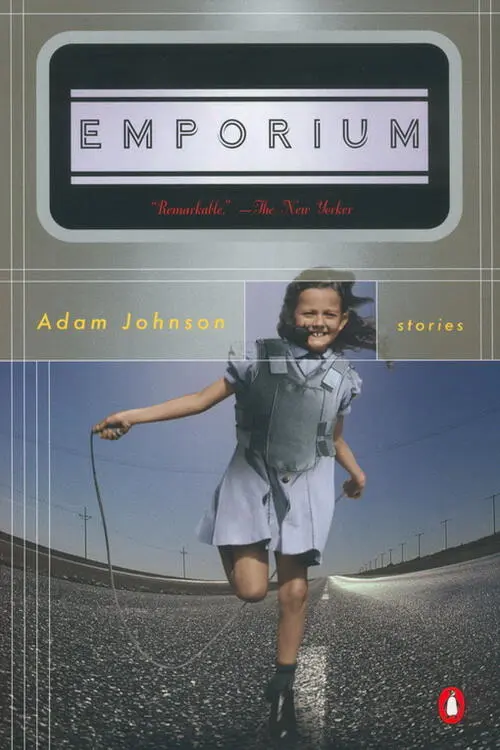
Adam Johnson - Emporium
Здесь есть возможность читать онлайн «Adam Johnson - Emporium» весь текст электронной книги совершенно бесплатно (целиком полную версию без сокращений). В некоторых случаях можно слушать аудио, скачать через торрент в формате fb2 и присутствует краткое содержание. Год выпуска: 2003, Издательство: Penguin Books, Жанр: Современная проза, на английском языке. Описание произведения, (предисловие) а так же отзывы посетителей доступны на портале библиотеки ЛибКат.
- Название:Emporium
- Автор:
- Издательство:Penguin Books
- Жанр:
- Год:2003
- ISBN:нет данных
- Рейтинг книги:3 / 5. Голосов: 1
-
Избранное:Добавить в избранное
- Отзывы:
-
Ваша оценка:
Emporium: краткое содержание, описание и аннотация
Предлагаем к чтению аннотацию, описание, краткое содержание или предисловие (зависит от того, что написал сам автор книги «Emporium»). Если вы не нашли необходимую информацию о книге — напишите в комментариях, мы постараемся отыскать её.
Emporium — читать онлайн бесплатно полную книгу (весь текст) целиком
Ниже представлен текст книги, разбитый по страницам. Система сохранения места последней прочитанной страницы, позволяет с удобством читать онлайн бесплатно книгу «Emporium», без необходимости каждый раз заново искать на чём Вы остановились. Поставьте закладку, и сможете в любой момент перейти на страницу, на которой закончили чтение.
Интервал:
Закладка:
“Wait’ll you get a load of Tasha,” Jimbo says as we crest the foothills outside Vegas. He’s pretty stoned, and from his description of Tasha, I know she’s the kind of thank-God-it’s-Friday secretary I’d work at Bennigan’s.
“Tasha’s seen the other side,” he says.
“The other side of what?”
Jimbo just raises his eyebrows, and we drive for a while.
“Maybe I’ll show her the white flash,” I tell him.
Jimbo doesn’t quite know what I mean by this, but he likes the sound of it. He smiles and steps on the gas, sending us full tilt through the newly paved scrub desert leading to the suburbs. “White flash,” he repeats.
Closing my eyes, I let the road’s G-force take me. I feel this Tasha woman cinch me into a billowy nylon flight suit, her hands folding Velcro, running zippers, jerking my straps tight. I hear her knock my helmet twice, meaning A-okay, thumbs up, as I follow her into Fly Away’s engine room. It is a more modern version of this engine, the DC-9, that kills my mother’s best friend, Tammy, climbing out of Dulles International. You’ve seen the footage, the one that goes into the icy river. I say this because Tammy is a fox, too, a woman I stare at endlessly as she and my mother sit by our condo’s swimming pool in white bikinis.
Marty’s house is on a pie-shaped lot at the end of a cul-de-sac in west Vegas. It’s long and low, hard-lined and brown, the kind of house John Wayne would’ve lived in, if he’d never been famous. Beyond the sprawling roof rise two jagged outcrops of stone, one with a five-story radio tower that flashes red strobes bright enough to make us wince a bit, even at noon. The light’s glow pattern is two fast and one slow, which warns overhead airplanes that this particular hazard’s in the approach lane.
On the front steps, we stare into twin, rough-hewn doors and Jimbo rings the bell again. “Like I said, Marty’s a soap-opera case,” he whispers. “Don’t say anything about his face. He’s sensitive about his face.”
I’ll tell you this. Jimbo’s not a good friend. He’s shallow and deceptive, and there’s a hole in him that will make him say anything. I’m not a good friend either. I am asleep in an essential way, and I will not begin to wake up for several years, not until I learn the meaning of the word loss, until I am in Acapulco and Ted hands me his favorite pistol, a chrome Super-25.
A woman finally answers the door in a UNLV Runnin’ Rebels T-shirt she’s adorned with glitter and spangles. She is clearly not happy to see us. I’m six foot four. Jimbo has no neck, and he’s holding a box labeled LIVE ANIMALS POISONOUS.
It takes her three full seconds to place Jimbo, then she turns and walks away.
We let ourselves into a room carpeted in cream wall-towall, with a black pumice fireplace and a ranch-style bar made from dark wood and warbled green glass. There is an elaborate seventies intercom system, with talk stations on every wall. Jimbo heads straight for a Wurlitzer and works its silent keys. “We used to play Ozzy on this,” he says. The walls are covered with photos of Marty, blond-haired, blue-eyed: Marty in a football uniform, Marty in a powder-blue prom cravat, Marty midair in front of a white ‘66 Mustang, which it turns out is the crash vehicle in question.
The Marty that rounds the corner, though, is hard to look at. He is tall, slightly stooped, with long jet hair that curtains his face. One eye points down and in a bit, making him seem half interested in something just beyond the tip of his nose. He looks almost sad, which is not what I expected after all of Jimbo’s descriptions of the crash scene on our drive up—“They found the steering wheel in the tree, a fucking tree, man”—the amnesia’s peculiar effects—“He doesn’t even know his dad’s name but he walks right to his locker and wheels out the combo”—horrific surgeries—“The third time they sewed it on it stuck”—and high school dramas—“Tasha and I stood by him at the pep rallies; we were the only ones.”
Jimbo and Marty do an elaborate handshake that ends with a knuckle punch and slips into a last toke off an imaginary joint; “fff,” they inhale. There are a lot of “wow”s and “dude”s in their reunion, and after neither notices that I am standing right next to them, I imagine as sort of a joke that they walk off without speaking to me, which they do.
I follow clear carpet runners down the hall, where there are two white doors. I open the wrong one. Inside sits a boy of about fourteen. His swingarm desk lamp is on, and he leans back in a blue director’s chair, his feet up on the white laminated desk, reading a racing magazine. He looks at me, looks back at the page. But I know this chair, the way canvas webbing gathers under your shoulder blades after a certain amount of nothing. I know how long it takes your ankles to go numb from propping them on a desk like that. I see years of airplane models and electric cars, a thousand magazines read atop tiger print sheets, all the things anyone would see, if they’d just open the door.
The kid sets down his issue of PitCrew . It’s the one featuring Rick Kreiger’s 500 win. Then he does a strange thing. He takes his desk lamp and swivels its armature so the hard bulb shines in my face.
This is where one story could become another.
This other story I could tell would be about the following years when your father doesn’t open the door. It would have to do with the after-school jobs you pick up to kill time, about the GM family sedan proving ground behind Futron’s industrial park, how you can spend whole lunch breaks without taking your eyes off circling cars that stop only to change the drivers who will run them into the ground. This different story would have to do with a mythology class in which you discover the gods are all-petty and their names are hard to remember, or the endless chain of nature shows about Africa a skilled TV viewer can find from midnight on, or the place your mind goes while waiting for a diode to finally light reject-red.
A woo-hoo high-five sounds in the next room, and this boy and I look toward the source, our eyes landing on a poster of the space shuttle. There is a white plastic intercom next to my shoulder that surprises me when it comes to life. “What’s your 10–20, copy?” a man asks over a hail of barking — the kid’s dad, I assume. When there is no answer, the father says, “Roger this: the griddle is firing up. The Runnin’ Rebs won the toss, and they’re taking the field.”
The boy returns the light to his magazine. “Please,” he says, with an air of boredom and indifference aimed at me, his father, and life in general. I have nothing deep to add, so I go.
When I open Marty’s door, there is a giant snake, but I try to act cool. The room’s darker than I expect, though I can clearly see the snake cage takes up a third of it, framed floor to ceiling with studs and chicken wire, and there is a faint smell of cat piss. Marty is shaking the box of scorpions. He holds it to his ear, his eyes roaming the room, looking right past me as he listens. He squints some, smiles. Satisfied, he sets it on a junk-strewn desk without opening it. Marty doesn’t need to look in that box just yet, either.
Jimbo reloads the bong and holds it out to me. It hovers between us, and I do not take it. In less than a year, after I fail mythology and the doors of Futron are chained shut, Jimbo will kiss me, awkwardly, on the neck, in a secretary stable named Fuddrucker’s. Even now, I look at him suspiciously. He knows I don’t smoke, and this stoner’s etiquette is only for Marty’s benefit. The snake hangs from a ceiling beam at the edge of my vision, its skin the felt green of a Vegas gaming table.
“Go for it,” Marty says. “Bong up.”
Читать дальшеИнтервал:
Закладка:
Похожие книги на «Emporium»
Представляем Вашему вниманию похожие книги на «Emporium» списком для выбора. Мы отобрали схожую по названию и смыслу литературу в надежде предоставить читателям больше вариантов отыскать новые, интересные, ещё непрочитанные произведения.



Обсуждение, отзывы о книге «Emporium» и просто собственные мнения читателей. Оставьте ваши комментарии, напишите, что Вы думаете о произведении, его смысле или главных героях. Укажите что конкретно понравилось, а что нет, и почему Вы так считаете.