Svetislav Basara - The Cyclist Conspiracy
Здесь есть возможность читать онлайн «Svetislav Basara - The Cyclist Conspiracy» весь текст электронной книги совершенно бесплатно (целиком полную версию без сокращений). В некоторых случаях можно слушать аудио, скачать через торрент в формате fb2 и присутствует краткое содержание. Год выпуска: 2012, Издательство: Open Letter, Жанр: Современная проза, на английском языке. Описание произведения, (предисловие) а так же отзывы посетителей доступны на портале библиотеки ЛибКат.
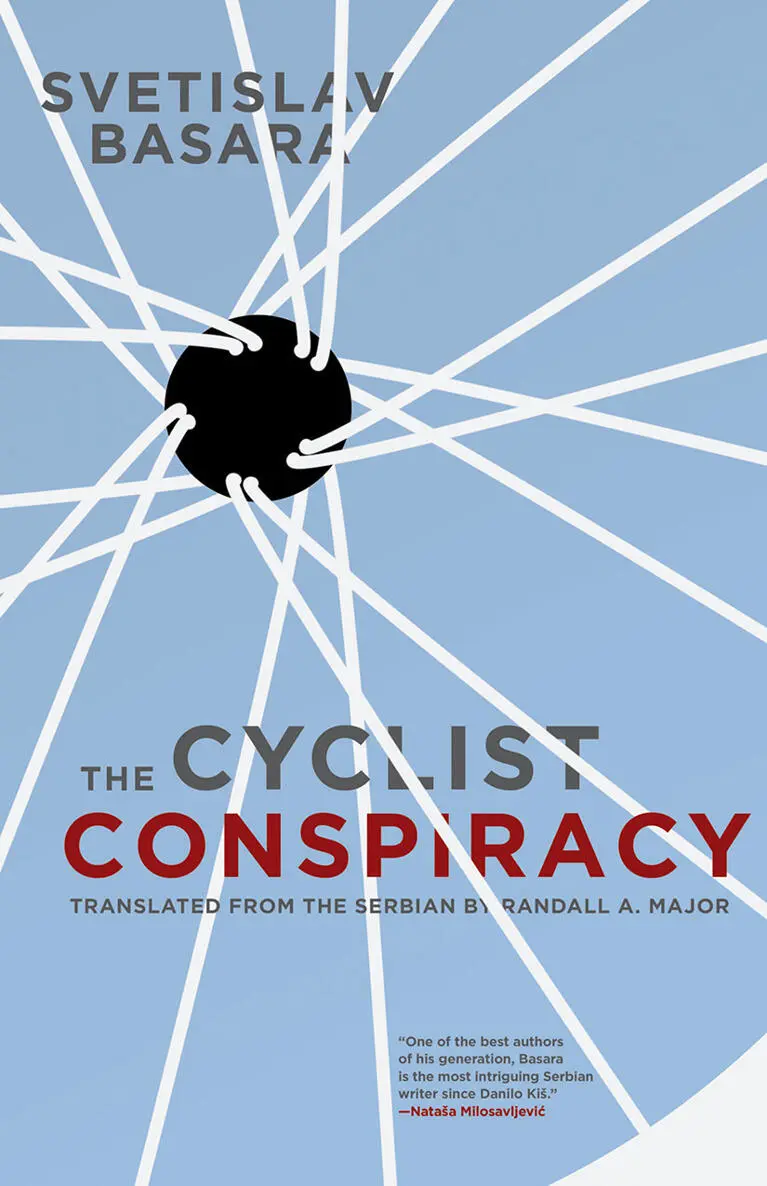
- Название:The Cyclist Conspiracy
- Автор:
- Издательство:Open Letter
- Жанр:
- Год:2012
- ISBN:нет данных
- Рейтинг книги:4 / 5. Голосов: 1
-
Избранное:Добавить в избранное
- Отзывы:
-
Ваша оценка:
The Cyclist Conspiracy: краткое содержание, описание и аннотация
Предлагаем к чтению аннотацию, описание, краткое содержание или предисловие (зависит от того, что написал сам автор книги «The Cyclist Conspiracy»). Если вы не нашли необходимую информацию о книге — напишите в комментариях, мы постараемся отыскать её.
Masterfully intertwining the threads of waking and dreams into the fabric of the present, the past, and the future, Svetislav Basara’s Pynchon-esque The Cyclist Conspiracy is a bold, funny, and imaginative romp.
The Cyclist Conspiracy — читать онлайн бесплатно полную книгу (весь текст) целиком
Ниже представлен текст книги, разбитый по страницам. Система сохранения места последней прочитанной страницы, позволяет с удобством читать онлайн бесплатно книгу «The Cyclist Conspiracy», без необходимости каждый раз заново искать на чём Вы остановились. Поставьте закладку, и сможете в любой момент перейти на страницу, на которой закончили чтение.
Интервал:
Закладка:
“Did you know, Pavel Kuzmich,” Vartolomeyich said to his neighbor, “that I got here on a bicycle and that one man prophesied that I would end up behind bars.”
Pavel Kuzmich smiled.
“My dear, Joseph Vartolomeyich,” he said quietly, “your prophet was actually not very keen.”
“By God, he was keen. He gave me that prophecy in 1920. And who would have even imagined that at the time… I wouldn’t have ever even dreamed it, and to make things even stranger, Pavel Kuzmich, the night after that Kowalsky fellow told me that I would do time, I dreamt these barracks.”
“These very barracks?”
“You don’t believe me?”
“On the contrary, Joseph Vartolomeyich, on the contrary. You see, I got here thanks to the fact that I was smart enough to believe in such things, and stupid enough to write about them…”
Pavel Kuzmich did not finish his sentence, and we found ourselves on an endless plain, surrounded in a grayish light. “Look to the east,” J. K. told me. I turned my head and, on the horizon, I saw a shining structure filled with blinding light. “That is the cathedral of the Holy Spirit, the place of worship of the Evangelical Bicycli…”
(Remainder of the manuscript destroyed)
AFANASIJ TIMOFEYEVICH DARMOLATOV. JUBILEE
That morning the mercury in the thermometer dropped below minus twenty, and the inmates were not taken to the building site. Joseph Vartolomeyich Kuznyetsov recognized in this a sarcastic token of attention from destiny or providence; on that day, exactly ten years before, he had been arrested. Now he could, in the relative peace of the barracks, celebrate the senseless jubilee. And he decided to celebrate it, just to spite destiny. He had some loose tobacco and three lumps of brown sugar.
“Pavel Kuzmich!” he called to his neighbor who was lying there staring blankly at the ceiling, “Let’s smoke a cigarette and enjoy ourselves. Today I’m celebrating.”
“And what, Joseph Vartolomeyich, are you celebrating, if I dare to ask? Your birthday?” asked Pavel Kuzmich Griboyedov, a philosopher, sentenced to five years, plus five more he had earned in the camp.
“No, Pavel Kuzmich. I quit celebrating birthdays. Today is a little jubilee for me. Ten full years since I changed my ‘profession.’” ********
“Joseph Vartolomeyich, you’re a real devil,” Griboyedov said, rolling a cigarette. “I’m convinced that you will leave here in perfect physical and spiritual health. It is impossible to destroy people like you, unless a direct order is given to do so. You are a real Russian, one of those about whom Kaiser Frederick the Great said: ‘You have to kill a Russian twice and then give him a shove.’ You are celebrating a jubilee. Oh, how Boris Mihailovich would laugh if he could hear you.”
“Hmmph, Pavel Kuzmich,” Vartolomeyich sighed, “I’m afraid that I’ve lived through it all and that your Kaiser just has to give me a shove.”
And they both burst out laughing.
“Hey!” frigate captain Zemski cried from the lower bunk. “It seems that the idleness has gone to your heads, boys.”
The captain’s remark brought them back to reality. They lay in silence, smoking. Josif Vartolomeyich inhaled the sharp hot puffs deep into his lungs and thought about how it would be better if people were made in the form a cloud of smoke, given their senses, feelings and reason, but still ungraspable and diffused; he thought of the accident by which man is, there you see, built like he is, stuffed into a pile of one hundred and fifty pounds, susceptible to imprisonment, capture, feeling cold and pain, and manipulation in general; he remembered, finally, that dusk ten years ago when he was arrested and, even today, it was not clear to him why they had also arrested his bicycle, carefully taking it apart and (while they beat him, by the way, in preparation) cut through the metal frame, shouting, “Where is the message? Where is the message?” Frightened by the beating, confused, Joseph Vartolomeyich could not gather his thoughts and figure out what kind of message should be in the bicycle, or if they were looking for it because it would fit nicely together with some sort of warrant they had for him about which he knew nothing. And by the time he did gather his thoughts, he had already been sentenced to five years, and the two months spent in Lubyanka seemed to be like two nightmarish days to him, nothing more.
Now, lustfully inhaling the last puff as the ember burned his fingers, now he was thinking quite differently. Those two months were not even worth two days, they were worth nothing at all, just as the rest of the nine years and nine months meant nothing. Everything was reduced to zero; time had passed and it was as if it had never even been. Joseph Vartolomeyich wondered: How can the future come out of such a nasty present?
Joseph Vartolomeyich often reflected on time, and he had concluded that time is nothing: all those fifty or sixty years dissipate in the end, and a man, hopefully, goes on — he comforted himself — and that gave him the strength to bear the brutal work and the cold and hunger and humiliation.
“Did you know, Pavel Kuzmich,” Vartolomeyich said to his neighbor, “that I got here on a bicycle and that one man prophesied that I would end up behind bars.”
Pavel Kuzmich smiled.
“My dear, Joseph Vartolomeyich,” he said quietly, “your prophet was actually not very keen.”
“By God, he was keen. He gave me that prophecy in 1920. And who would have even imagined that at the time… I wouldn’t have ever even dreamed it, and to make things even stranger, Pavel Kuzmich, the night after that Kowalsky fellow told me that I would do time, I dreamt these barracks.”
“These very barracks?”
“You don’t believe me?”
“On the contrary, Joseph Vartolomeyich, on the contrary. You see, I got here thanks to the fact that I was smart enough to believe in such things, and stupid enough to write about them…”
“That Kowalsky,” Kuznyetsov continued, “who was named Joseph, like me, was half German, half Polish and half devil; I met him in 1920 at a friend’s place. Who knows where he ended up. I saw him two or three times. He’s probably doing time like us somewhere, or perhaps that Kaiser of yours gave him a push…”
Joseph Vartolomeyich and Pavel Kuzmich again burst out laughing.
“Hey, hey,” complained Zemski from down below, “you’re inviting trouble. If you laugh in the morning, you’ll cry in the evening.”
“Ugh, Foma Ilyich,” cried Griboyedov, “does that mean we should start crying in the morning?”
“Ugh, ugh,” sighed Foma Ilyich.
“Ugh, ugh,” sighed the blackened beams on the ceiling.
“Ugh, ugh,” sighed the wind.
“Ugh, ugh,” sighed the taiga.
Pavel Kuzmich Griboyedov was a brilliant student of classical German philosophy, but he did not like the classics — except for Hegel. He had a poetic streak in him and he could not get accustomed to the rigid logic that reminded him of a Prussian military drill. Pavel Kuzmich was a nihilist; partly because it was fashionable, partly because he followed the paths of his heart.
“Hmmm,” sighed Pavel Kuzmich at tea parties, “what is history, my brothers? The famous link: cause-effect-cause. So, now, if we replace the series — cause-effect-cause with the series: binga-banga-binga, we end up in the same place. History is commonplace gibberish, nonsense…”
That is what Pavel Kuzmich said in order to entertain girls and his friends, but he worked seriously at home. He wrote a voluminous Treatise about Time in which he methodically proved — with evidence that ended up lost in the flames of a bonfire, unfortunately — that the present is determined not by the past, as it used to be thought, but by the future. The greatest minds of the time, reading fragments of the treatise, predicted that Pavel Kuzmich had a bright future ahead of him.
Читать дальшеИнтервал:
Закладка:
Похожие книги на «The Cyclist Conspiracy»
Представляем Вашему вниманию похожие книги на «The Cyclist Conspiracy» списком для выбора. Мы отобрали схожую по названию и смыслу литературу в надежде предоставить читателям больше вариантов отыскать новые, интересные, ещё непрочитанные произведения.





Обсуждение, отзывы о книге «The Cyclist Conspiracy» и просто собственные мнения читателей. Оставьте ваши комментарии, напишите, что Вы думаете о произведении, его смысле или главных героях. Укажите что конкретно понравилось, а что нет, и почему Вы так считаете.