Svetislav Basara - The Cyclist Conspiracy
Здесь есть возможность читать онлайн «Svetislav Basara - The Cyclist Conspiracy» весь текст электронной книги совершенно бесплатно (целиком полную версию без сокращений). В некоторых случаях можно слушать аудио, скачать через торрент в формате fb2 и присутствует краткое содержание. Год выпуска: 2012, Издательство: Open Letter, Жанр: Современная проза, на английском языке. Описание произведения, (предисловие) а так же отзывы посетителей доступны на портале библиотеки ЛибКат.
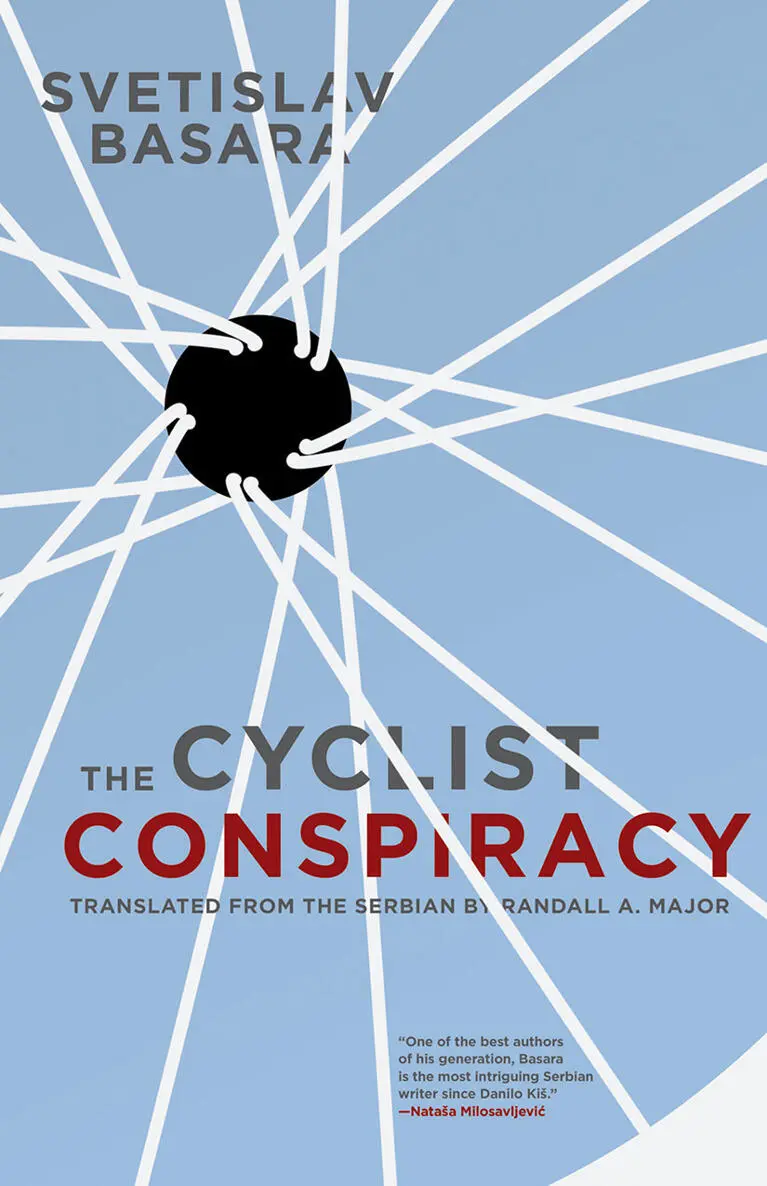
- Название:The Cyclist Conspiracy
- Автор:
- Издательство:Open Letter
- Жанр:
- Год:2012
- ISBN:нет данных
- Рейтинг книги:4 / 5. Голосов: 1
-
Избранное:Добавить в избранное
- Отзывы:
-
Ваша оценка:
The Cyclist Conspiracy: краткое содержание, описание и аннотация
Предлагаем к чтению аннотацию, описание, краткое содержание или предисловие (зависит от того, что написал сам автор книги «The Cyclist Conspiracy»). Если вы не нашли необходимую информацию о книге — напишите в комментариях, мы постараемся отыскать её.
Masterfully intertwining the threads of waking and dreams into the fabric of the present, the past, and the future, Svetislav Basara’s Pynchon-esque The Cyclist Conspiracy is a bold, funny, and imaginative romp.
The Cyclist Conspiracy — читать онлайн бесплатно полную книгу (весь текст) целиком
Ниже представлен текст книги, разбитый по страницам. Система сохранения места последней прочитанной страницы, позволяет с удобством читать онлайн бесплатно книгу «The Cyclist Conspiracy», без необходимости каждый раз заново искать на чём Вы остановились. Поставьте закладку, и сможете в любой момент перейти на страницу, на которой закончили чтение.
Интервал:
Закладка:
The entire ruse would not be worthy of mention if it did not also contain a series of political implications wrapped in a thin veil of mystery. The Evangelical Bicyclists, whether they exist or not, consider themselves to be legitimate subjects of the Eastern Roman Empire, Byzantium, and they do not recognize any of the states that have appeared on the territory that Byzantium once occupied. It is not far from reason to suppose that the Evangelical Bicyclists could easily be a creation of a department for political propaganda of one of the great powers, for whom the existing state of peace is not agreeable. In any case, it is a morbid legend that is threatening to become fashionable, a testimony to the fact the phantoms of superstition are still raging the world of people, that vagueness and secrecy are still popular and that they persistently, but with ever less success, attempt to stand in the way of the scientific and technological progress of humankind.
Christian Science Monitor
ÇULABA ÇULABI. HOW I BECAME A MEMBER OF THE ORDER OF LITTLE BROTHERS OF THE EVANGELICAL BICYCLISTS OF THE ROSE CROSS (THE HISTORY OF TIMEPIECES)
I must admit: that morning when I was arrested, I actually did strike my mother. Because she did not wake me up on time. The night before I had left her a message to wake me up at eight, she woke me up at nine and so I was late to an important meeting. I got up and, angrily, gave her a slap. Almost a symbolic one. This comes as a kind of confession. Does my conscience bother me? Yes, but my conscience bothers me whenever I do anything; for example when I cross the street or smell a flower. So, I slapped my mother and quickly experienced all the things that a slap can get a man into, a slap that is, like everything else anyway, perhaps just fiction. Not even half an hour passed and I was already arrested and standing in the police station in front of the shocked policemen who simply could not believe that I had raised my hand against a parent. The very nature of those men’s jobs is to raise their hand against people who are not related to them in any way whatsoever, and they — oh, the hypocrisy! — were shocked because I gave my mother a gentle slap. I am of the opinion that a man should occasionally beat his mother, if for no other reason than the fact that she gave birth to him — bang! — cut the umbilical cord, and shoved him into the world, where he is constantly attempting to return to the safety of the uterus by pushing his penis into women’s vulvae, vainly attempting to widen the entrance, to slip back inside, to escape from the face of the planet, committing the deadly sin of promiscuity.
I thought about the whole thing later in my jail cell. And about how quite possible things are incredible to today’s people. What is easier than hitting your mother? She is always nearby, and she is never expecting a slap. And yet, to the healthy mind that is incomprehensible. What was Jesus of Nazareth hoping for when he preached the final resurrection of the dead? This healthy mind, since I like to represent things visually, always reminds me of that lieutenant of the guard at the Kremlin who falls asleep every night, sinking into the nothingness, not surprised by it — yet, at the very mention of “resurrection” grabs his Kalashnikov and angrily shoots at the crows on the Kremlin domes where, supposedly, the listening devices of the CIA have been placed, of the famous Lieutenant Morozov, described in the Moscow Memoirs of T. J. James, first secretary of the United States embassy. Indeed, such guys killed hundreds of people at the Gulag, and they never raised their hand against their mother. In such situations, the best thing to do is reach for Hegel; that man could justify anything. “The process of life,” he writes, “is the formation of the character just as much as it is the removal of it.” That dialectic is irrefutable. In spite of everything, we strive just to have our personality formed, which is understandable to an extent, but impossible. That causes a misunderstanding. Life strives to remove us, we struggle and thereby we get further entangled in the contradiction, as if in quicksand. Because of everything mentioned, you should not hold that little slap against me; I was just being a tool of the unconquerable force of destruction.
You see, I thought, each of us has a Lieutenant Morozov deep in our souls. I also do, of course. One morning, for example, I opened the window and bird flew into my room, followed by several more and in the twinkle of an eye the room was full of the flapping of little wings and loud chirping. In my mania for classifying things, I noticed that there were several species: Fringilla coeleba, Tudus merula, Sturnus vulgaris, Hirundo rustica, Ignica pillus … I stood in the middle of the uproar, like Moses on Mt. Sinai, and asked myself: How can this be? Then again, I accepted it as a normal fact that, in the very same way, one hundred thousand people suddenly swarm in through the doors of a football stadium. The birds were all over the room: on the bookshelf, on the lamp, on the wardrobe, on the bed, on the table. Two or three of the littlest ones were squatting on the tilting picture of Joseph Vissarionovich, threatening to knock it over. I stood in the middle of that feathery uproar and crossed my arms, thinking: They will ruin everything; they will bury me and the room in droppings, it will all turn into guano, an excellent phosphate fertilizer. It never even occurred to me that they were harbingers of heaven, symbols of angels, which Providence had only sent me so that I would put aside systematization and classification.
At that time, before I met Kowalsky in prison, I lived in a chamber of hell. In truth, I was waiting to hear God’s voice, but not very energetically, more just to deceive myself. In my brutishness, I was practically waiting for a thundering shout from the heights of heaven, which shows perfectly the enormity of my idiocy, my addiction to anthropomorphism that is not inhibited even when faced with such nonsense as “ the legs of a chair ” and “ the head of state .” Kowalsky was the one who finally explained it to me: God has spoken for ages and he can send messages, through a mediator, to certain lucky souls in their sleep; complete silence is perfect articulation and all speech is a lie, utter nonsense at the very least. This Kowalsky fellow was a member of some sort of sect, the Bicyclists of the Rose Cross. I learned a lot about Bicyclism in those few days I spent with him in the same cell. He was arrested for breaking clocks. The Bicyclists of the Rose Cross, in fact, believe that timepieces are Satanic devices. *****This is how Kowalsky described the event to me. First, early in the morning he broke his alarm clock. Then he went to see a few friends, convinced them of the usefulness of breaking those devices, and together they broke twelve of them, some wristwatches, a few pocket watches, some alarm clocks, right in front of some flabbergasted passersby in the street in the very center of town. However, they did not stop there. In a nearby store they bought two dozen more cheap watches and began to break them, while Kowalsky preached to the curious onlookers that they should leave time behind and look toward eternity. Then, Kowalsky and his friends got on their bicycles and rode off down the street, breaking the town’s clocks until the police stopped them and arrested them. Still, Kowalsky carried out the biggest exploit at the police station. He hypnotized the police officers present and ordered them to break their watches. When they returned from their hypnotic sate, the police vented all their anger on Kowalsky. He was covered with bruises, but satisfied. I have to admit that I was greatly pleased with this idea about breaking clocks.
Читать дальшеИнтервал:
Закладка:
Похожие книги на «The Cyclist Conspiracy»
Представляем Вашему вниманию похожие книги на «The Cyclist Conspiracy» списком для выбора. Мы отобрали схожую по названию и смыслу литературу в надежде предоставить читателям больше вариантов отыскать новые, интересные, ещё непрочитанные произведения.












Обсуждение, отзывы о книге «The Cyclist Conspiracy» и просто собственные мнения читателей. Оставьте ваши комментарии, напишите, что Вы думаете о произведении, его смысле или главных героях. Укажите что конкретно понравилось, а что нет, и почему Вы так считаете.