Masande Ntshanga - The Reactive
Здесь есть возможность читать онлайн «Masande Ntshanga - The Reactive» весь текст электронной книги совершенно бесплатно (целиком полную версию без сокращений). В некоторых случаях можно слушать аудио, скачать через торрент в формате fb2 и присутствует краткое содержание. Год выпуска: 2016, Издательство: Two Dollar Radio, Жанр: Современная проза, на английском языке. Описание произведения, (предисловие) а так же отзывы посетителей доступны на портале библиотеки ЛибКат.
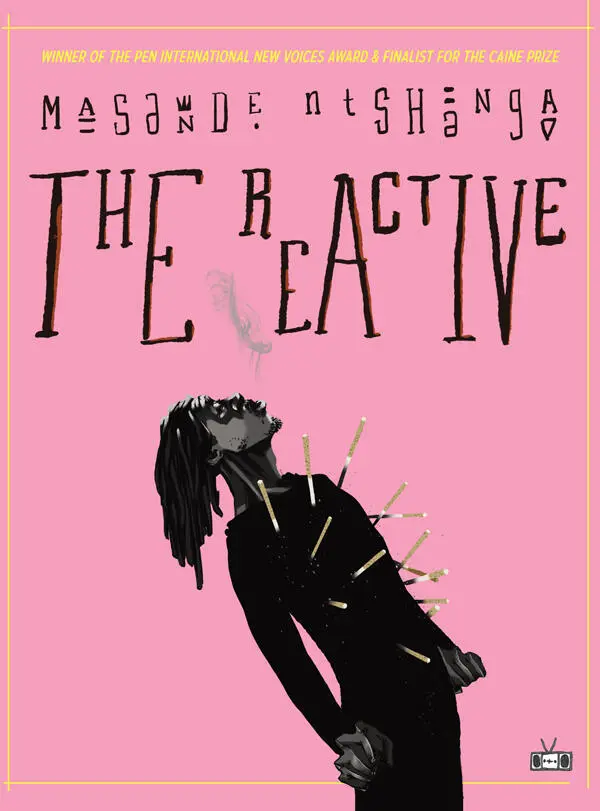
- Название:The Reactive
- Автор:
- Издательство:Two Dollar Radio
- Жанр:
- Год:2016
- ISBN:нет данных
- Рейтинг книги:5 / 5. Голосов: 1
-
Избранное:Добавить в избранное
- Отзывы:
-
Ваша оценка:
The Reactive: краткое содержание, описание и аннотация
Предлагаем к чтению аннотацию, описание, краткое содержание или предисловие (зависит от того, что написал сам автор книги «The Reactive»). Если вы не нашли необходимую информацию о книге — напишите в комментариях, мы постараемся отыскать её.
, [Ntshanga] has created an immersive and powerful portrait of drug use, community, and health issues by exploring what it was like to be young, black, South African, and HIV positive in the early aughts."
— "Gritty and revealing, Ntshanga's debut novel offers a brazen portrait of present-day South Africa. This is an eye-opening, ambitious novel."
— "Ntshanga offers a devastating story yet tells it with noteworthy glow and flow that keeps pages turning until the glimmer-of-hope ending."
— "Electrifying… [Ntshanga] succeeds at exploring major themes — illness, family, and, most effectively, class — while keeping readers in suspense. Ntshanga's promising debut is both moving and satisfyingly complex."
— "A powerful, compassionate story that refuses to rest or shuffle off into the murk of the mind. It exists so that we never forget."
— From the winner of the PEN International New Voices Award comes the story of Lindanathi, a young HIV+ man grappling with the death of his brother, for which he feels unduly responsible. He and his friends — Cecelia and Ruan — work low-paying jobs and sell anti-retroviral drugs (during the period in South Africa before ARVs became broadly distributed). In between, they huff glue, drift through parties, and traverse the streets of Cape Town where they observe the grave material disparities of their country.
A mysterious masked man appears seeking to buy their surplus of ARVs, an offer that would present the friends with the opportunity to escape their environs, while at the same time forcing Lindanathi to confront his path, and finally, his past.
With brilliant, shimmering prose, Ntshanga has delivered a redemptive, ambitious, and unforgettable first novel.
Masande Ntshanga
The White Review, Chimurenga, VICE
n + 1
Rolling Stone
The Reactive — читать онлайн бесплатно полную книгу (весь текст) целиком
Ниже представлен текст книги, разбитый по страницам. Система сохранения места последней прочитанной страницы, позволяет с удобством читать онлайн бесплатно книгу «The Reactive», без необходимости каждый раз заново искать на чём Вы остановились. Поставьте закладку, и сможете в любой момент перейти на страницу, на которой закончили чтение.
Интервал:
Закладка:
I nod.
I don’t recall getting to my feet, but I find myself standing.
In front of me, the screen begins to blink.
Then the man’s voice booms out from the walls again, and he tells me to walk towards the room at the end of the hallway.
I walk.
Inside the room, there’s no light, but I can make out a bed. Feeling dizzy, I grope for it in the dark.
Then I lie down on the single mattress, thinking of Ruan and Cecelia. My eyelids start to weigh down on my eyes, and my breath leaves me as if for the final time.
Cecelia
The first time I thought about dying — thought about it at length, the way I do now — goes so far back I get a headache whenever Ruan and Nathi ask me about it. The two of them know it’s an old story, but they still bother me about what happened that night.
Well, it started with me and my friend Claire.
I’d got to know Claire over the internet the previous summer. We’d met by chance, in a chat room about Rothko, an artist we were both trying to emulate at the time. I knew from the beginning that Claire was an exceptional painter, the kind of artist a Pretoria high school student wouldn’t usually get to know. I considered myself lucky. Claire wasn’t a famous artist; she wasn’t in coffee-table books or hung at the Fried Contemporary, but she was timely and transparent. Or at least she was those things to me. I was sixteen. It had been four years since my mother died and I was living with my aunt, Sylvia, in a townhouse in Mooikloof. Claire had just turned twenty-eight.
We’d chat for hours, most days, until late in the evening. Everyone thought Claire should be in a hospital, she told me, and sometimes she’d say she was texting me from one, a psychiatric clinic in Grahamstown or in Randburg, but I wasn’t always sure I believed her. Later, I decided there was a lot my friend was putting on for me — that Claire could be more than a little pretentious — but I also knew that I liked that about her. I wanted us to keep in touch, so I sent her emails and jokes whenever she told me she’d been admitted.
We talked about the death thing a few months in. One night, in a long email, Claire told me about her mother. She said that once, when nobody was looking and everyone was thinking Claire was so brave for not crying, she tried to pull her mother off a life-support machine. She told me how she didn’t think, how she just reached for the plug and pulled. On the hospital bed, with all those tubes and needles and vials, her mother kept her eyes closed and hid a smile underneath her oxygen mask.
Claire told me that her mother, a self-taught water-color artist and an anthropologist at Rhodes, really liked to suffer, and that she pulled this guilt-trip shit on everyone she met. Claire told me to imagine being like that — hurting myself so I could suffer with the rest of the planet. It’s all very artistic and exhausting, she said.
Then she asked me about what happened with my mother, and I told her. I said I did what she’d tried to do. I pulled my mother off life-support. Only I didn’t use a plug. It was me that I removed from the side of her bed: when my mother’s stomach cancer got serious, I began to keep away from the hospital. When she requested to see me, I pretended to agree, but never showed up at the ward. Maybe I wanted to preserve her, I said to Claire. This was how my mother had stayed alive in my head for so long after she was gone.
Ruan
The last job I had, before my uncle took me in, was a post as a high school sport medic. I was twenty-two, and, for a while, I made enough to get by. Most days, I’d be at some high school holding an ice pack to a kid’s nose. There’d be blood flowing down the length of my arm and this kid, he’d say I’m wasting his time. He’d tell me to let him go. He’d tell me, I’m fine, I’m fine, Jesus. It’s not like I’ve never had a nosebleed before.
Those days, a guy called Ralph used to supervise me. From the side of the field, he’d motion with his arms and tell me what to do.
Usually: Ruan, what the fuck are you doing?
Usually: Let the kid play, for Christ’s sake.
On most days, before he became my supervisor, Ralph was a gambler. He liked to tell me I was losing him money when I did my job. We had a lot of guys like that. Guys who believed the AIDS-infected should be put on one island and left to fend for themselves; guys who laughed and joked about how every chip you ate was another Ethiopian family dead.
I often saw myself back at my flat. Inside my shower, I would add more grime to the grout between the tiles. I would wash what was left of the blood from my armpits.
Sometimes I asked myself, you eat with these same hands?
I asked myself, what are you doing here?
Then I met Part.
When the two of us got together, I told her it’s funny about my being ugly, because when God was making faces, I wasn’t by his side telling him to give me eyes like a movie star.
We were inside my van, where it felt like we were inside a womb, incubating. The noise outside was a hum while Part, with her short skirt and hands on her knees, asked me how bad the bleeding got from an overdose of pethidine.
Her question didn’t surprise me. Teenage girls tried to score drugs from me all the time, and some people thought that was my job. The truth was, our strongest drugs were headache tablets, and mostly we just reserved gauze swabs and vials of iodine.
Still, I smiled at her, in that funny way I have.
I told her the uglier I look on the outside, the more of the opposite I am on the inside.
I’m not really hurt, she said, before shooting up with an imaginary needle. Something I’d noticed about her was that her hair was symmetrical. When she raised her arm to shoot up again, her legs parted a bit wider, and her panties reflected on the stretcher’s silver bar.
You know, she said, my father works for the police, and he says the first thing you do when you question someone is to look at their facial bone structure.
I nodded.
She told me that if you’re self-conscious, you don’t believe in yourself, let alone your lies, and that in history, the saints were just people who got through their self-loathing by praising someone else.
I nodded again, and this made her draw closer.
Part told me she was eighteen. She was the only person I’d get to know before I met Nathi and Cecelia.
That day, her panties slid down her waist while her skirt hitched upwards. Inside my van, I imagined that the time I could spend in jail for being together with her was the time it had taken me to accept that these afternoons on the fields were adding up to my life. The way Part and I came together; that afternoon, in between kisses, she told me repeatedly how fucked I was, she told me repeatedly how my face meant I would never be able to lie.
Me
Cissie and I sometimes go to the cemetery, where we test the ground and tell each other to choose sites. My friend Cecelia, the smart one, the artist, she’s the reason for this, and she tells me we’re preparing ourselves for the end of the world. Today, she’s all orange flowing hair and marijuana. She squints at the sunset bleeding behind the hills and tells me, when it comes, it won’t be mass destruction; the end of the world is the destruction of the individual.
Cissie says she was friends with a famous artist in high school. Myself, back then, I was anyone I could find.
Exhaling, I say, subjectivity causes a switch between existence and the individual.
Cissie looks at me and I knit my fingers, letting the sun’s blood seep in between. For a long time, I could never look at her. Cecelia, the agonizing artist; Cecelia, the cliché. I always looked at her when she wasn’t looking at me. That way, I wouldn’t fall for her for being beautiful and she wouldn’t pity me for being sick.
Читать дальшеИнтервал:
Закладка:
Похожие книги на «The Reactive»
Представляем Вашему вниманию похожие книги на «The Reactive» списком для выбора. Мы отобрали схожую по названию и смыслу литературу в надежде предоставить читателям больше вариантов отыскать новые, интересные, ещё непрочитанные произведения.



![Theresa Cheung - The Dream Dictionary from A to Z [Revised edition] - The Ultimate A–Z to Interpret the Secrets of Your Dreams](/books/692092/theresa-cheung-the-dream-dictionary-from-a-to-z-r-thumb.webp)






Обсуждение, отзывы о книге «The Reactive» и просто собственные мнения читателей. Оставьте ваши комментарии, напишите, что Вы думаете о произведении, его смысле или главных героях. Укажите что конкретно понравилось, а что нет, и почему Вы так считаете.