John Powys - Rodmoor
Здесь есть возможность читать онлайн «John Powys - Rodmoor» весь текст электронной книги совершенно бесплатно (целиком полную версию без сокращений). В некоторых случаях можно слушать аудио, скачать через торрент в формате fb2 и присутствует краткое содержание. Год выпуска: 2008, Издательство: Faber and Faber, Жанр: Современная проза, на английском языке. Описание произведения, (предисловие) а так же отзывы посетителей доступны на портале библиотеки ЛибКат.
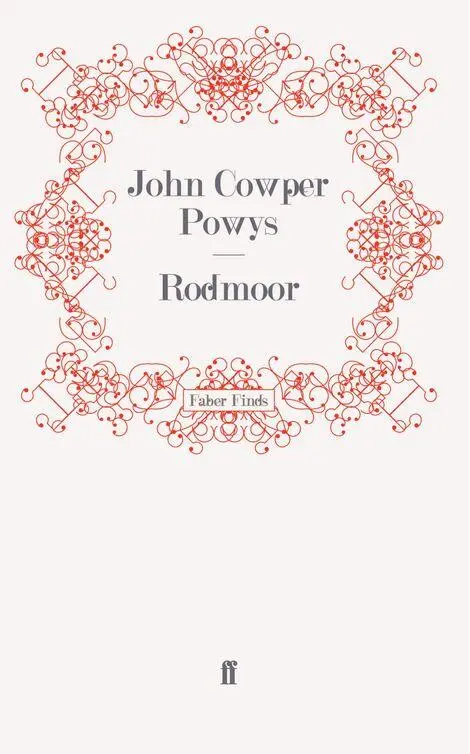
- Название:Rodmoor
- Автор:
- Издательство:Faber and Faber
- Жанр:
- Год:2008
- ISBN:нет данных
- Рейтинг книги:5 / 5. Голосов: 1
-
Избранное:Добавить в избранное
- Отзывы:
-
Ваша оценка:
Rodmoor: краткое содержание, описание и аннотация
Предлагаем к чтению аннотацию, описание, краткое содержание или предисловие (зависит от того, что написал сам автор книги «Rodmoor»). Если вы не нашли необходимую информацию о книге — напишите в комментариях, мы постараемся отыскать её.
This was Powys second novel, published in 1916. It deploys a rich and memorable cast of characters.
Rodmoor — читать онлайн бесплатно полную книгу (весь текст) целиком
Ниже представлен текст книги, разбитый по страницам. Система сохранения места последней прочитанной страницы, позволяет с удобством читать онлайн бесплатно книгу «Rodmoor», без необходимости каждый раз заново искать на чём Вы остановились. Поставьте закладку, и сможете в любой момент перейти на страницу, на которой закончили чтение.
Интервал:
Закладка:
His face as he listened to her darkened to a kind of savage fury. Its despotic and imperious lines emphasized themselves to a degree that was really terrifying.
“You won’t?” he cried, “you won’t, you won’t?” And seizing her roughly by the shoulder he actually began twisting the rope round her body.
She resisted desperately, pushing him away with all the strength of her arms. In the struggle between them, which soon became a dangerous one, her hand thrusting back his head unintentionally drew blood with its delicate finger-nails from his upper lip. The blood trickled into his mouth and, maddened by the taste of it, he let her go and seizing the end of the rope, struck her with it across the breast. This blow seemed to bewilder her. She ceased all resistance. She became docile and passive in his hands.
Mechanically he went on with the task he had set himself, of fastening the rope round her beneath her arm-pits and tying it into a knot. But her absolute submissiveness seemed presently to paralyze him as much as his previous violence had disarmed and paralyzed her. He unloosed the knot he was making and with a sudden jerk pulled the rope away from her. The rope swung back to its former position and dangled in the air, swaying gently from side to side. They stood looking at each other in startled silence and then, quite suddenly, the girl moved forward and flung her arms round his neck.
“I love you!” she murmured in a voice unlike any he had heard her use before. “I love you! I love you!” and her lips clung to his with a long and passionate kiss.
Sorio’s emotions at that moment would have caused her, had she been conscious of them, a reaction even less endurable than that which she had just been through. To confess the truth he had no emotion at all. He mechanically returned her kisses; he mechanically embraced her. But all the while he was thinking of those water-beetles with shiny metallic coats that were gyrating even now so swiftly round that reedy pool.
“Water-beetles!” he thought, as the girl’s convulsive kisses, salt with her passionate tears, hurt his wounded lip. “Water-beetles! We are all like that. The world is like that! Water-beetles upon a dark stream.”
She let him go at last and they moved out together hand in hand into the open air. Above them the enormous windmill still upheld its motionless arms while from somewhere in the fens behind it came a strange whistling cry, the cry of one of those winged intruders from foreign shores, which even now was perhaps bidding farewell to regions of exile and calling out for some companion for its flight over the North Sea.
With his hand still held tightly in hers, Philippa walked silently by his side all that long way across the meadows and dykes. Sorio took advantage of her unusually gentle mood and began plaintively telling her about the nervous sufferings he endured in Rodmoor and about his hatred for the people there and his conviction that they took delight in annoying him. Then little by little, as the girl’s sympathetic silence led him on, he fell to flinging out — in short, jerky, broken sentences — as if each word were torn up by the roots from the very soil of his soul, stammered-references to Baptiste. He spoke as if he were talking to himself rather than to her. He kept repeating over and over again some muttered phrase about the bond of abnormal affection which existed between them. And then he suddenly burst out into a description of Baptiste. He rambled on for a long while upon this topic, leaving in the end only a very blurred impression upon his hearer’s mind. All, in fact, the girl was able to definitely arrive at from what he said was that Baptiste resembled his mother — a Frenchwoman of the coast of Brittany — and that he was tall and had dark blue eyes.
“With the longest lashes,” Sorio kept repeating, as if he were describing to her some one it was important she should remember, “that you, or any one else, has ever seen! They lie on his cheek when he’s asleep like — like—”
He fumbled with the feathery head of a reed he had picked as they were walking but seemed unable to find any suitable comparison. It was curious to see the shamefaced, embarrassed way he threw forth, one by one, and as if each word caused him definite pain in the uttering, these allusions to his boy.
Philippa let him ramble on as he pleased, hardly interrupting him by a gesture, listening to him, in fact, as if she were listening to a person talking in his sleep. She learnt that it was only with the greatest difficulty that he had persuaded Baptiste to keep his position in New York and not fling everything up and follow him to London. She learnt that Baptiste had copied out with his own hand the larger portion of Sorio’s book and that now, as he completed each new chapter, he sent it by registered mail straight to the boy in “Eleventh Street.”
“It will explain my life, my whole life, that book,” Adrian muttered. “You’ve only heard a few of its ideas, Phil, only a few. The secret of things being found, not in the instinct of creation but in the instinct of destruction, is only the beginning of it. I go further — much further than that. Don’t laugh at me, Phil, if I just say this — only just this: I show in my book how what every living thing really aims at is to escape from itself, to escape from itself by the destruction of itself. Do you get the idea in that, Phil? Everything in the world is — how shall I put it? — these ideas are not easy, they tear at a person’s brain before they become clear! — everything in the world is on the edge, on the verge, of dissolving away into what people call nothingness. That is what Shakespeare had in his mind when he said, ‘the great globe itself, yea! all which it inherits, shall dissolve and — and—’ I forget exactly how it runs but it ends with ‘leave not a rack behind.’ But the point I make in my book is this. This ‘nothingness,’ this ‘death,’ if you like, to which everything struggles is only a name for what lies beyond life —for what lies, I mean, beyond the extreme limit of the life of every individual thing. We shrink back from it, everything shrinks back from it, because it is the annihilation of all one’s familiar associations, the destruction of the impulse to go on being oneself! But though we shrink back from it, something in us, something that is deeper than ourselves pushes us on to this destruction. This is why, when people have been outraged in the very roots of their being, when they have been lacerated and flayed more than they can bear, when they have been, so to speak, raked through and combed out, they often fall back upon a soft delicious tide of deep large happiness, indescribable, beyond words.”
He was too absorbed in what he was saying to notice that as he made this remark his companion murmured a passionate assent.
“They do! They do! They do!” the girl repeated, with unrestrained emotion.
“That is why,” he continued without heeding her, “there is always a fierce pleasure in what fools call ‘cynicism.’ Cynicism is really the only philosophy worth calling a philosophy because it alone recognizes ‘that everything which exists ought to be destroyed.’ Those are the very words used by the devil in Faust, do you remember? And Goethe himself knew in his heart the truth of cynicism, only he loved life so well, — the great child that he was! — that he couldn’t endure the thought of destruction. He understood it though, and confessed it, too. Spinoza helped him to see it. Ah, Phil, my girl, there was a philosopher! The only one — the only one! And see how the rabble are afraid of Spinoza! See how they turn to the contemptible Hegel, the grocer of philosophy, with his precious ‘self-assertion ‘and ‘self-realization’! And there are some idiots who fail to see that Spinoza was a cynic, that he hated life and wished to destroy life. They pretend that he worshipped Nature. Nature! He denied the existence of it. He wished to annihilate it, and he did annihilate it, in his terrible logic. He worshipped only one thing, that which is beyond the limit, beyond the extremest verge, beyond the point where every living thing ceases to exist and becomes nothing! That’s what Spinoza worshipped and that’s what I worship, Phil. I worship the blinding white light which puts out all the candles and all the shadows in the world. It blinds you and ends you and so you call it darkness. But it only begins where darkness is destroyed with everything else! Darkness is like cruelty. It’s the opposite of love. But what I worship is as far beyond love as it is beyond the sun and all the shadows thrown by the sun!”
Читать дальшеИнтервал:
Закладка:
Похожие книги на «Rodmoor»
Представляем Вашему вниманию похожие книги на «Rodmoor» списком для выбора. Мы отобрали схожую по названию и смыслу литературу в надежде предоставить читателям больше вариантов отыскать новые, интересные, ещё непрочитанные произведения.



Обсуждение, отзывы о книге «Rodmoor» и просто собственные мнения читателей. Оставьте ваши комментарии, напишите, что Вы думаете о произведении, его смысле или главных героях. Укажите что конкретно понравилось, а что нет, и почему Вы так считаете.