Emili Teixidor - Black Bread
Здесь есть возможность читать онлайн «Emili Teixidor - Black Bread» весь текст электронной книги совершенно бесплатно (целиком полную версию без сокращений). В некоторых случаях можно слушать аудио, скачать через торрент в формате fb2 и присутствует краткое содержание. Год выпуска: 2016, Издательство: Biblioasis, Жанр: Современная проза, на английском языке. Описание произведения, (предисловие) а так же отзывы посетителей доступны на портале библиотеки ЛибКат.
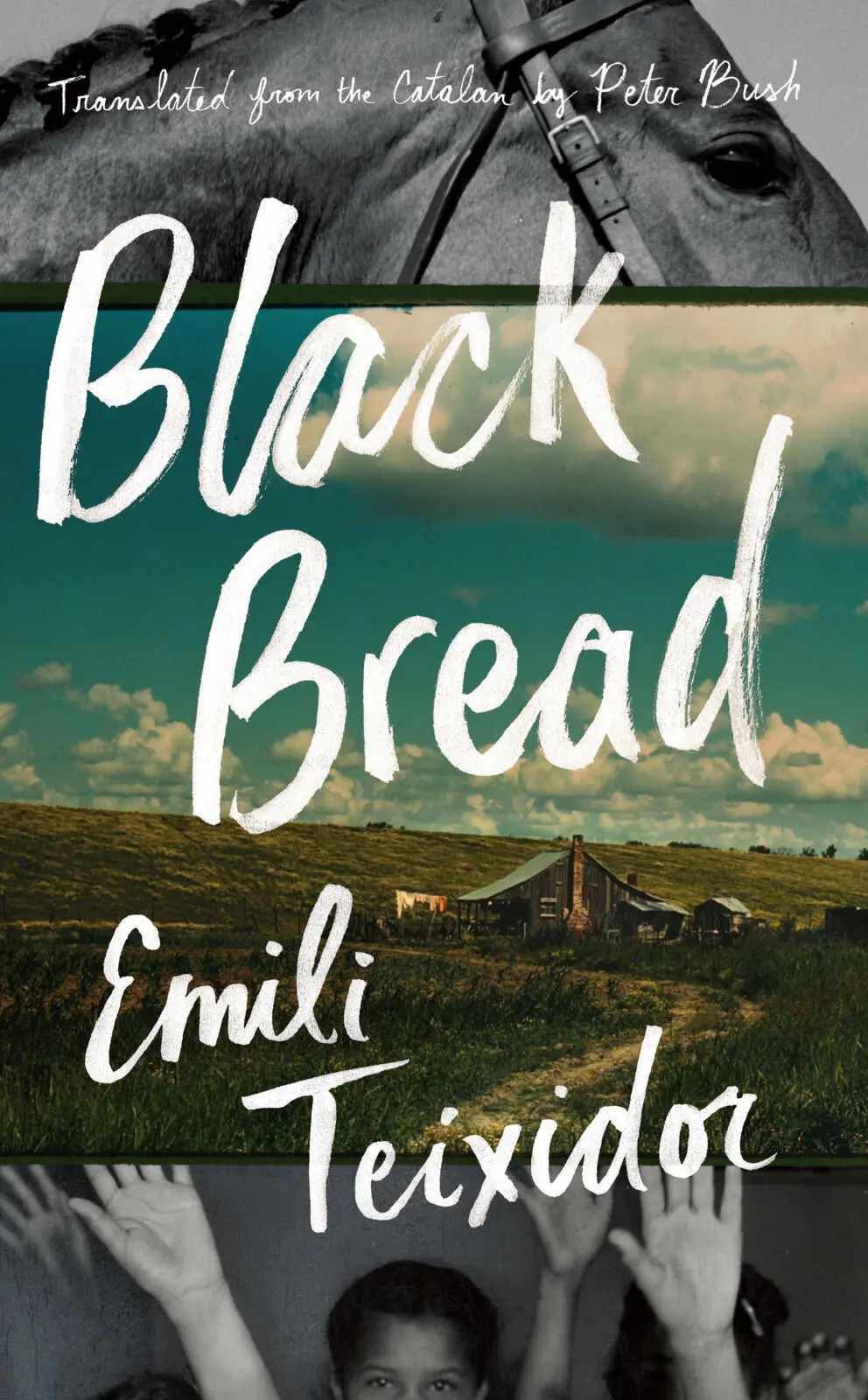
- Название:Black Bread
- Автор:
- Издательство:Biblioasis
- Жанр:
- Год:2016
- ISBN:нет данных
- Рейтинг книги:3 / 5. Голосов: 1
-
Избранное:Добавить в избранное
- Отзывы:
-
Ваша оценка:
Black Bread: краткое содержание, описание и аннотация
Предлагаем к чтению аннотацию, описание, краткое содержание или предисловие (зависит от того, что написал сам автор книги «Black Bread»). Если вы не нашли необходимую информацию о книге — напишите в комментариях, мы постараемся отыскать её.
Born in 1933,
's first novel,
, was published to tremendous acclaim in 1988, followed by several more which established him as one of Spain's greatest contemporary authors.
Black Bread — читать онлайн бесплатно полную книгу (весь текст) целиком
Ниже представлен текст книги, разбитый по страницам. Система сохранения места последней прочитанной страницы, позволяет с удобством читать онлайн бесплатно книгу «Black Bread», без необходимости каждый раз заново искать на чём Вы остановились. Поставьте закладку, и сможете в любой момент перейти на страницу, на которой закончили чтение.
Интервал:
Закладка:
Does memory have a guiding thread or purpose? Why am I still haunted by Father’s farmhouse, by its fruit orchards, by that impenetrable wood, and if it wasn’t for the phantoms and fears crowding my head, by that pleasant landscape of sandy hills with its backdrop of invisible crags and blue mountains? What is the meaning of these memories that come so insistently to mind in no apparent order and from a hodgepodge of locations? Why haven’t I retained with equally gentle emotions a vision of the farmhouse that belonged to my mother’s grandparents and huge family? Why do some landscapes live within us and others not? Why do some individuals, family or not, hold the key to entering into our inner being while others are banished to the darkness outside, as the friars would say, rejected as miscreants, unworthy of crossing the threshold of memory?
Could that mysterious set of dead people Grandmother described to us really be true, exist invisibly, holding out hands to each other to avoid sinking definitively into the abyss, the last in the line — the one we knew in life — holding out an arm and an open hand, even tickling our backs and the soles of our feet, always beneath us, immersed in an invisible world and attached to a long necklace of which we only recognize the last bead in the rosary?
Sometimes it is simply a word that ignites the whole chain: azalea, don’t forget to water the azalea, jug, a jug of milk, or pew, Grandmother always sits on the pew, or morel, we’ll go to the woods to pick morels or we’ll make a morel and hedge mushroom omelette, or a karakul, a Persian sheep that made us laugh, it’s a karakul, its lambs have got the runs from colostrum, the first milk after birth, or mistletoe, wild lettuce and purslane that were for the pigs, but mistletoe was also a game played with folded belts, and Father Tafalla’s frenzy, a word that only he used, the frenzy of the insurgents, a word that inspired fear, that was more than an insult…words that functioned like the first exercises pupils do when learning to read, the shock of discovery, a noun we’ve not heard for years that transports us far away and opens the floodgates to all those images and old words that are mired in oblivion.
Azalea, jug, pew, morel, hedge mushroom, karakul, mistletoe, wild lettuce, purslane, orange water, frenzy, crabapple, broody hen, looms, shuttles, lock-gates, hob, kitchen range, convolvulus and wild radish, herbs to ripen cheese in the churn, anvil to forge horseshoes, predators not to be trusted because they attack you, fertilizing land…
Like the small white pebbles in the story about children lost in the woods, that the youngest, trailing behind the line led by his parents, big brothers and sisters, dropped on the ground, the white stones he’d put in his pocket so he could find the path and his way home when his parents abandoned him.
Without parents, Cry-Baby and I were left with only words to help us get back on the right path. The secrets were but words, like every illumination. Small white stones. Stones. Smooth pebbles from the stream. Words.
18
There were word games, games that became the fashion and that overnight were replaced by others whose provenance nobody knew, not even those who’d brought them to class. That was the case with the nonsense game.
We all four joined in the round, because we only played when Oak-Leaf did, after we left school in the afternoon, in the clearing in the woods. The game was only interesting because of the words thrown up by the questions and answers we exchanged, following the rules of the game, and the comments Oak-Leaf often added, arousing our sense of mischief and appealing to our most hidden desires and a curiosity that was surfacing only now and even then against our will.
One of the four players whispered into the ear of his neighbour, so the others couldn’t hear, “what use is our head?” or “what use are our legs?”; the individual questioned would reply just as warily, “our head is for thinking” or “our legs are for dancing.” Once the round was finished, each person had to repeat a question and an answer, ignoring their own contribution, and only repeating part of the question to the people to their left and right, “He asked me what use our head is and she replied ‘it was good for dancing.’” That way we came up with the silliest nonsense and the maddest responses.
First Oak-Leaf and then Quirze introduced new words that, camouflaged by fantastic definitions, seemed even more mysterious to Cry-Baby and me. And they, rogues or rapscallions, according to Grandmother, worked it so they got the most amusing or obscene. They directed the game and laughed the most.
So you might get, “What’s the point of our bum?” and he told me, “It was to eat with,” or she asked, “What’s a male for?” and he told me, “It was an egg-making animal.” The game started with innocent nonsense, then suddenly a secret, forbidden word cropped up, “He asked me what a cunt is for and I heard it was a hot, black sauce for dunking sponge-fingers in,” or “she asked me what a hot chocolate delight was and someone replied it was a black hole women had.” The words were uttered and immediately stripped of their obscene meaning — unless that was highlighted and caricatured by an arbitrary reply — and that dislocation of meaning and the surprise and laughter they triggered meant the game seemed quite ingenuous.
There were always words left at the end that Cry-Baby and I didn’t know and we’d have to consult Quirze, or, less usually, Oak-Leaf. The whole repertoire of basic eroticism the two rogues or rapscallions would place on the table like a trump card to win a victory for the person who played it.
Once we’d run through the list of words referring to sexuality, our game took a turn that from the very beginning, from the first question and answer, felt as, if not more, exciting than the previous exchanges, and definitely more perilous. Nobody had set down the rules, but apparently after focusing on obscene words, someone decided it would be more fun with the names of the people who in some way practised the actions the words referred to.
“What is Madern the teacher good for?” introduced the first real person into our closed circle. Cry-Baby blushed bright red the second she heard me repeat the question Oak-Leaf had asked me. As I’d not suspected that her words carried any hidden agenda, I asked Quirze an innocuous question that elicited a ridiculous statement nobody found at all funny.
“Mr. Madern is good for opening your mouth when you’ve got toothache.”
I grasped my opportunity to stick my oar in, “What is Pere Màrtir good for?” and when she heard that, Oak-Leaf gave me a surprised look and then continued with the game.
However, she saw to it that I got a surprise outcome: “He asked me, ‘What is Pere Màrtir good for?’ and someone said: ‘he’s good for nothing.’” When Quirze heard that, he glanced furiously in the direction of Oak-Leaf and she wrinkled her lip into a grin and defied his glare, and a moment later, as if they’d both said something to one another, they burst out laughing, she first, then he joined in, though less wholeheartedly.
Cry-Baby noticed the game had begun to follow a different pattern, and a few days after the inclusion of proper names, she got up halfway through a session and declared she was tired and bored and didn’t want to play anymore. As well as Mr. Madern and Pere Màrtir we dropped into our round of nonsense, with varying results, Aunt Enriqueta, Father Tafalla from the Sant Camillus monastery, blond, bad-tempered Canary from the Civil Guard, the other one, Curly Lettuce, Gamundi and Siscu, a boy from school who was always trailing after Oak-Leaf, Xavier, the novice from Navarra, and a woman from the hamlet nicknamed Jump for Joy who was reputed to go with any man who asked for it, though she wasn’t considered to be a whore, Cal Set, the official brothel in Vic, renowned throughout the district, Sweet Biscuit who sold sweets in the factory town whose body was like a sponge cake, whom everyone thought was effeminate and half-queer, and even Grandmother Mercè’s goblins.
Читать дальшеИнтервал:
Закладка:
Похожие книги на «Black Bread»
Представляем Вашему вниманию похожие книги на «Black Bread» списком для выбора. Мы отобрали схожую по названию и смыслу литературу в надежде предоставить читателям больше вариантов отыскать новые, интересные, ещё непрочитанные произведения.







Обсуждение, отзывы о книге «Black Bread» и просто собственные мнения читателей. Оставьте ваши комментарии, напишите, что Вы думаете о произведении, его смысле или главных героях. Укажите что конкретно понравилось, а что нет, и почему Вы так считаете.