Wojciech Zukrowski - Stone Tablets
Здесь есть возможность читать онлайн «Wojciech Zukrowski - Stone Tablets» весь текст электронной книги совершенно бесплатно (целиком полную версию без сокращений). В некоторых случаях можно слушать аудио, скачать через торрент в формате fb2 и присутствует краткое содержание. Год выпуска: 2016, Издательство: Paul Dry Books, Жанр: Современная проза, на английском языке. Описание произведения, (предисловие) а так же отзывы посетителей доступны на портале библиотеки ЛибКат.
- Название:Stone Tablets
- Автор:
- Издательство:Paul Dry Books
- Жанр:
- Год:2016
- ISBN:нет данных
- Рейтинг книги:4 / 5. Голосов: 1
-
Избранное:Добавить в избранное
- Отзывы:
-
Ваша оценка:
Stone Tablets: краткое содержание, описание и аннотация
Предлагаем к чтению аннотацию, описание, краткое содержание или предисловие (зависит от того, что написал сам автор книги «Stone Tablets»). Если вы не нашли необходимую информацию о книге — напишите в комментариях, мы постараемся отыскать её.
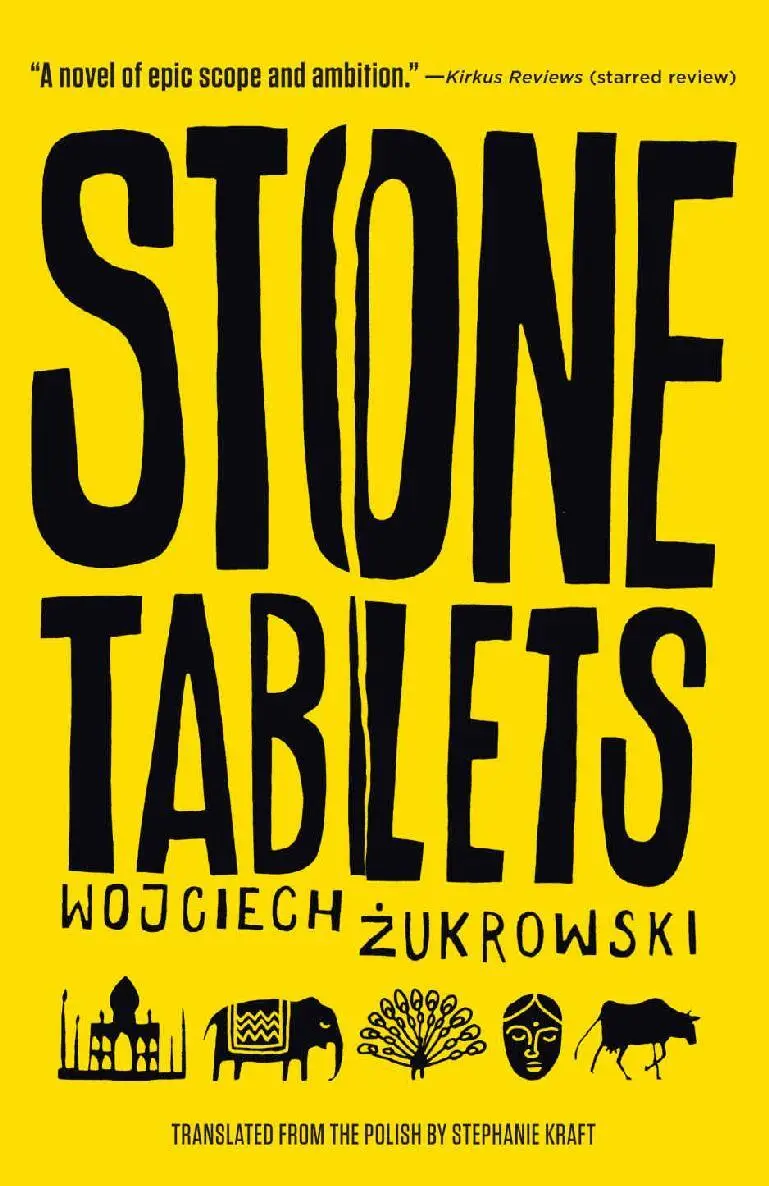
(starred review) An influential Polish classic celebrates 50 years — and its first English edition Stone Tablets Draining heat, brilliant color, intense smells, and intrusive animals enliven this sweeping Cold War romance. Based on the author’s own experience as a Polish diplomat in India in the late 1950s,
was one of the first literary works in Poland to offer trenchant criticisms of Stalinism. Stephanie Kraft’s wondrously vivid translation unlocks this book for the first time to English-speaking readers.
"A high-paced, passionate narrative in which every detail is vital." — Leslaw Bartelski
"[Zukrowski is] a brilliantly talented observer of life, a visionary skilled at combining the concrete with the magical, lyricism with realism." — Leszek Zulinski
Wojciech Zukrowski
Stone Tablets — читать онлайн бесплатно полную книгу (весь текст) целиком
Ниже представлен текст книги, разбитый по страницам. Система сохранения места последней прочитанной страницы, позволяет с удобством читать онлайн бесплатно книгу «Stone Tablets», без необходимости каждый раз заново искать на чём Вы остановились. Поставьте закладку, и сможете в любой момент перейти на страницу, на которой закончили чтение.
Интервал:
Закладка:
“How did Nehru explain this?” Terey asked. “He had to give you an answer, after all.”
“He said that the issue was complicated, that it was over our heads. That we are led by the impulses of our hearts and not by political acumen…That we should study, and leave politics to those older than ourselves,” they said, interrupting each other, full of indignation. Their sandals clattered on the damp asphalt; they walked briskly to keep warm in the chilly twilight.
“We had to attack him because he changed his opinion as if it were a banner. Then he admitted that he had only gotten the full reports today, and he said it was an act of courage for him to alter his assessment of the situation now that he knows a great deal more; that he has learned better than to rush to judgment about matters concerning which he has not thought deeply.”
“Then we began to whistle.”
“He called us a band of fools.”
“He is burned out.”
“He is afraid of the Russians and the Chinese.”
“He is in the pocket of the Russians,” they sniffed with sudden malice. “He has sold out for the steel mills they are building for us.”
“We agreed among ourselves that we would go and protest at the embassy. They wanted to give us five rupees each to go away.”
“And that fellow who wanted to pay us more to protest?”
“But what a beautiful car he had…”
“An American.”
“Not one of us took a rupee from him, either. We are independent.”
“We are young. We can afford to defend the truth for its own sake.”
They accompanied him to Nagar’s villa. They made an appointment to visit him at the embassy the next day, and asked for informational brochures. They wanted to sign on with the Hungarian-Indian Friendship Society. The boy who had held him so tenderly by the arm whispered, “And I would like to get a few Hungarian stamps, for I have a collection…”
Istvan was touched. Their impulses were so childlike, but they were sincere and full of zeal. “We are for socialism,” they assured him, seizing his hand in the darkness. “But violence is contemptible.”
He had hardly shut the gate when Trompette, bored with solitude, bounded out with a joyful bark. She tried to climb onto his chest and lick his face.
“Stop wiping your muddy paws on me.” He held her affectionately by the back of her neck, though she wriggled with delight in his presence and her pink tongue, like a slice of ham, quivered with readiness to kiss him in canine fashion.
“Mr. Nagar is not here.” The young Indian stepped out of the office with movements like a woman’s. With a gentle gesture he invited the counselor to come in for a rest if he liked.
“What is happening in Budapest?”
“The situation is under control.”
“That’s what I heard a week ago.”
“There is a new government. In the course of six hours the streets were cleared. Tanks demolished the barricades.”
“And what of the previous government?”
“They protested. They appealed to the conscience of Europe. But before it was aroused”—he spoke with a mocking, melancholy air—“the tanks rolled through to the parliament and the premier sought asylum in the Yugoslavian embassy.”
“And Mindszenty?” Terey saw that the secretary did not even know the name. “Well, the cardinal. The one who was let out of prison.”
“You have strange names, hard to pronounce or remember. He has taken refuge with the Americans. In Budapest there is a curfew. Meetings are prohibited. The military is disarmed.” He spread his hands in a sympathetic gesture. “After the Russian forces were called in, the West gave no help. Even diplomatic protests were very measured. The press has already turned its attention away from Hungary, Mr. Terey. It is not important to them,” he said emphatically.
“And what is important?”
“Suez. Incoming bulletins say the march of French and English units has been halted. Israel as well is prepared to withdraw its troops. They have gone lax; they have lost the momentum for battle. Khrushchev has won.” The Hindu seemed to pause and think, to remind himself of what he had heard. “They calculated that he would be drawn into an altercation in Hungary. In the meantime, he delivered one blow with a fist, then at once supported Egypt. He threatened to send weapons and volunteers, and that would have meant — war, a third world war. So what could the Americans do? Support the Arabs, for otherwise the Russians would have garnered all their sympathy. The French and English themselves were on the battlefield. The cat jumped at the mouse and found itself nose to nose with the watchdog, so it looked around to see which tree to run up in order to feel safe.”
His long eyelashes fluttered. He bustled around the hall preparing a drink for the counselor. Istvan thought of a woman who, in her husband’s absence, entertains a visitor and, finding herself at a loss, repeats opinions she has heard, stretching her mental horizons and wounding and intimidating without knowing what she has said.
Istvan sank between the cushions of the chair, gazing despondently at two slivers of wood in the fireplace that were bristling with little combs of flame. Suddenly everything became oppressive to him: the black head of the rhinoceros that Nagar had not shot, only bought. The room tricked out with hunting imagery for show. The purebred setter not trained for hunting. The French cuisine to efface the memory of years of hunger. The masks that hid the lonely, hounded man longing for peace and a comfortable life, a man who had been born on the cusp of three empires: the kaiser’s in Germany, the emperor’s in Austria, and the czar’s in Russia. A man who had been cut off from his native country, the religion of his childhood, and the memory of his murdered family, and for those losses had gained so little in exchange.
Perhaps even his homosexuality was a façade, an indulgence that eased him into a circle of refined snobs, of artists full of eccentricity and ennui. What do I hope to find here? he wondered, suddenly disconcerted. No; facts are facts; only commentary can change them to half-truths, quarter-truths, stuff them with sweet lies. I came here for bulletins, nothing more. Nagar gets them sooner than anyone else. And he likes me, so he does not withhold what for several hours is exclusively his property. Tomorrow I will hear the same facts on New Delhi radio; I will read them in the papers. They will grow old terribly quickly. Their significance will last for a little while, and in that hour — the hour when they astonish and dazzle us with the Hungarians’ extraordinary devotion to their cause — they will also leave us shocked by the forces that threatened them. The next day, after we have grown used to them, they simply are —they only add to the sum of our ineffective knowledge of life, of what is behind us. Of the past.
There is no way to overwhelm the opposing forces. A nation of twelve million, and it is only a chip in a game. Human life, the highest good, ten lives, a hundred thousand, have no significance…What can be done? How to help one’s own? Whose side to be on?
No. He shook his head as if answering a question put to him suddenly by someone else. I will not shoot at the Russians. They mobilized me then. I was in uniform. The gun barrel showed who the opponent was. I had no choice. It became clear that there was no compass unless you looked into your conscience, unless you acknowledged other people’s right to food and freedom. We wanted, after all, to save our country. And we returned from the war mutilated, written into the register of enemies, alongside those humanity judged to be criminals. They made us into…no. One must have the courage to say: we became, having paid with enormous sacrifices, with the ruin of our country, their partners.
Читать дальшеИнтервал:
Закладка:
Похожие книги на «Stone Tablets»
Представляем Вашему вниманию похожие книги на «Stone Tablets» списком для выбора. Мы отобрали схожую по названию и смыслу литературу в надежде предоставить читателям больше вариантов отыскать новые, интересные, ещё непрочитанные произведения.







Обсуждение, отзывы о книге «Stone Tablets» и просто собственные мнения читателей. Оставьте ваши комментарии, напишите, что Вы думаете о произведении, его смысле или главных героях. Укажите что конкретно понравилось, а что нет, и почему Вы так считаете.