Jay McInerney - Bright, Precious Days
Здесь есть возможность читать онлайн «Jay McInerney - Bright, Precious Days» весь текст электронной книги совершенно бесплатно (целиком полную версию без сокращений). В некоторых случаях можно слушать аудио, скачать через торрент в формате fb2 и присутствует краткое содержание. Год выпуска: 2016, Издательство: Knopf, Жанр: Современная проза, на английском языке. Описание произведения, (предисловие) а так же отзывы посетителей доступны на портале библиотеки ЛибКат.
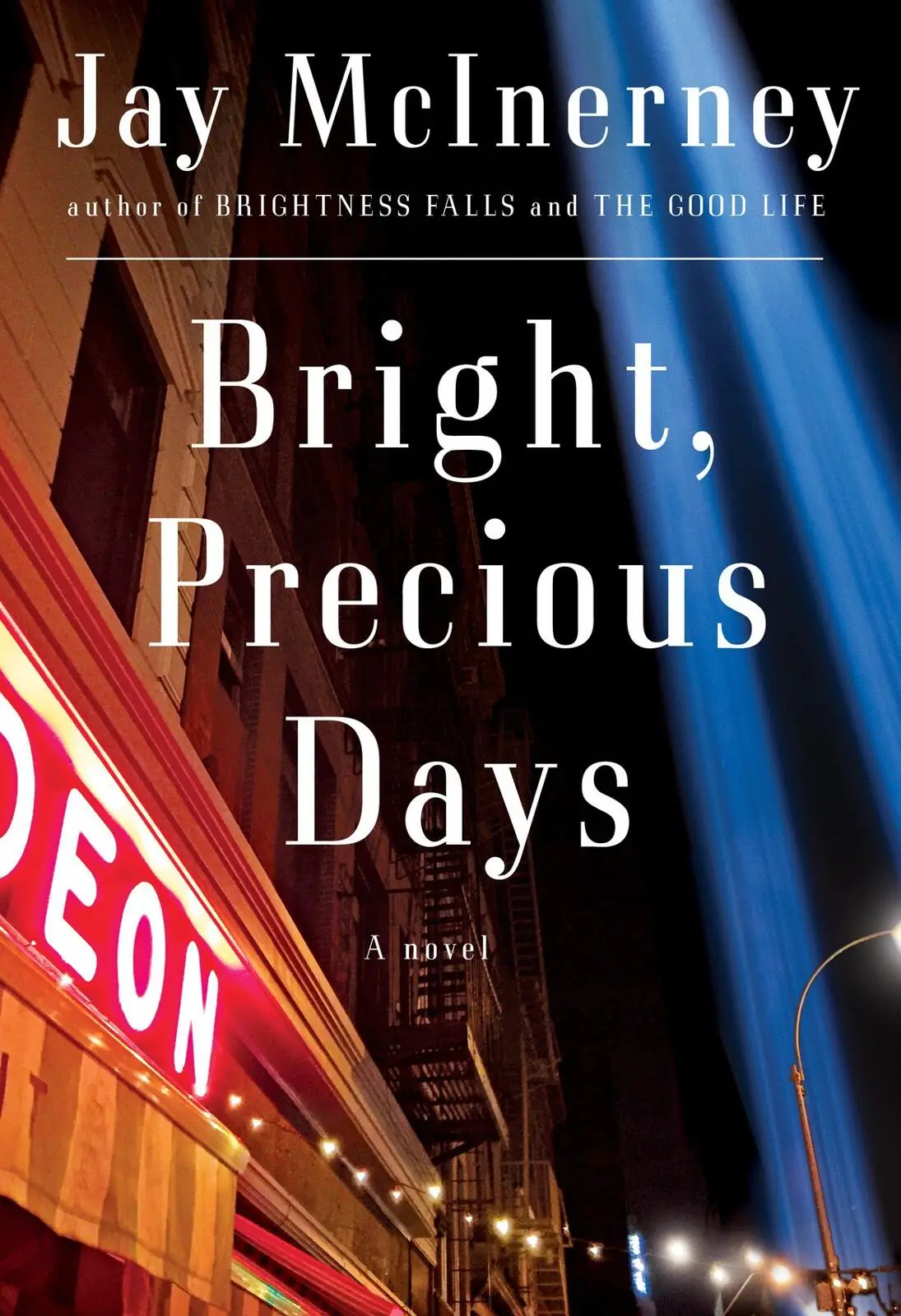
- Название:Bright, Precious Days
- Автор:
- Издательство:Knopf
- Жанр:
- Год:2016
- ISBN:нет данных
- Рейтинг книги:5 / 5. Голосов: 1
-
Избранное:Добавить в избранное
- Отзывы:
-
Ваша оценка:
Bright, Precious Days: краткое содержание, описание и аннотация
Предлагаем к чтению аннотацию, описание, краткое содержание или предисловие (зависит от того, что написал сам автор книги «Bright, Precious Days»). Если вы не нашли необходимую информацию о книге — напишите в комментариях, мы постараемся отыскать её.
a sexy, vibrant, cross-generational New York story — a literary and commercial read of the highest order.
Russell and Corrine Calloway seem to be living the New York dream: book parties one night and high-society charity events the next; jobs they care about (and actually enjoy); twin children, a boy and a girl whose birth was truly miraculous; a loft in TriBeCa and summers in the Hamptons. But all of this comes at a high cost. Russell, an independent publisher, has cultural clout but minimal cash; as he navigates an industry that requires, beyond astute literary taste, constant financial improvisation, he encounters an audacious, expensive and potentially ruinous opportunity. Meanwhile, instead of seeking personal profit in this incredibly wealthy city, Corrine is devoted to feeding its hungry poor, and they soon discover they're being priced out of their now fashionable neighborhood.
Then Corrine's world is turned upside down when the man with whom she'd had an ill-fated affair in the wake of 9/11 suddenly reappears. As the novel unfolds across a period of stupendous change-including Obama's historic election and the global economic collapse he inherited — the Calloways will find themselves and their marriage tested more severely than they ever could have anticipated.
Bright, Precious Days — читать онлайн бесплатно полную книгу (весь текст) целиком
Ниже представлен текст книги, разбитый по страницам. Система сохранения места последней прочитанной страницы, позволяет с удобством читать онлайн бесплатно книгу «Bright, Precious Days», без необходимости каждый раз заново искать на чём Вы остановились. Поставьте закладку, и сможете в любой момент перейти на страницу, на которой закончили чтение.
Интервал:
Закладка:
The women wore sundresses and sandals, and the early arrivals were hidden behind big sunglasses — Tom Ford was the frame of the moment — which they pushed to the tops of their heads after the sun went down in a way that they hoped was reminiscent of Jackie O. Corrine was wearing a stretchy turquoise paisley Pucci that she’d bought when Russell took her to Capri for a literary conference, and she was wondering if it wasn’t just a little too tight.
She was always surprised that she knew almost every single person, except for the houseguests, who were inevitably profuse in thanking her for allowing them to come. She wasn’t aware that Tug Barkley had been invited until she saw him amble up the drive wearing nothing but cargo shorts and a wifebeater, flanked by two glamazons in tiny white dresses. Tug’s interest had revived the long-dormant production of Youth and Beauty, though she’d never actually met him. He seemed to sense she was the hostess, smiling broadly and thrusting out his hand. “Hey, I’m Tug. Thanks for having me.”
“I’m Corrine,” she said. “It’s a real pleasure to meet you.” While she considered herself immune to the charms of vapid celebrities, that wasn’t how she felt at this moment. Perhaps it was the fact that this was the man who would play Jeff on-screen. Except, of course, it was more than that. “Actually, I’m working on the Youth and Beauty screenplay with Cody Erhardt.”
“That’s cool,” he said. “Love Cody.”
Somewhat taken aback, expecting some kind of follow-up or acknowledgment, she explained that there were bars inside and out, and told them to make themselves at home. She was only slightly surprised to see Russell bound off the porch and greet Tug like an old friend. Russell was nothing if not gregarious, and if she sometimes thought he was indiscriminate in collecting people, she also couldn’t help sometimes admiring the breadth of his acquaintance and his enthusiasm for new people, as well as his conviction that there were still friends to be made at an age when most men were consolidating their portfolios of names and faces. After all these years he still had a boyish love of parties, and a provincial’s wonderment at the social spectacle of New York, with all its bright stars and unlikely juxtapositions — and this was undoubtedly New York, with a sprinkle of Hollywood, spread out on the browning lawn beside the old shingled farmhouse.
Cody, meanwhile, was chatting up one of the gorgeous young things who’d showed up with Tug. “I’m just saying every novel’s unique, a reinvention of the form. A screenplay has conventions that need to be observed — action, dialogue, three-act structure.”
“What’s three-act structure?”
“Boy meets girl, boy and girl get into pickle, boy gets pickle into girl.”
She giggled, raising her hand to her face to cover a crooked tooth.
“I haven’t heard that one,” Tug said, returning with three drinks in hand, one of which he handed off to her. “So I see you’ve met the great Cody Erhardt.”
“Cody who?”
Cody looked miffed, of course.
“Shit, that just shows what’s happened to this business,” Tug said. “Cody here’s the man. He did all these amazing movies in the seventies. Part of that Scorsese-Schrader clique. American Ninja, Death by a Thousand Cuts. ”
The great man himself, who had tried at one time to get his pickle into Corrine, bowed in acknowledgment of the compliment.
“Oh right,” the girl said. “I loved American Ninja. ”
—
Burly, bearded Rob Klemp, the painter, in paint-stained cargo shorts, was talking to reedy Jillian Simms, the fashion designer, angelic in white jeans and white T-shirt, her blond hair flat against her skull, pulled back in a ponytail. What were they talking about? Sometimes Corrine wondered how these people knew one another, and how the hell they knew them. As she got closer, she heard them arguing.
“Come on, Obama has no résumé,” Jillian said. “I mean, he’s been a senator for, what? Three minutes?”
“Long enough to be right about the war in Iraq.”
“Hillary’s got substance. Face it, Obama’s a lightweight.”
Russell had loaded up a special iPod for the occasion, which seemed to Corrine to consist of Don Henley’s “Boys of Summer,” the Go-Go’s “Vacation,” the Motels’ “Suddenly Last Summer,” “Summertime Blues” by various artists, “Margaritaville,” plus pretty much all of the Beach Boys catalog. Thankfully, he’d skipped “Big Girls Don’t Cry” and “Umbrella,” the ubiquitous anthems of the summer.
“Oh my God,” Corrine said, spotting a newcomer. “That’s Tony Duplex.”
“Yeah,” Rob said. “He came with Gary Arkadian. Tony’s got a new show going up this fall at Arkadian’s gallery.”
“I haven’t seen him in years,” Corrine said. Tony looked very much out of place in a tight black suit over a shirt as white as his complexion.
“He disappeared up a crack pipe for most of the nineties, but apparently he’s back.”
“I remember,” she said. He’d been great friends with Jeff, in fact.
Not surprisingly, he looked frail for his years. They were almost surely the same age, but he looked much older, his face pitted and canyoned. He showed no sign of recognition when Russell came over and introduced him to Corrine. One of those downtown bad boys who failed to leave the party while the getting was good, he’d managed to sustain his drug habit well into the nineties, by which time his critical reputation had crashed and his drug of choice had gone out of fashion. As she recalled, there’d been some kind of fight with a collector who held dozens of his paintings, and the guy dumped them on the market all at once, right before Robert Hughes wrote a withering review of his latest show. She hadn’t heard his name for years; then, recently, she’d seen a picture of him at a party in New York magazine, and she seemed to recall a mention of his resurrection in the Post ’s Page Six.
“Thanks for having me,” he said, shaking her hand limply. Obviously he had no memory of the night she’d met him on the Lower East Side, ransoming him and Jeff from a shortchanged drug dealer with a handful of gold coins.
Kip Taylor emerged from the throng, with one hand raised in greeting, the other perched on his wife’s shoulder, accompanied by Luke and Giselle McGavock. Corrine tried to mute her shock as the group approached, to compose her features as Kip and Vanessa hugged her in turn, at which point the question of how to greet Luke presented itself. He answered it quickly by kissing her cheek, as did Giselle.
“I hope you don’t mind us crashing your party,” Luke said. “We’re staying with Kip and Vanessa this weekend.”
“You’re more than welcome,” Corrine said, hoping she sounded less flustered than she felt.
“I told them it was the party of the season,” Kip said.
“Hardly that,” Corrine said.
Luke grazed her with a rueful, apologetic glance.
Ten minutes later he found her alone in the kitchen, where she’d quickly retreated.
“I didn’t mean to sneak up on you,” he said. “Kip only mentioned that we were coming here an hour ago.”
“Why should I mind?” she said, realizing immediately that her tone was peevish. “I’m sorry,” she said. “I’m just — I just wasn’t expecting to see you.”
“I thought about calling. I didn’t know if I should. But I’d love to see you.”
“Here I am.”
“I mean alone.”
“We head back to the city on Monday,” she said.
“I’ll be there next week.”
“And your wife?” She wasn’t sure which designation she liked least, her name or her title.
Читать дальшеИнтервал:
Закладка:
Похожие книги на «Bright, Precious Days»
Представляем Вашему вниманию похожие книги на «Bright, Precious Days» списком для выбора. Мы отобрали схожую по названию и смыслу литературу в надежде предоставить читателям больше вариантов отыскать новые, интересные, ещё непрочитанные произведения.










Обсуждение, отзывы о книге «Bright, Precious Days» и просто собственные мнения читателей. Оставьте ваши комментарии, напишите, что Вы думаете о произведении, его смысле или главных героях. Укажите что конкретно понравилось, а что нет, и почему Вы так считаете.