Jonis Agee - The Bones of Paradise
Здесь есть возможность читать онлайн «Jonis Agee - The Bones of Paradise» весь текст электронной книги совершенно бесплатно (целиком полную версию без сокращений). В некоторых случаях можно слушать аудио, скачать через торрент в формате fb2 и присутствует краткое содержание. Год выпуска: 2016, Издательство: William Morrow, Жанр: Современная проза, на английском языке. Описание произведения, (предисловие) а так же отзывы посетителей доступны на портале библиотеки ЛибКат.
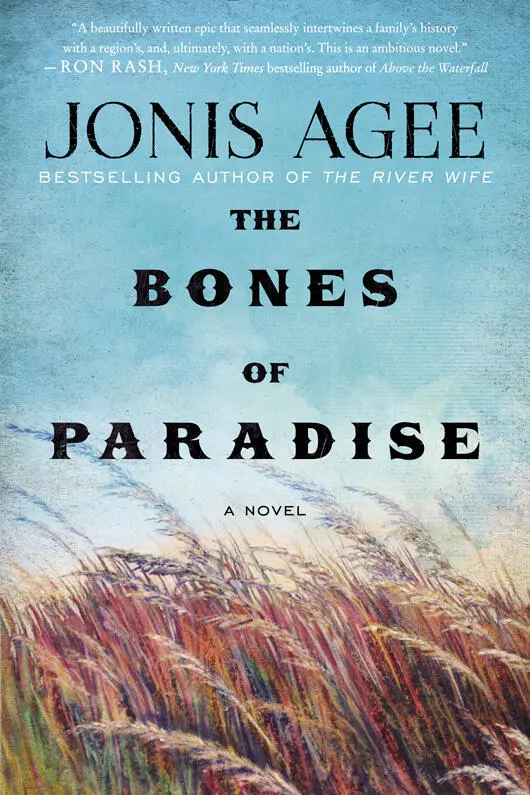
- Название:The Bones of Paradise
- Автор:
- Издательство:William Morrow
- Жанр:
- Год:2016
- ISBN:нет данных
- Рейтинг книги:3 / 5. Голосов: 1
-
Избранное:Добавить в избранное
- Отзывы:
-
Ваша оценка:
The Bones of Paradise: краткое содержание, описание и аннотация
Предлагаем к чтению аннотацию, описание, краткое содержание или предисловие (зависит от того, что написал сам автор книги «The Bones of Paradise»). Если вы не нашли необходимую информацию о книге — напишите в комментариях, мы постараемся отыскать её.
returns with a multi-generational family saga, set in the unforgiving Nebraska Sandhills in the years following the massacre at Wounded Knee—an ambitious tale of history, vengeance, race, guilt, betrayal, family, and belonging, filled with a vivid cast of characters shaped by violence, love, and a desperate loyalty to the land. Ten years after the 7th Calvary massacred more than 200 Lakota men, women, and children at Wounded Knee, J. B. Bennett, a white rancher, and Star, a young Native American woman, are murdered in a remote meadow on J. B.’s land. The deaths bring together the scattered members of the Bennett family: his cunning and hard father, Drum; his estranged wife, Dulcinea; and his young sons, Cullen and Hayward. As the mystery of these twin deaths unfolds, the history of the dysfunctional Bennett’s and their damning secrets are revealed exposing the conflicted heart of a nation caught between past and future.
At the center of
are two remarkable women. Dulcinea, returned after bitter years of self-exile, yearns for redemption and the courage to mend her broken family and reclaim the land that is rightfully hers. Rose, scarred by the terrible slaughters that have decimated and dislocated her people, struggles to accept the death of her sister, Star, and refuses to rest until she is avenged.
A kaleidoscopic portrait of misfits, schemers, chancers, and dreamers, Jonis Agee’s bold new novel is a panorama of America at the dawn of a new century. A beautiful evocation of this magnificent, blood-soaked land—its sweeping prairies, seas of golden grass and sandy hills, all at the mercy of two unpredictable and terrifying forces, weather and lawlessness—and the durable men and women who dared to tame it. Intimate and epic,
is a remarkable achievement: a mystery, a tragedy, a romance, and an unflagging exploration of the beauty and brutality, tenderness and cruelty that defined the settling of the American west.
The Bones of Paradise — читать онлайн бесплатно полную книгу (весь текст) целиком
Ниже представлен текст книги, разбитый по страницам. Система сохранения места последней прочитанной страницы, позволяет с удобством читать онлайн бесплатно книгу «The Bones of Paradise», без необходимости каждый раз заново искать на чём Вы остановились. Поставьте закладку, и сможете в любой момент перейти на страницу, на которой закончили чтение.
Интервал:
Закладка:
“What is it?” she asked Drum from the porch rocker where she sat with her two boys, one in her lap, the other beside her. Drum, realizing J.B. had said nothing, began a stream of invective.
“J.B. is in the barn. I’ll call him.”
As soon as she spoke, she saw in his eyes that he knew something she didn’t, and his narrow lips twitched below the carefully waxed mustache.
She was rarely alone with Drum and was foolish enough to assume he abided by the rules of civilized society, though why she imagined that she could not say. She was still a young woman then, with a child at her knee, another at her breast on the porch of her own home.
“I’m takin’ that youngster,” he said and used his chin to indicate Cullen, who quickly hid his face in her skirt. She should have rushed inside for the rifle by the door, she should have called out. Instead, she tried to bargain, though her heartbeat was too slow and loud, as if it would strike the wall of her chest and burst.
“Taking him for a ride? He’s too young to be on a horse by himself.”
The triumph in his eyes made her look down at Hayward and jiggle him in her arms, hoping his cry would give her an excuse to flee inside, though she doubted she could stand at that moment. Her legs were shaking and weak.
“No, ma’am. Taking him to live with me. Be raised the way a boy should be, grow up and run the ranches as they ought to be run.”
He gazed at the boy a moment, his lips pursed with thought. “You think a boy clinging to his mama’s skirts grows up to be worth a damn? You think I was raised soft? Or J.B.? Well, never mind about him.” Drum looked at the house with its curtains at the windows and bushes and flowers and herringbone brick walk. “Made a mistake sending him to the wife’s kin, shiftless as they come. Took me five years to put some sense in that boy once I got him back.”
Drum’s expression, the frown and tight lips, said it was her ruining the hard work he’d put into raising his son. She didn’t say a word. Truth be told, she couldn’t. Her heart beat too fast now, drying her breath so she couldn’t raise enough moisture to unlock her lips or her tongue that stuck to the roof of her mouth.
Cullen whimpered and clung harder, digging his tiny fingers into her leg, leaving bruises that took weeks to disappear, though she never wanted to lose them and found comfort in pressing her nails into the purple marks he left. Hayward ignored her efforts to wake him, merely smiled in his sleep while his brother broke into hiccupping sobs and stamped his feet as if he knew the days that lay ahead would forbid his tears. Still she did nothing, didn’t believe her ears, simply sat in the rocking chair J.B. had given her when she was pregnant with Cullen. She had rocked both her babies in that chair, and by the time his brother was born, Cullen had learned to stand on it and ride up and down, laughing, his head thrown back, eyes closed. Drum dismounted and walked toward the porch.
“I would have you leave now,” she said, finally standing and half turning, but he was too quick and snatched her son before she could stop him. The boy kicked and punched and scratched. Dulcinea grabbed the metal dipper on the water pail on the bench by the door and slashed it across Drum’s face, smashing his lips against his teeth.
With the momentary distraction, Cullen escaped and ran not to his mother, but around her into the house, with her on his heels. She barred the door, placed the baby in his cradle, took down the rifle, checked the load, and aimed it at the window so Drum could see. Blood dripped down his chin onto his faded gray shirt and she felt a wave of satisfaction when he spoke because the split in his lip garbled his words.
“This ain’t the end of it, missy. Not even halfway. I’ll be back—tell J.B. to have the boy ready.”
He didn’t bother touching his hat brim, a courtesy afforded even the most vile female in the hills. And he left the little paint gelding tied to the front fence. When J.B. came in for the noon meal, he took the paint to the corral, unsaddled and fed it. She stared out the kitchen window while it whinnied and paced to be taken home.
“What’s this all about, J.B.?” She demanded an answer and was met with silence and a shrug. It took her a while to find the reason, and by then it was already too late.
“You’re up early,” Vera said, her hands coated with flour from rolling and cutting biscuits as Dulcinea entered the kitchen. Rose glanced at her without smiling, like she had something on her mind. Rose usually said nothing while Vera and she talked, but Dulcinea heard her conversing with Lily whenever she thought they were alone. This morning, however, Rose spoke.
“You were up early, too,” Rose said. Vera’s shoulders stiffened, and her hands paused as she lifted the flour-dusted glass to cut the next biscuit shape. Vera’s mouth opened to respond, and then she stopped and merely shrugged.
“Nearly summer solstice,” Dulcinea said, “nobody can sleep.”
Vera glanced at her with her eyebrows raised. She finished cutting out the biscuits and placed the tin sheet in the oven while Rose sliced the bacon and Dulcinea greased the big pan and began to fry the meat.
“Here.” Rose handed her a bib apron and helped her with the tie so she wouldn’t splatter her clothes with grease. Fifteen minutes later, she forked the strips onto the platter beside Vera’s scrambled eggs and set it on the back of the stove to stay warm.
“We taking the horses out today?” Rose asked.
“We’ll clean stalls first.”
“I can do that,” Rose said, “I’m fast.” She meant quicker. “I promised Jerome I’d help him with the young horses this afternoon. Maybe Lily can stay with you, Vera, if you aren’t too busy.”
Something passed between the two women, but Dulcinea didn’t know what it was.
When the coffee was boiled, Rose set the giant pot to the side while Vera removed the biscuits and rolled them onto a plate for the table. They’d learned to work as a well-oiled machine in the kitchen, made the meal chores quicker. Sometimes she marveled that Vera had done all this by herself for years. She should be sick of it by now, and Dulcinea was half-convinced her suspicions were true as Vera watched the men file in for their meal. When Black Bill entered, she studiously averted her eyes and fiddled with food already cooked and washed dishes already clean. It was only after everyone was seated, women included, with heads down shoveling food and chewing as quickly as possible, that Vera fixed her attention on Black Bill. Her skin grew dewy and her eyes shone bright. There was a tremor in her fingers, and she merely picked at her food, spreading it around on her plate. Higgs didn’t seem to notice. Dulcinea wanted to say something to her, but didn’t dare.
“I won’t say nothing,” Rose muttered when she and Vera were shoulder to shoulder at the wash sink. Vera ignored her. Nor would Vera permit Dulcinea to help with the cleanup, so she got ready to ride.
“Someone’s here.” Rose glanced out the window and opened the door as the lawyer dismounted his horse.
“Now what’s he doing here again?” Dulcinea murmured as the two women started down the walk to the gate.
“I thought we might go for a ride this fine morning.” He swept an arm toward the sun-dappled hills and smiled at Dulcinea.
“You come, too,” she said to Rose and they exchanged a knowing look.
Surprisingly, Rose looked at Chance and said, “Did you find that girl’s home last night?” Her eyes glittered.
Chance shrugged. “Close enough,” he said and went inside as Rose and Dulcinea hurried to the barn to tack up their horses.
“He’s carrying a pickax and shovel on his saddle again,” Rose said as she tightened the cinch on her horse.
Читать дальшеИнтервал:
Закладка:
Похожие книги на «The Bones of Paradise»
Представляем Вашему вниманию похожие книги на «The Bones of Paradise» списком для выбора. Мы отобрали схожую по названию и смыслу литературу в надежде предоставить читателям больше вариантов отыскать новые, интересные, ещё непрочитанные произведения.







Обсуждение, отзывы о книге «The Bones of Paradise» и просто собственные мнения читателей. Оставьте ваши комментарии, напишите, что Вы думаете о произведении, его смысле или главных героях. Укажите что конкретно понравилось, а что нет, и почему Вы так считаете.