Stephen Dixon - Late Stories
Здесь есть возможность читать онлайн «Stephen Dixon - Late Stories» весь текст электронной книги совершенно бесплатно (целиком полную версию без сокращений). В некоторых случаях можно слушать аудио, скачать через торрент в формате fb2 и присутствует краткое содержание. Год выпуска: 2016, Издательство: TRNSFR, Жанр: Современная проза, на английском языке. Описание произведения, (предисловие) а так же отзывы посетителей доступны на портале библиотеки ЛибКат.
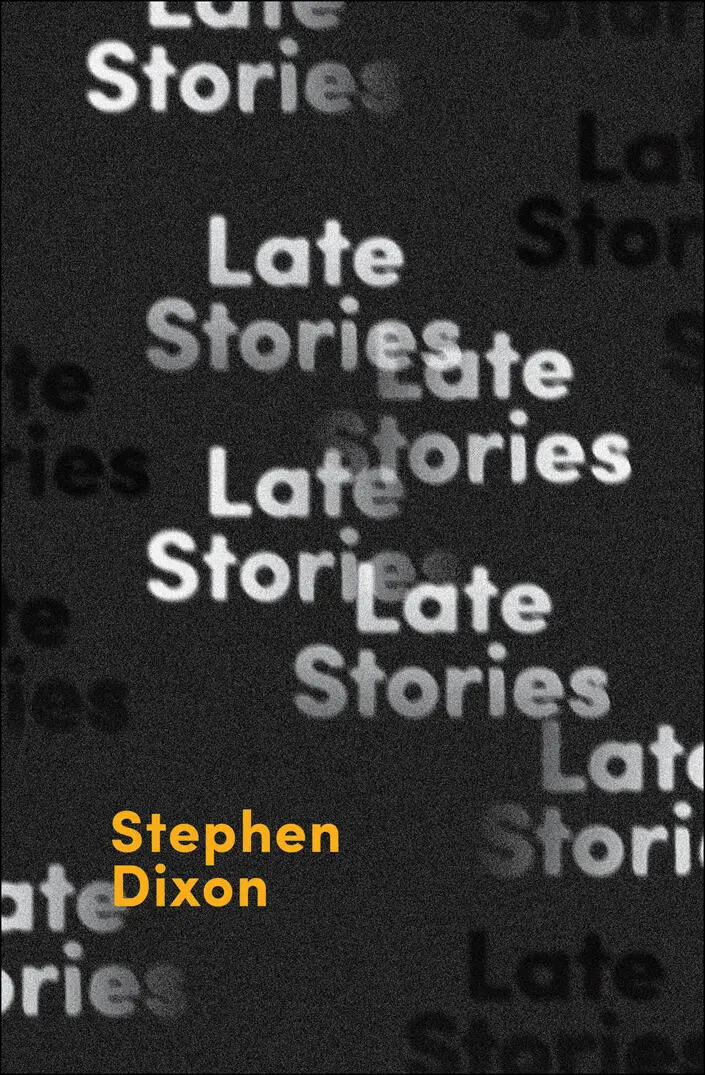
- Название:Late Stories
- Автор:
- Издательство:TRNSFR
- Жанр:
- Год:2016
- ISBN:нет данных
- Рейтинг книги:5 / 5. Голосов: 1
-
Избранное:Добавить в избранное
- Отзывы:
-
Ваша оценка:
Late Stories: краткое содержание, описание и аннотация
Предлагаем к чтению аннотацию, описание, краткое содержание или предисловие (зависит от того, что написал сам автор книги «Late Stories»). Если вы не нашли необходимую информацию о книге — напишите в комментариях, мы постараемся отыскать её.
detail the excursions of an aging narrator navigating the amorphous landscape of grief in a series of tender and often waggishly elliptical digressions.
Described by Jonathan Lethem as "one of the great secret masters" of contemporary American literature, Stephen Dixon is at the height of his form in these uncanny and virtuoso fictions.
With
, master stylist Dixon returns with a collection exploring the elision of memory and reality in the wake of loss.
Late Stories — читать онлайн бесплатно полную книгу (весь текст) целиком
Ниже представлен текст книги, разбитый по страницам. Система сохранения места последней прочитанной страницы, позволяет с удобством читать онлайн бесплатно книгу «Late Stories», без необходимости каждый раз заново искать на чём Вы остановились. Поставьте закладку, и сможете в любой момент перейти на страницу, на которой закончили чтение.
Интервал:
Закладка:
So I’m okay, he thinks. More than okay. I put on my sneakers. My fingers never had trouble tying laces. Probably because I’ve been doing it, I’d say instinctively, since I was around three or four. I remember when I first did it. “Look at me,” I said. I knew I’d done something to be proud of. And my mother saying “You have accomplished”—or some simpler word than that—“something much earlier than most children your age.” When I brought it up thirty to forty years later she said she had no recollection ever telling me that or of the incident, but she believed it because that’s the kind of boy I was: “Always ahead of things. You caught on quick or worked on it till you mastered it.” She was always praising me. My father not at all, except when I sang “God Bless America” for his friends. He’d stand me up on a kitchen counter, and after I sung, he and his friends would give me change.
Laces tied, I take the mug out of the kitchen sink where I put it this morning, and drink what’s left of the coffee in it. Now I’m ready and fortified, he thinks. So get yourself outside and run. If you can’t run, walk, but walk fast. You can’t let yourself just fade. I open the kitchen door to the outside. I walk to the road, check my mailbox for mail. Just an ad for a new health club that opened nearby. That’s funny. Or appropriate to what I’ve been thinking. Appropriate and funny. But stop stalling. You gonna go or not? So get a move on. If you run well, or better than you have in a long time, you’ll get better. The hell with medicine that comes in a pill. Oh, I’ll take it if I have to but I won’t rely on it completely. And the other things the doctor has available to me if the pills no longer work. Hell with them too. This is the way to go. At least try. I swing my arms around twenty times. I count them: twenty on each side. I put my palms flat against a tree trunk and move my feet back till I’m at a ninety-degree angle to the tree — or is it forty-five? — and stretch. I do this for a minute or two. Then I sort of do push-ups against the tree while at the same angle, ninety or forty-five, palms still flat. Ten of them.
Do more, he thinks. Make it twenty, and I do another ten. Now I’m really ready. Now I’m going to go, and I start off. It’s faster than a walk, but not as fast as a power walk. Then it’s as fast as that. So maybe it’s just a slow jog. But jog harder, faster. I do that. Just make it to the Stuarts’ mailbox. I make it there. Now make it to the Fromners’ mailbox. I’m going at a good jogging pace, faster than a power walk, not as fast as a regular run, and nothing hurts. My back feels fine. I pass the Fromners’ mailbox and feel I can make it at the same pace to the Philbricks’ mailbox. I make it there and pass it and jog at an even faster clip all the way to Hawthorn Street. I go right at Hawthorn and jog up a slight incline to Coolidge Street, which isn’t that far — the length of a typical New York City block, I’d say, twentieth of a mile — and start to run on it.
I’m running now, he thinks, a real run on Coolidge to the road that goes past my house. So I’m making the entire loop without stopping. Haven’t done that in I don’t know how long. A year? Two? I keep running to my mailbox, which is about ten feet from the road. Don’t stop. Make it all the way to the house. I run on my driveway to it. I plop down on one of the chairs on the patio near the kitchen door. So how far have I run? Quarter of a mile? A third? A half? Even a little more? Possible. Anyway, around five times as far as I was last able to do, and most of it a fast jog or regular run, not just a fast walk. I’m breathing hard. But healthy deep breaths. The kind I used to get after a sprint, which I used to love to do and did a lot till my illness forced me to stop. So I’m not fading after all. And to keep myself from fading, I’ve got to keep pushing myself like I just did. Push, push some more and even more than that, and you’ll be fine. Want to take another run? You can do it. You’re not going to drop. Your breath has already settled. You’ll make it just fine, if not as far. And anytime you want to stop, just stop, for you’ve done plenty today and proved what you set out to prove. I go back to the road. I jog in place for about thirty seconds and then start to run. I get tired after about a hundred feet, and stop, and start to walk back. A car approaches going the opposite way from me on the other side of the road. I wave. The driver waves. I feel so good.
Flowers
In a number of stories I’ve read the past fifty years or so, someone is bringing flowers to the grave of someone he or she knew. To a wife, husband, parent, lover, close friend, a child. In a couple of the stories the person is bringing the flowers to his or her own grave. In one of these stories, she’s not dead. It’s just a burial plot and a gravestone with her name and date of birth on it followed by a hyphen but no death date. In another story, he is dead but is bringing a bunch of flowers to the adjoining grave of his wife. I forget how the writer works this part out by the end of the story. In fact, I forget everything about the story except that a dead man brings flowers to the grave of his dead wife. I also forget the name of the writer. I know he’s Latin-American and I think, though he must be very old by now, he’s still alive. I don’t recall seeing an obituary of him, though I think I would have since he was once famous, or hearing anyone talk about him as if he were dead. I remember the long poetic title of the story has the word “flowers” in it.
I have no one, really, to bring flowers to his or her grave. My parents and two of my siblings are buried in a cemetery on Long Island — I think in Suffolk County. I know it was way out there on the island, so it couldn’t be Nassau County. And it’s my sister who’s buried there; my brother’s gravestone is a cenotaph. He was on a freighter that sent out distress signals during a violent storm in the North Atlantic more than fifty years ago and must have sunk. I forget the cemetery’s name. I know it has a “mountain” in it — maybe Sinai or Nebo. It’s been almost twenty years since I’ve been to it. To get there I took the Long Island Expressway and drove for about an hour on it. It was for my mother’s burial. I was with my wife and daughters. And shortly after I passed a huge sod farm on my right — this is what I was told to look out for — I took the next exit to a wide boulevard that had a number of cemeteries and flower stores and a diner on it. Jewish, Catholic, and two veterans cemeteries and a couple of others. I remember that all the graves in the veterans cemeteries were in neat rows and most of them had little American flags on them. It was around Memorial Day, so probably that was why. I doubt I’ll ever go out there again. I’m sure I won’t. I don’t see the point. I’d look at the graves for a few minutes, less if it was very cold out, and leave. I don’t pray and I wouldn’t read from some little prayer book they’d offer me in the cemetery office when I’d go in there to get the location of the graves, and I know the burial site is taken care of. My father paid for that a long time ago and it was good, he said, for another fifty years. He was proud of the arrangement he made with the cemetery for so little money. Although it wouldn’t bother me if the site isn’t taken care of and the graves are grown over. I have no idea what the names of the cemeteries are where my grandparents are buried. All four of them were dead before I was born, or maybe my mother’s father died a year or two after. Anyway, I never knew them. I know that both cemeteries are in Queens — close to the Queensboro Bridge, I think it is, and the East River. It must be around seventy years since I went to them. My mother took us kids by cab to the cemetery her parents were in. My father didn’t want to go, I remember my mother saying years after, or maybe was too busy working that day. Another time, and this time we went by car and my father drove, the whole family went to a cemetery close to the one my mother’s parents were in, to visit the graves of my father’s parents and two of his brothers, who died very young of diphtheria, I think, though it also could have been of influenza during the great epidemic back then. The trip to the cemetery was also around seventy years ago. I can picture all of us kids squished into the rear seat, though that image could have come from any number of times we were in the car together. A Plymouth. We always had Plymouths. “The Jewish Chevrolet,” my father called it, though I’m not really sure why. I think my father paid a lump sum for the upkeep of his parents’ gravesite—“In perpetuity,” I can hear him say, making it into a funny-sounding word. And the Thayer Family Circle, as my mother and her eight brothers and sisters called themselves when they and their spouses met at one of their homes twice a year to have a buffet dinner and discuss family business, paid for the upkeep of their parents’ gravesite. I don’t know if they got the same kind of arrangement my father did for his parents’ gravesite and my family’s. If they didn’t and because all my aunts and uncles on my mother’s side of the family are dead, I don’t know who’s looking after it, if anyone is.
Читать дальшеИнтервал:
Закладка:
Похожие книги на «Late Stories»
Представляем Вашему вниманию похожие книги на «Late Stories» списком для выбора. Мы отобрали схожую по названию и смыслу литературу в надежде предоставить читателям больше вариантов отыскать новые, интересные, ещё непрочитанные произведения.

Обсуждение, отзывы о книге «Late Stories» и просто собственные мнения читателей. Оставьте ваши комментарии, напишите, что Вы думаете о произведении, его смысле или главных героях. Укажите что конкретно понравилось, а что нет, и почему Вы так считаете.