Роберт Фиш - Rough Diamond
Здесь есть возможность читать онлайн «Роберт Фиш - Rough Diamond» весь текст электронной книги совершенно бесплатно (целиком полную версию без сокращений). В некоторых случаях можно слушать аудио, скачать через торрент в формате fb2 и присутствует краткое содержание. Город: Garden City, N.Y., Год выпуска: 1981, ISBN: 1981, Издательство: Doubleday, Жанр: Современная проза, на английском языке. Описание произведения, (предисловие) а так же отзывы посетителей доступны на портале библиотеки ЛибКат.
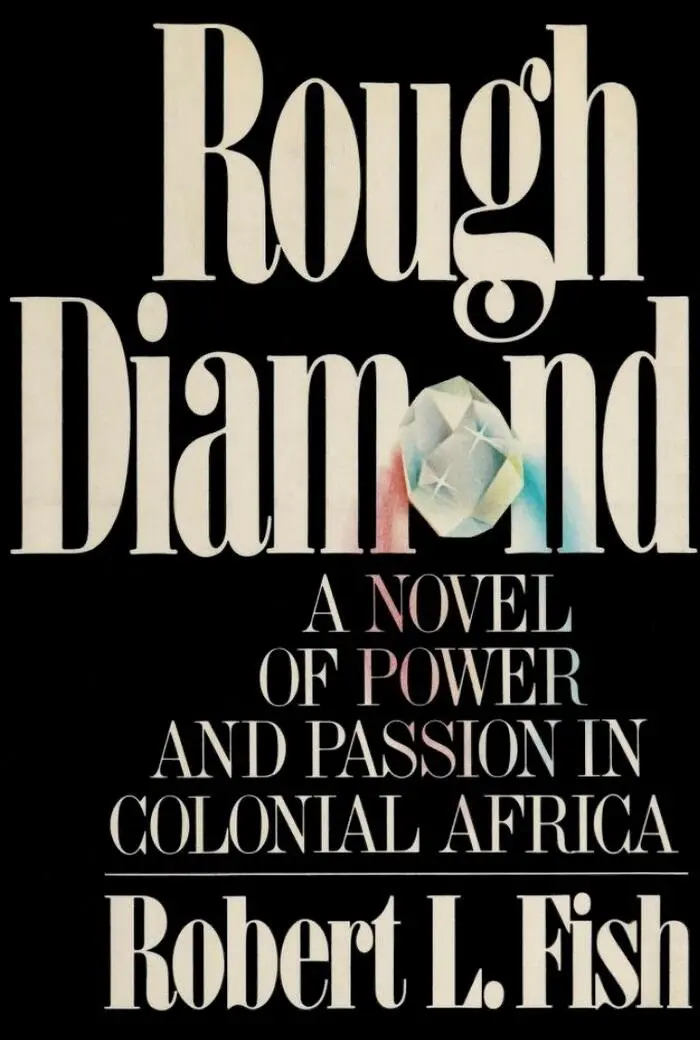
- Название:Rough Diamond
- Автор:
- Издательство:Doubleday
- Жанр:
- Год:1981
- Город:Garden City, N.Y.
- ISBN:978-0-385-15648-6
- Рейтинг книги:5 / 5. Голосов: 1
-
Избранное:Добавить в избранное
- Отзывы:
-
Ваша оценка:
Rough Diamond: краткое содержание, описание и аннотация
Предлагаем к чтению аннотацию, описание, краткое содержание или предисловие (зависит от того, что написал сам автор книги «Rough Diamond»). Если вы не нашли необходимую информацию о книге — напишите в комментариях, мы постараемся отыскать её.
Young Barney Barnato had nothing to lose when he abandoned his squalid existence in London’s East End and set out for the Dark Continent to make his fortune. He built an empire and became a threat to the ruthless Cecil Rhodes, who scorned the pauper-turned-tycoon and tried at every turn to destroy him.
But the ghetto Jew proved to be more than a match for the snobbish Rhodes, who had bought himself a title and craved total control of the diamond trade, where millions were made and lost overnight.
Barnato’s struggle, which took him from unbearable poverty to unimagined riches, from loveless slums to the loving arms of a beautiful woman, always stalked by the malevolent Rhodes, makes for a riveting novel blending history with fiction in the frontier days of nineteenth-century empire building.
Rough Diamond — читать онлайн бесплатно полную книгу (весь текст) целиком
Ниже представлен текст книги, разбитый по страницам. Система сохранения места последней прочитанной страницы, позволяет с удобством читать онлайн бесплатно книгу «Rough Diamond», без необходимости каждый раз заново искать на чём Вы остановились. Поставьте закладку, и сможете в любой момент перейти на страницу, на которой закончили чтение.
Интервал:
Закладка:
“What are you doing here? I thought I told you—”
“Papa, what is a circo?”
“Foolishness is what it is,” his father said sourly. “Some acrobats, maybe a clown — a silly man with paint on his face — a woman with a beard, possibly a girl that rides a horse standing up, and some worn-out animals. As if we don’t see enough animals — may they rot in hell! — without going to a circus to see more! Come on!” He took Armando painfully by the ear and pulled; it had been his method of controlling the boy since childhood. This time, however, Armando resisted.
“I would like to see this circus,” he said.
“What you would really like is a touch of the whip!” his father said viciously, and started to unwind the sjambok from his belt; a little liquor had a tendency to make Armando’s father recall all the injustices to which his life had been subjected, not the least of which had been this monstrous son. But he had barely drawn the sjambok back, prepared to let it whistle across his son’s back as an outlet for all his frustrations, when Armando reached out and plucked the whip from his father’s hand. As people stopped to stare, Armando wound one end of the whip about one large hand, and holding the other end tightly, he gave one jerk and broke the sjambok in two. There were gasps from the people watching. The whip had been made from a thin strip of rhinoceros skin and no one had ever seen a sjambok broken before; supposedly they could not be broken. Armando tossed the broken whip aside and then picked his father up. He lifted him over his head and threw him a good fifteen feet, to land heavily against the wheel of a nearby ox wagon. Armando then walked over, dragged his father back from the wheel, and raised him by his ankles, upending him and shaking him until some loose change fell free from his pockets. Armando then dropped his unconscious father, picked up the loose silver coins, and started to walk away. He had finally done what he had wanted to do since he was ten years old, when his father had taken him by the ear and pushed him temporarily from his mother’s side to take his place in that warm, comfortable refuge. It was obvious to Armando that returning home was now impossible, but before he made any definite plans for the future, he intended to see this circo and find out what it was all about. And to determine if, indeed, the girl in the poster was that close to being nude, or if, indeed, she worked for the circo at all.
But he had only taken a step or two when he was confronted. It was the man who had been nailing up the posters; he was still holding the hammer. Armando frowned. He was in no mood to be further threatened that day, but before he could take the hammer from the man’s hand and either break it in two or thrust it down the man’s throat, the man had stepped back and dropped the hammer, evidently realizing the possible misinterpretation that could be put upon the tool.
“Wait!” the man said hastily, holding up an apologetic hand. “How would you like a job?”
Armando let his huge arms fall, relaxing his fists. Here he was leaving home for the first time in his life, and two minutes after the decision had been made, he was being offered a job! Well, with his size and strength, it was not surprising. There were undoubtedly many jobs to be had — loading wagons, unloading wagons. This man probably wanted him to finish nailing up the posters. Well, he could do that, too. It took little brains that he could see.
“What’s the job?” he asked.
“Working in the circus. As the strong man,” the man said.
He could get into the circus without paying! Then Armando stopped to think. “What’s a strong man in the circus supposed to do?” he asked suspiciously, and then shook his head at himself for being so stupid. Undoubtedly to put up the tent. Well, he could do that, too.
“Just lift things,” the man said, and eyed Armando’s size and the muscles in the big arms. He didn’t know how the next statement might be taken, so he made his voice conversational, making it all seem quite innocuous. “Maybe sometimes fight people, too.”
“Fight people?” Normally Armando did not like to fight people; his mother was opposed to his fighting. Still, he had fought all the boys in his school, many of them older — although not bigger — and he had never lost. And he had been taught that when one took a job one did what one was told. “All right,” he said. “How much would the job pay?”
The man wet his lips. He would have liked to say just room and board, but there was always the possibility that the boy was not as stupid as he looked. He didn’t look particularly bright, but why take a chance with a boy that size? With those monstrous muscles? “You come along with me,” the man said confidently. “We’ll come to some arrangement, I’m sure.”
And that was how Armando Mattos Silveira de Costa became known as the Man Mountain of Angola, the Angolan Ape, the Benguela Beast; as well as being billed as the Strongest Man in the World! That was also how the posters that advised the world thereafter of Armando’s talents all stated that he would fight any man in the audience for a period of six rounds by any rules the challenger might prefer, the challenger, should he defeat Armando, to receive Five Pounds! On the other hand, should the challenger lose — which had never failed to occur — the challenger was guaranteed the best medical aid the town where the bout took place could offer. To Armando it meant a few minutes of minimum effort, for the local champions that fell before his lethal fists it meant momentary glory and often the soothing hand of some fair maiden afterward, and to the owner of the circus, of course, it meant a performance for which all tickets never failed to be sold. Everyone was happy.
Except Armando’s mother, even though her pride in her son now came close to bursting the heart in her more than ample breast as she heard of triumph after triumph for the fruit of her loins. She would lean over and cuff her husband’s ears.
“The money could have been ours, idiota!” she would say viciously, and swing the heavy arms that were Armando’s legacy. “Burro! Bêsta! Estúpido!” And Armando’s father would sadly know that he would sleep alone one more night…
The money that had been earned in the almost three years since Barney and Harry Isaacs’ two nephews had arrived in Kimberley had not been bad money; in the East End of London it would have been untold wealth. But the East End was not Kimberley, and the ambitions Barney Isaacs had had in the East End were not the ambitions Barney Isaacs had in Kimberley in southern Africa. For one thing, there had been no Fay Bees — beautiful, desirable Fay Bees — in the East End. Although Barney would have been the first to admit that any attempt at matchmaking on his part had been a total failure.
“Barney,” Harry had said one day with narrowed eyes to indicate he was running short of patience, a thing quite unlike Barney’s normally calm brother, “are you trying to push your girl friend off onto me?”
Barney had instantly flared. “What d’you mean?”
“What I say. Now, look,” Harry had said in a more normal tone, “I like Fay. She’s a great girl, and a beautiful girl. But she’s simply not for me. Or me for her, as far as that goes. I told you before that I have a girl waiting for me back in London that I’m going back to as soon as we build up our stake a little more.”
“You’re crazy,” Barney said but without conviction, and somehow felt happy about it.
“I’m crazy,” Harry had agreed evenly, and had looked at his brother a long moment. “Anyway,” he added quietly, “one of us is crazy.” And he had gone about his business.
Читать дальшеИнтервал:
Закладка:
Похожие книги на «Rough Diamond»
Представляем Вашему вниманию похожие книги на «Rough Diamond» списком для выбора. Мы отобрали схожую по названию и смыслу литературу в надежде предоставить читателям больше вариантов отыскать новые, интересные, ещё непрочитанные произведения.





Обсуждение, отзывы о книге «Rough Diamond» и просто собственные мнения читателей. Оставьте ваши комментарии, напишите, что Вы думаете о произведении, его смысле или главных героях. Укажите что конкретно понравилось, а что нет, и почему Вы так считаете.