Keith Gessen - A Terrible Country
Здесь есть возможность читать онлайн «Keith Gessen - A Terrible Country» весь текст электронной книги совершенно бесплатно (целиком полную версию без сокращений). В некоторых случаях можно слушать аудио, скачать через торрент в формате fb2 и присутствует краткое содержание. Город: New York, Год выпуска: 2018, ISBN: 2018, Издательство: Viking, Жанр: Современная проза, на английском языке. Описание произведения, (предисловие) а так же отзывы посетителей доступны на портале библиотеки ЛибКат.
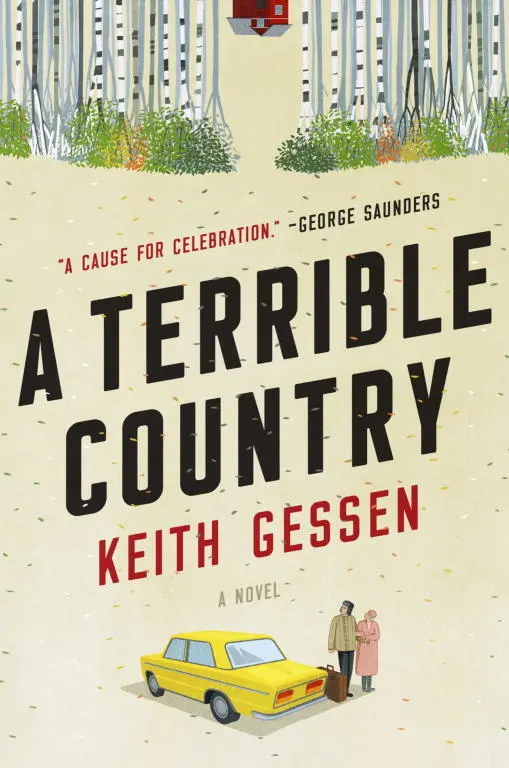
- Название:A Terrible Country
- Автор:
- Издательство:Viking
- Жанр:
- Год:2018
- Город:New York
- ISBN:978-0-735-22131-4
- Рейтинг книги:3 / 5. Голосов: 1
-
Избранное:Добавить в избранное
- Отзывы:
-
Ваша оценка:
A Terrible Country: краткое содержание, описание и аннотация
Предлагаем к чтению аннотацию, описание, краткое содержание или предисловие (зависит от того, что написал сам автор книги «A Terrible Country»). Если вы не нашли необходимую информацию о книге — напишите в комментариях, мы постараемся отыскать её.
A Terrible Country — читать онлайн бесплатно полную книгу (весь текст) целиком
Ниже представлен текст книги, разбитый по страницам. Система сохранения места последней прочитанной страницы, позволяет с удобством читать онлайн бесплатно книгу «A Terrible Country», без необходимости каждый раз заново искать на чём Вы остановились. Поставьте закладку, и сможете в любой момент перейти на страницу, на которой закончили чтение.
Интервал:
Закладка:
“My grandmother’s not a big swimmer these days. Do you think we can ask him?”
“I don’t see why not. He can say no if he wants. We did help him build the thing.”
I got off the phone as I was descending into the underpass at Pushkin Square. I walked through it holding my phone in my hand. It was bright and full of people, some hurrying home, others tarrying in front of one of the many kiosks. There were fancy malls all over Moscow now but it was easier and more convenient and cheaper to buy something in an underpass. A few years earlier a Chechen terrorist had set off a bomb in this underpass, killing a dozen people. For a while people avoided it, but then they started coming again. What could they do? It was the very center of the city. I felt a surge of solidarity with all these people who did not care one way or another whether Chechnya was independent, whether it was Islamic or not, but who had to worry nonetheless when they passed through the Pushkin underpass whether someone might decide to blow them up. I passed a pie stand where I sometimes got a nice apricot pie for thirty rubles. I was sorry that I’d eaten so many cookies at Emma Abramovna’s and was too stuffed to buy one now.
I emerged right next to Pushkin. In his sideburns and top hat, he towered, twelve feet tall and green, over the square. Why so big? Pushkin himself was quite short. But he was a genius. The great-grandson of an African slave brought to Russia to entertain the tsar’s court, by the age of eighteen he was producing poetry that was clearly superior to any written in Russian until then. At the time, Russian literary language did not quite exist; most educated Russians wrote in French, only the very rich were educated, and what literature there was bore the marks of this double separation from actual Russian life. Pushkin managed to change this. His poetry was exquisite and it sounded like Russian; even now, two hundred years later, it was perfectly clear and comprehensible. His talent was eventually too much. The tsar personally censored his work. He was surrounded by intrigue; a young French officer who was flirting with his wife killed him in a duel before he turned forty.
I called Nikolai and he picked up right away. “Listen,” I said, “I’m hoping to get my grandmother out of town for a week sometime this summer, and I can’t really think of any place that would work, so I was wondering—do you think we could use your dacha for a week?”
“Of course!” he said. “I would be honored to provide shelter for a woman whose dacha was taken from her by unscrupulous capitalists.” There was a pause. “But if the place is going to be ready for the summer, I’m going to need some help.”
So for several weekends in a row I made the long trip out there and painted and sanded and helped the Uzbek construction guys unload their small trucks and set up the bathroom and the kitchen. We agreed that I could have the dacha for a week in mid-July.
In the meantime, my grandmother grew increasingly despondent. She was shrinking physically, but her personality was shrinking as well. There was less and less of her inside her. She was becoming, more and more, what she had been as a little girl: the dutiful daughter of an overbearing mother. I had intuited that she’d been this way from her stories of her childhood; now I saw this very person before me, in the guise of a ninety-year-old with a cane.
The semester was again rounding into its final stretch and this meant final papers and dozens if not hundreds of emails in which students asked for clarification about what the final paper entailed and what exactly I was looking for and could I send some samples of successful papers that they could emulate? I was able to do much of this from the windowsill, and my grandmother had become better at not interrupting. I think the fact that I was so visibly before her, at my computer, meant that she was both reassured that I was around and also convinced that I was doing something, and should be left alone.
In the evenings she still enjoyed our Soviet films. Sometimes Yulia, who remained our main source for tips on what to watch, joined us. Other times I saw her later. She slept over a fair amount now, and my grandmother seemed to find this arrangement congenial. It was as if she were sprouting a new family.
But in the late afternoon hours, after lunch, she spoke of suicide. “You know,” she said one day, over tea, “I asked one of the pharmacists to give me poison. I even gave her the money. But now she won’t do it.”
“What? Who?”
“The pharmacist.”
“Where?”
“Over there.” She motioned outdoors.
“What kind of poison?” I said.
“I asked her for something that would kill me. She said she had something like that.”
I couldn’t tell if this had actually happened. I imagined myself showing up at the pharmacy and demanding to know, through the glass, if they had promised to poison my grandmother.
“In one of the European countries there is a place you can go,” my grandmother went on, “a house, you can go to the house and if you want to die, they will help you.”
She was talking about physician-assisted suicide, euthanasia. It was practiced in the Netherlands. Perhaps she had seen a segment about it on the news.
“Isn’t that nice?” she went on. “If you want to go, you can go.”
I no longer argued with her about these things. I agreed with her that it was nice. Sadly, I suggested, the same was not possible here.
“No,” my grandmother agreed. “It’s not.”
My grandmother dreamed of killing herself. Her doctor had said there was no safe way for her to take anti-depressants, so I tried to give her some Saint-John’s-wort tea. But she had a bad reaction: it made her hyper and paranoid. She woke up several times in the middle of the night and told me she thought she heard noises outside her window. I had to come and sit in the armchair next to her bed while she slept. I threw out the Saint-John’s-wort. She remained depressed. I felt like she was asking me to kill her, and I could not do it.
A better person might have done it. A better or more courageous person. I was beginning to think that maybe I was not that better or more courageous person. I had become a slightly better person here. I had stopped looking at Facebook quite so much; I had become less bitterly jealous of all my classmates. I was being nice to Yulia, and, aside from refusing to strangle my grandmother with a pillow, I was being a decent friend to her. But compared to the vastly better person I had hoped to become, this wasn’t much to speak of. And I could always go back to being the person I was before. In fact all it would take would probably be a return to the United States.
I had even begun to have my doubts about Yulia. I didn’t want to have them, but I did. She too was a little depressed. And incredibly sensitive. I wasn’t sure I could handle being in the constant presence of someone so morally acute. I wasn’t sure I could live up to it. I was sure, in fact, that I could not.
More to the point, would I really be able to stay in Moscow indefinitely? On the one hand it was appealing. I didn’t care that much about good coffee. And I liked the food. But the daily grind of life was something else. Just to do anything—to get my skates sharpened, to get a library book, to get from one part of the city to another—was an unbelievable hassle. What in New York took twenty minutes, here took an hour. What in New York took an hour, here took pretty much all day. It wore you down. The frowns on the faces of the people wore you down. The lies on the television too, after a while, wore you down.
Sometimes in the evenings as she was going to bed my grandmother asked me to sit with her while she read. She would lie in her little twin bed, her glasses on her nose, and hold up a thin sheaf of pages she’d torn from one of her books, while I sat in the armchair by her bed and read whatever I was reading then. Eventually she would fall asleep, I would gently remove her glasses, pull her blanket over her, and turn off the light. One night that spring she fell asleep and for a while I sat in my chair and wondered if I should do it. My grandmother was in pain—not physical pain, though a bit of that, but emotional pain. She was bored, she felt useless, she was sad. She lay with her mouth hanging open, her teeth out, my grandmother, the mother of my mother, lightly snoring. She had a pillow under her knees, which I could remove without waking her and then press over her face—I had already removed her glasses—and perhaps if I did it gently enough she would not even wake up. This is what she wanted above all, not to wake up! “Leva just went to sleep one night” was something she said a lot about Uncle Lev. “He just went to sleep and died.” But of course she’d wake up if I tried to suffocate her with a pillow. I pictured her fighting me instinctively, even as intellectually she wanted the end to come. And then what exactly would I tell the police? That she asked me to do it? I pictured the baby-faced policeman I’d talked to when my grandmother was missing—would he be understanding? Should I try to bribe him? Or would that be an implicit admission of guilt?
Читать дальшеИнтервал:
Закладка:
Похожие книги на «A Terrible Country»
Представляем Вашему вниманию похожие книги на «A Terrible Country» списком для выбора. Мы отобрали схожую по названию и смыслу литературу в надежде предоставить читателям больше вариантов отыскать новые, интересные, ещё непрочитанные произведения.









Обсуждение, отзывы о книге «A Terrible Country» и просто собственные мнения читателей. Оставьте ваши комментарии, напишите, что Вы думаете о произведении, его смысле или главных героях. Укажите что конкретно понравилось, а что нет, и почему Вы так считаете.