William McGivern - Savage Streets
Здесь есть возможность читать онлайн «William McGivern - Savage Streets» весь текст электронной книги совершенно бесплатно (целиком полную версию без сокращений). В некоторых случаях можно слушать аудио, скачать через торрент в формате fb2 и присутствует краткое содержание. Город: New York, Год выпуска: 1959, ISBN: 1959, Издательство: Dodd, Mead & Company, Жанр: Современная проза, на английском языке. Описание произведения, (предисловие) а так же отзывы посетителей доступны на портале библиотеки ЛибКат.
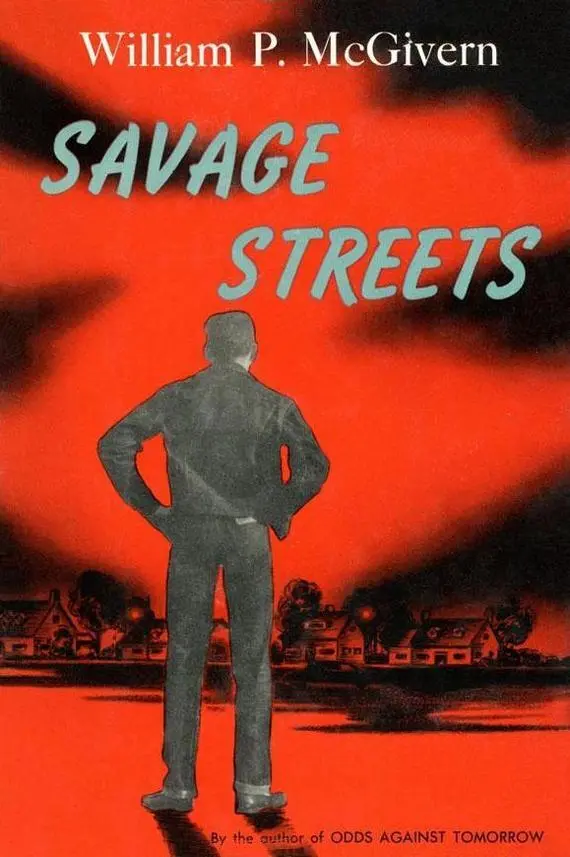
- Название:Savage Streets
- Автор:
- Издательство:Dodd, Mead & Company
- Жанр:
- Год:1959
- Город:New York
- ISBN:978-1-125-15174-7
- Рейтинг книги:4 / 5. Голосов: 1
-
Избранное:Добавить в избранное
- Отзывы:
-
Ваша оценка:
Savage Streets: краткое содержание, описание и аннотация
Предлагаем к чтению аннотацию, описание, краткое содержание или предисловие (зависит от того, что написал сам автор книги «Savage Streets»). Если вы не нашли необходимую информацию о книге — напишите в комментариях, мы постараемся отыскать её.
The adults recognized the danger signals. It was obvious their children’s values and safety were being threatened. This was a time for calmness, for issues to be clearly defined. But the parents failed to realize that their own values were also put to test in this explosive situation. A conviction of righteousness swept through the community like a grass fire, and with it an impatience with the law and a disregard for the rights of anyone beyond the threatened portals of Faircrest. What man, what individual life is ever strong enough to survive such a spell of riot?
Here, in a tense and unusual book, is a sobering picture of what could happen in any modern American community.
Savage Streets — читать онлайн бесплатно полную книгу (весь текст) целиком
Ниже представлен текст книги, разбитый по страницам. Система сохранения места последней прочитанной страницы, позволяет с удобством читать онлайн бесплатно книгу «Savage Streets», без необходимости каждый раз заново искать на чём Вы остановились. Поставьте закладку, и сможете в любой момент перейти на страницу, на которой закончили чтение.
Интервал:
Закладка:
“I’m not going to get loaded, don’t worry about that,” Norton said, and Farrell saw that a nerve or muscle was twitching at the comer of his mouth. “You don’t know me very well, I guess,” Norton went on, watching Farrell with narrowing eyes, as if trying to guess his thoughts. “You don’t know me at all, as a matter of fact,” he said. “Isn’t that right?”
“I guess no one ever knows all about another person,” Farrell said.
“That’s what I mean,” Norton said quickly. “You may think you know a person pretty well, but actually you don’t. Do you understand what I mean? We all act the way we want people to think we are. Isn’t that it?” He finished his drink and moved the glass across the bar. “Look, John, I called you because I had to talk to somebody, and this may come as a surprise to you, but I respect you as much as any man I’ve ever known. As God is my judge, I respect you. And I respect your wife and children. Did you know that, John?”
The Martinis were taking effect, Farrell saw, eating through the protective layers of reserve and circumspection. “Well, I appreciate that,” he said. “What did you want to talk to me about?”
“You’re an older man than I am, and I respect your judgment,” Norton said. “That’s not just being polite, John. That’s the absolute truth.”
Farrell nodded and sipped his drink.
“You don’t know anything about me, John,” Norton said insistently. “You as much as admitted that, didn’t you? So you’re going to be shocked as the devil at what I’m going to tell you.” He turned to face Farrell, and there was suddenly a look of pain about his eyes that lent significance to his prediction. He had already drunk half of his fourth Martini, but Farrell realized that he wasn’t drunk; his face was pale and a strand of dark hair hung over his forehead, but the liquor had not yet touched the core of his personality.
“Well, I’ll try not to be shocked,” Farrell said.
“I’ve never been sorry for anybody or anything in my life,” Norton said. “Doesn’t that shock you?”
“I don’t know what you mean.”
“Well, listen. I’ll tell you something about myself. Since last night I’ve been going through hell. Not because of what happened, not for a second. But about why I was never sorry for anybody or anything.” Norton took a deep breath. “It’s because I’m a heel, that’s why, John. I’m no good, no good at all.”
“We all get to thinking that at times,” Farrell said. “It’s probably a healthy sign. Anyway, I feel rotten about last night too.”
“Just listen, I want to tell you something about me,” Norton said, gripping Farrell’s arm. “First of all, you know Janey. She’s the most wonderful girl in the world, you’ve got to believe that. If you saw her with Junior, taking care of him, reading to him, molding him into — into...” He sighed and fumbled for a cigarette. “I can’t explain it very well. You’ve just got to take my word for it, John.”
“I know what you mean.”
“I was certain you’d understand, John. That’s why I’m telling you this. I respect you more than anybody I’ve ever known. But I’m a bastard. You’ve got to realize that.”
“You’re just in a bad mood,” Farrell said. “It will pass.”
“No, listen: it’s nothing like that. Janey and I got married when we were pretty young. She was twenty-one, I was twenty-four. Well, she came from a different background than I did. I don’t mean she had money, but her family was different. Her father taught English in high school, and her mother was a lovely person, like Janey is. The way they talked to one another, the way they read books and listened to music, the whole way they lived was different. They always set the table as if it was for company. I mean, even when it was just themselves, they lived nicely. What I’m trying to explain,” Norton said, articulating with a painful effort, “is that it was natural to them, it wasn’t an act or anything like that. It was all peaceful and beautiful. That’s one side.” He frowned and stared at his glass. “What was the other? Oh, yes.” The frown faded and he smiled bitterly. “We were the other side. My family. We were decent, honest people, mind you, but we were different from the Schuylers — that was Janey’s family name. Did you know that?”
“No, I didn’t,” Farrell said.
“It’s funny, you live practically next door to people and you don’t know the wife’s family name. If you don’t mind my asking, John, what was Barbara’s family name?”
“Walker.”
Norton stared at the surface of the bar and Farrell saw the muscle twitching at the comer of his mouth. “I don’t know why I asked you that,” he said. “I don’t usually ask people personal questions.”
“Maybe we could leave this for another time,” Farrell said. “We should be getting home.”
“No, I want to finish,” Norton said. “Please let me finish, John.”
“Sure, go ahead.”
“The trouble started after we were married,” Norton said. “I worked for a bank in Chicago, and we took an apartment on the South Side not far from where my family lived. That was the big mistake, I guess. My father had been dead a long time and there was just mother and my two older brothers. They were different from me. They didn’t finish high school, and they got kind of down-to-earth jobs, I guess you could call them. One was a clerk at Montgomery Ward’s, Monkey Ward, he called it, and the other found himself a place with a company that supplied automobile parts to retailers.”
Norton rubbed his forehead. “They played softball at night in the street, grown-up men, mind you. They put on sweat shirts and caps after work and played baseball in the street. When it got dark they went to a tavern on Seventy-third Street and drank beer with their buddies. They never got married, they just drifted along like they were still kids, paying board and room to my mother and occasionally going off on a fishing trip for a week-end. Am I making this clear, John? Do you see what I mean?”
“They had things under pretty good control, I’d say. What was the trouble?”
“I was ashamed of them,” Norton said, meeting Farrell’s eyes with an obvious effort. “Now listen; after I got married they got in the habit of dropping in at night on Janey and me. Just dropping in, you understand. They’d never call and ask us if we were busy or having friends in or anything like that. The doorbell would ring and they’d walk in — well, like they belonged there. They’d talk about baseball and watch television and maybe have a beer or two, that’s all. My older brother used to always explain that wrestling matches were all fixed.” Norton shook his head. “Maybe he told us that a thousand times, I don’t know. Maybe it was more. They behaved all right, in their way, but they wouldn’t call before they came over, they just wouldn’t, John. It wasn’t their fault, they didn’t know any better, you see. Janey...” Norton gulped down his drink. “Well, Janey put up with it for a long time. She’s got the patience of an angel, I’ll say that any time. But finally she suggested — suggested, John, she didn’t tell me — she just suggested that I tactfully ask them to phone us before they stopped in. But I couldn’t do it.” Norton pounded his fist softly on the bar. “I just couldn’t do it. I couldn’t tell my brothers that. They wouldn’t have understood. My oldest brother, that’s Ernie, was my hero when I was a little kid. How could I tell him? And my other brother, well if you knew him he was the sweetest guy in the world. He was so generous he never thought about himself. And I was ashamed of them, John, but I knew Janey was in the right. Can’t you see what hell it was?”
Читать дальшеИнтервал:
Закладка:
Похожие книги на «Savage Streets»
Представляем Вашему вниманию похожие книги на «Savage Streets» списком для выбора. Мы отобрали схожую по названию и смыслу литературу в надежде предоставить читателям больше вариантов отыскать новые, интересные, ещё непрочитанные произведения.







Обсуждение, отзывы о книге «Savage Streets» и просто собственные мнения читателей. Оставьте ваши комментарии, напишите, что Вы думаете о произведении, его смысле или главных героях. Укажите что конкретно понравилось, а что нет, и почему Вы так считаете.