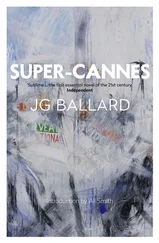
J.G. Ballard - Super-Cannes
Здесь есть возможность читать онлайн «J.G. Ballard - Super-Cannes» — ознакомительный отрывок электронной книги совершенно бесплатно, а после прочтения отрывка купить полную версию. В некоторых случаях можно слушать аудио, скачать через торрент в формате fb2 и присутствует краткое содержание. Жанр: Современная проза, на английском языке. Описание произведения, (предисловие) а так же отзывы посетителей доступны на портале библиотеки ЛибКат.
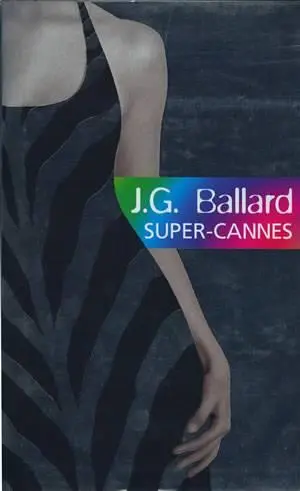
- Название:Super-Cannes
- Автор:
- Жанр:
- Год:неизвестен
- ISBN:нет данных
- Рейтинг книги:5 / 5. Голосов: 1
-
Избранное:Добавить в избранное
- Отзывы:
-
Ваша оценка:
Super-Cannes: краткое содержание, описание и аннотация
Предлагаем к чтению аннотацию, описание, краткое содержание или предисловие (зависит от того, что написал сам автор книги «Super-Cannes»). Если вы не нашли необходимую информацию о книге — напишите в комментариях, мы постараемся отыскать её.
'Sublime: an elegant, elaborate trap of a novel, which reads as a companion piece to Cocaine Nights but takes ideas from that novel and runs further. The first essential novel of the 21st century.'
– Nicholas Royle, Independent
'Possibly his greatest book. Super-Cannes is both a novel of ideas and a compelling thriller that will keep you turning the pages to the shocking denouement. Only Ballard could have produced it.'
– Simon Hinde, Sunday Express
'In this tautly paced thriller he brilliantly details how man's darker side derails a vast experiment in living, and shows the dangers of a near-future in which going mad is the only way of staying sane.'
– Charlotte Mosley, Daily Mail
'Vintage Ballard, a gripping blend of stylised thriller and fantastic imaginings.'
– Alex Clark, Guardian
'Ballard at his best. Truly superb: the best book he has written. The story achieves the optimum balance of perfectly wrought lucid thriller-writing with formidable and pervasive intelligence.'
– Edward Docx, Daily Express
'Like watching a slow-motion action replay of a spectacular collision, you can't take your eyes away from Super-Cannes.'
– Mike Pattenden, The Times
'Super-Cannes is one of those novels whose last 100 pages you turn over faster and faster, wanting hundreds more: One peels this novel like an onion. Halfway through, I thought I could see the denouement. Three-quarters of the way through, something quite different seemed to be looming up. I have to say that the ending eluded and amazed me. As Ballard always amazes.'
– John Sutherland, Sunday Times
'Ballard's extraordinary new novel reads like a survival manual for the new century: There is a peculiar Englishness that manifests itself in exploration of the exotic, and J. G. Ballard is the most exotic author of all. Super-Cannes is a gleaming, tooled-up taste of tomorrow, beguiling, subversive and so appropriate to the mood of the new century that it feels like a survival handbook; it might just save your life.'
– Christopher Fowler, Independent on Sunday
'A magical hybrid that belongs to no known genre, a masterpiece of the surrealist imagination, Super-Cannes is another triumph by Britain 's most uncompromisingly contemporary novelist.'
John Gray, New Statesman
'J. G. Ballard is the Dr Moreau of British fiction, creator of controlled environments and out-of-control dystopias: More than any other writer Ballard understands the transformation technology may effect on human desire. This is his most potent statement yet of the outcome of that transformation, an elegant nightmare with all the internal coherence of an Escher engraving or a Calvino fable: Ballard unravels the secrets of his post-industrial Elysium with panache, leading us into a society which is both an exaggerated parable for our times and a chill piece of futurology: compelling.'
– Tim Adams, Observer
'With this sharply focused novel, Ballard takes a long sniper's look at the mirror-walled corporate dream, and then shatters it.'
– Helen Brown, Daily Telegraph
'Ballard remains that very rare thing, an original. He is undoubtedly the most exciting of contemporary novelists.
His genius lies in the mood he creates and his often dazzlingly surreal images. Super-Cannes possesses a relentless energy and an atmosphere of calculated corruption: the chilling narrative succeeds as an apocalyptic comment on modern society's inhuman dance of death.'
– Eileen Battersby, Irish Times
'Tainted idylls have always been J. G. Ballard's fictional speciality. With Super-Cannes, he dreams up one of his most memorable. Electrifyingly vivid prose and a storyline alive with shocks power a novel that casts lurid light on an exclusive Riviera enclave of the technological ©lite.'
– Peter Kemp, Sunday Times
'For those who know his work, the familiar pleasures are all present: fecund ideas, the disquieting poetry of his imagery and a strong spine of narrative. For first-timers, the ride begins here. Much writing is touted as essential; little, however, can claim any such distillation of its times. Ballard's is the real thing.'
– Gareth Evans, Time Out
'A dark and incendiary thriller, doing to the gated community and business park what Bram Stoker did for the Transylvanian castle.'
– S. B. Kelly, Scotland on Sunday
'He continues to produce the most trenchant and effective critique of the era and remains the most important contemporary British writer.' Will Self, Independent 'The storyline of intrigue and manipulation sees Ballard's devious imagination on tiptop form. Pacy, intelligent and accessible – one of his most enjoyable books ever, a pageturner that is also a novel of ideas.'
– David Profumo, Literary Review
'One of our strangest and most brilliant novelists. A new novel from Ballard is a literary event to make the heart jolt with uneasy expectation. Super-Cannes, super-saturated with Ballard iconography, is one of the first novels to gaze unflinchingly at the new millennium.'
– Catherine Lockerbie, Scotsman
'Super-Cannes is prime Ballard – weighty, potent and extraordinary.'
– John Preston, Evening Standard
'Ballard just gets hipper and hipper.'
– Guardian
Super-Cannes — читать онлайн ознакомительный отрывок
Ниже представлен текст книги, разбитый по страницам. Система сохранения места последней прочитанной страницы, позволяет с удобством читать онлайн бесплатно книгу «Super-Cannes», без необходимости каждый раз заново искать на чём Вы остановились. Поставьте закладку, и сможете в любой момент перейти на страницу, на которой закончили чтение.
Интервал:
Закладка:
'Mr Sinclair? Enough of the girls now…'
Sister émilie called from below. I put away the photograph and closed the office door behind me. As I walked down the stairs I noticed that I was still carrying the zebra dress and fishnet tights. Rather than hand them to the nun, I stuffed them into my jacket.
After making my thanks and a cash donation to Sister émilie, who silently bowed to me, I returned to the Jaguar. I drove through the shabby streets of La Bocca, with their melancholy Arab men haunting the doorways. I was glad to be within a twenty-minute drive of the Croisette and its kingdom of light. A smell of cheap perfume filled the car, rising from the zebra bundle on the passenger seat. I stopped by a dustbin outside a supermarket, stepped from the car and slid the garments under the lid.
The teenager's scent, rancid but curiously stirring, still clung to my hands. But I was thinking of the photograph I had seen in Greenwood 's office at the refuge. Frances Baring was dressed in a business suit, but all the others in the group, including Greenwood himself, were wearing their leather bowling jackets.
18 The Street of Darkest Night
Dusk came quickly to Cannes, in the few moments that distracted me as I ordered another Tom Collins from the waiter at the Rialto Bar. The sky seemed to tilt, tipping the sun like a slew of glowing ash behind the heights of the Esterel, taking with it the hang-gliders who sailed the evening airs. The hotels along the Croisette retreated into themselves, withdrawing behind their formal facades. The lights had moved offshore. Electric snowflakes marked the Christmas-tree rigging of the yachts moored near the beach, and a blaze of candlepower bathed the two cruise liners anchored in the Napoule Channel.
Shore parties of passengers strolled under the palm trees, too unsteady after their days at sea to risk crossing the Croisette. They stared at the hundreds of Volvo salesmen emerging from a conference at the Noga Hilton, like travellers glimpsing an unknown tribe about to perform its rites of passage with its sacred regalia, the marketing brochure and the promotional video.
Prostitutes came out at dusk, usherettes in the theatre of the night, shining their miniature torches at any kerb that threatened their high-heels. Two of them entered the Rialto and sat at the next table, muscular brunettes with the hips and thighs of professional athletes. They ordered drinks they never touched, killing time before they set off to trawl the hotels.
I, too, was waiting for the clock to move on, but with rather less hope. Jane was chairing another late-evening committee at the clinic, mapping out a further stage in the scheme that would bring, if not immortality, then perpetually monitored health to Eden-Olympia. Our brains, I often told her, would soon need a false ceiling to make room for the ducting demanded by our 'intelligent' lifestyle. Before breakfast we would set ourselves a psychological test, tapping yes-or-no answers to alternative-choice questions, while a standby alarm offered an emergency package entitled 'What to do till the psychiatrist comes'.
As the prostitutes talked to each other in a creole of French and Arabic, their scent drifted over my table, a dream of houris borne by the night-world of the Croisette, the untaxed contraband of the senses in this lazy entrepôt of chance and desire. I needed to escape from Eden-Olympia, with its ceaseless work and its ethic of corporate responsibility. The business park was the outpost of an advanced kind of puritanism, and a virtually sex-free zone.
Jane and I rarely made love. The flair she had shown during my days as a virtual cripple had been smothered by a sleep of eye-masks and sedatives, followed by cold showers and snatched breakfasts. She moved naked around our bedroom, in full view of Simone Delage and her husband, flaunting not her sex but her indifference to it.
Cannes offered an antidote to this spartan regime. My parents had been unfaithful, but in the old, unhappy way. My father's affairs complicated his busy life, giving him the harassed existence of a secret agent, forever one step ahead of being unmasked, a fraying conspiracy of rented cars and silent phone calls. He communicated with one lover, the wife of an architect in the same street, by adjusting the roller-blinds, a prearranged code that my mother discovered in a flash of insight worthy of the Bletchley Enigma team. As soon as my father left the house she ran from room to room, raising and lowering the blinds at random.
I remembered the lover's bemused gaze as she drove past, trying to make sense of the baffling signals, and my mother's smile of triumph. Less happily, I once found her ironing a half-burned credit-card receipt she had fished from a lavatory bowl.
The streetwalkers stood up, testing their stilettos before stepping into the night. The younger of the two, a twenty-year-old with eyes wiser than any grandmother's, glanced at me for a microsecond too long, as if ready to fit a car-park quickie into her busy evening schedule.
But sex with prostitutes required a special knack, as I had learned during my RAF days in Germany. My girlfriends in England on the whole seemed to like me, at least on even days of the month, from the sixteen-year-old ballet student who dragged me into the family-planning clinic to the adjutant's secretary who listened good-naturedly as I worried on about my parents' postponed divorce. The Polish whores in the bars outside RAF Mülheim were a different breed, scarcely women at all but furies from Aeschylus who intensely loathed their clients. They were obsessed with the Turkish pimps and their children boarded with reluctant sisters, and any show of feeling disgusted them. Warmth and emotion were the true depravity. They wanted to be used like appliances rented out for the hour, offering any part of themselves to the crudest fantasies of the men who paid them.
But at least they were real, in a way that eluded Eden-Olympia.
I finished my drink, left a 500-franc note on the saucer and stood up to explore the night. I felt surprisingly light-headed, like a dreamer who had strayed onto a film set of tropical palms and cruise liners. At any moment an orchestra would strike up and the crowds on the Croisette, the Volvo dealers and Arab playboys and orthopaedic surgeons, would form themselves into a disciplined, arm-swinging chorus, belting out a big-band hit.
I followed the two prostitutes past the Noga Hilton, curious to see how far I could go before the puritan conscience pulled the plug. Uninspired by the car-dealers, the women locked arms and strode down the Rue Amouretti to the Place Dubois. They paused to scream abuse at a passing motorist, and veered away into the darkness.
Unable to keep up with them, I rested my knee outside Mère Besson. After scanning the evening's menu I set off towards the multi-storey garage near the railway station, where I had parked the Jaguar. A darker Cannes gathered itself around me once I crossed the Rue d'Antibes. Off-duty chauffeurs, Arab pushers and out-of-work waiters filled the narrow bars. They played the fruit machines, their thighs rocking the pintables until the tilt-signs flashed, an eye on the new arrivals who stepped from the Marseilles train, would-be construction workers and pairs of sharp-tempered young women who shouldered their way to the head of the taxi queue. Pimps ambled around the tunnel entrance to the underpass, a cloaca that drained away the festival city's dreams of lust and fortune.
Inhaling the heady air of north African tobacco, and the cheap aftershave of nerve-gas potency, I crossed the Rue Jaurès to the garage. I fed my ticket into the pay-machine as two men and a young girl walked down the concrete ramp towards the street.
With their leather jackets and hard shoulders, the men looked like plainclothes police, and I guessed that they had caught an absconding eleven-year-old trying to board the Paris express.
Читать дальшеИнтервал:
Закладка:
Похожие книги на «Super-Cannes»
Представляем Вашему вниманию похожие книги на «Super-Cannes» списком для выбора. Мы отобрали схожую по названию и смыслу литературу в надежде предоставить читателям больше вариантов отыскать новые, интересные, ещё непрочитанные произведения.



Обсуждение, отзывы о книге «Super-Cannes» и просто собственные мнения читателей. Оставьте ваши комментарии, напишите, что Вы думаете о произведении, его смысле или главных героях. Укажите что конкретно понравилось, а что нет, и почему Вы так считаете.