Kenzaburo Oe - Somersault
Здесь есть возможность читать онлайн «Kenzaburo Oe - Somersault» весь текст электронной книги совершенно бесплатно (целиком полную версию без сокращений). В некоторых случаях можно слушать аудио, скачать через торрент в формате fb2 и присутствует краткое содержание. Жанр: Современная проза, на английском языке. Описание произведения, (предисловие) а так же отзывы посетителей доступны на портале библиотеки ЛибКат.
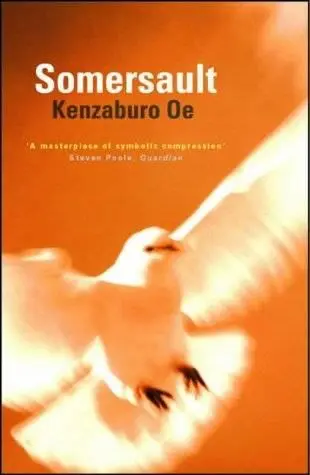
- Название:Somersault
- Автор:
- Жанр:
- Год:неизвестен
- ISBN:нет данных
- Рейтинг книги:4 / 5. Голосов: 1
-
Избранное:Добавить в избранное
- Отзывы:
-
Ваша оценка:
Somersault: краткое содержание, описание и аннотация
Предлагаем к чтению аннотацию, описание, краткое содержание или предисловие (зависит от того, что написал сам автор книги «Somersault»). Если вы не нашли необходимую информацию о книге — напишите в комментариях, мы постараемся отыскать её.
From Publishers Weekly
Nobelist Oe's giant new novel is inspired by the Aum Shinrikyo cult, which released sarin gas in Tokyo 's subway system in 1995. Ten years before the novel begins, Patron and Guide, the elderly leaders of Oe's fictional cult, discover, to their horror, that a militant faction of the organization is planning to seize a nuclear power plant. They dissolve the cult very publicly, on TV, in an act known as the Somersault. Ten years later, Patron decides to restart the fragmented movement, after the militant wing kidnaps and murders Guide, moving the headquarters of the church from Tokyo to the country town of Shikoku. Patron's idea is that he is really a fool Christ; in the end, however, he can't escape his followers' more violent expectations. Oe divides the story between Patron and his inner circle, which consists of his public relations man, Ogi, who is not a believer; his secretary, Dancer, an assertive, desirable young woman; his chauffeur, Ikuo; and Ikuo's lover, Kizu, who replaces Guide as co-leader of the cult. Kizu is a middle-aged artist, troubled by the reoccurrence of colon cancer. Like a Thomas Mann character, he discovers homoerotic passion in the throes of illness. Oe's Dostoyevskian themes should fill his story with thunder, but the pace is slow, and Patron doesn't have the depth of a Myshkin or a Karamazov-he seems anything but charismatic. It is Kizu and Ikuo's story that rises above room temperature, Kizu's sharp, painterly intelligence contrasting with Ikuo's rather sinister ardor. Oe has attempted to create a sprawling masterpiece, but American readers might decide there's more sprawl than masterpiece here.
Somersault — читать онлайн бесплатно полную книгу (весь текст) целиком
Ниже представлен текст книги, разбитый по страницам. Система сохранения места последней прочитанной страницы, позволяет с удобством читать онлайн бесплатно книгу «Somersault», без необходимости каждый раз заново искать на чём Вы остановились. Поставьте закладку, и сможете в любой момент перейти на страницу, на которой закончили чтение.
Интервал:
Закладка:
Why don't we give our passions a run for their money? I was divorced not long ago, so any moral issue that might restrain you has vanished. I have some free time before Patron's public sermon.
You Know Who.
The press conference began, the opening question coming from a fe- male reporter, a third-generation Japanese named Karen Sato from the Los Angeles Times who was also helping a TV team with its coverage. She was in her mid-twenties, and her question was directed to Kizu.
"Professor, since you've given lectures on cross-cultural symbolism, there's something I'd like to ask you," Ms. Sato said, in rapid-fire English, relying too much on what the publicity pamphlet said about Kizu's back- ground and his abilities in English. (Ikuo, who had sat beside Kizu for this very reason, could tell how nonplussed he was and explained basically what the woman had asked. Kizu was typical of his generation in that he could speak English but often had trouble catching what others said.)
"I heard that the children carrying the chochin lanterns last night," the woman continued, "went up into the woods carrying the souls of the dead.
And that these souls return to the valley and enter the bodies of newborn babies. The souls, in other words, in a Neoplatonic way, travel back and forth between the profane world of the valley and the spiritual world of the moun- tains. But if the souls keep on doing this over and over, it reminds one of Buddhist transmigration. So do you interpret it, Professor, from a western or an oriental viewpoint?"
"I know a little about Neoplatonism from the commentaries on Blake's paintings," Kizu replied, "where the soul when it ascends to heaven returns to God's presence and a community of souls. According to the legends of this region, the soul rests in solitude at the base of the selected tree until the time comes for it to be reborn. In Buddhist transmigration, human souls are also reborn in animal bodies, which is different from souls being reborn inside newborn babies. I see the Young Fireflies' view of life and death, based on the premodern life of the people of this region, as something quite unique.
"Imagine, if you will, a solitary village springing up in the midst of a vast forest and coming up with its own legends as if it were a remote island.
The souls of people who live in the village after physical death still remain in the forest that overlooks the valley. And they come down to the valley any number of times. I interpret it as the world of the living and the world of the dead forming, in this topography, a single unit."
"If it's that unique a view of life and death, then I guess it is a religious philosophy, isn't it?" the woman said. "As people with an anti-Japanese reli- gious philosophy coming into the area and building a church, didn't you ex- perience opposition?"
Ms. Sato's question seemed to want to probe further. Ogi picked up the ball and responded.
"I've heard that there was a movement among the townspeople to oppose our move," he said, in the English he'd learned in college, "but since we've actually moved here there's been next to nothing in the way of harassment."
"Your statement implies there was some. Could you give us some examples?"
"Young people from along the river in the valley, and from hamlets in the forest, had formed a group to revive some of the cultural legends of the area. One element of this group made a sort of… installation in the chapel designed to menace us. But that was the end of it. There are almost no local people participating in our church, nor have we been proselytizing in the hope that they would join us. In fact, this conference is the first official opportu- nity for us to get together with the local community."
"I heard that last night's wonderful demonstration was done by young people from the community," the woman reporter went on. "Is this an ex- ception, then, local people who participate in the church?"
"That's correct," Ogi said. "And they aren't members of the church, mind you. As you know, last night's demonstration was a revival of an ancient rite.
Actually they're the group I was talking about that confronted us early on. The church is very pleased that now our relationship is on the right track. A repre- sentative of that group is here today, so why don't you ask him directly?
Gii made an endearing yet not frivolous move, as if he were caving m and wanting to flee, which brought on a sympathetic burst of laughter from the others. Kizu wondered whether he was just pretending to have such a negative reaction to English, but Karen Sato accepted this at face value and added a final comment in Japanese to wind up her questions.
"Your demonstration was-subarashikatta-wonderful!"
3
The next person who stood up to ask a question was a Japanese woman who looked to be in her late forties. She was dressed stylishly, but her man- ner was unassertive, and when she began to speak Kizu was struck by her tone of voice, deeply dyed as it was with an emotional and physical exhaus- tion resulting, no doubt, from the hardships she'd gone through.
"Patron's teachings have sustained me over the years," the woman began.
"So much so that at the time of the Somersault, when many people were all upset and left the church, I couldn't understand why. After his trances, Patron and Guide would craft a message for us. Just hearing a fraction of this I knew how beautiful a person Patron was, how lovely his soul was, and I became a believer.
"Then Patron announced that, though he'd been preaching repen- tance, he'd been mistaken, that the people of this country had no fundamen- tal relationship with the God who was in charge of the end of the world.
Borrowing the God that Westerners believe in, and thinking that we too must do something in order to show our repentance, was no different from children dressing up as adults and putting on a play. You can't take it seri- ously, in other words. 'And all I did,' Patron went on, 'was enjoy directing this little children's play.' He also said it was laughable that we thought- by acting out some cute little children's play-that their God would deign to pay us a glance. When I saw this announcement on the TV news I thought, Ah, so that's what's been going on! Because I'd never felt comfortable with the western God, either.
"Despite all this, though, I saw him-the laughingstock of Japan-as still a beautiful person, with a beautiful soul. Could anything be as painful as this: denying everything about yourself?
"I accepted what he said, that everything he'd told us up till then had nothing to do with God. That being the case, a thought struck me. If those weren't the words of God, they were still the words of a beautiful person, of a beautiful soul. Even if he said he'd only been fooling around, he had the right to do that. He said he knew he was crazy but he still kept on talking and talking, and if that's the case I think he had even more right to fool around like he did.
"I thought, it's okay that I was so struck by this unsurpassed, even painful joking, by the words of this unhappy, crazed person. I even felt that what this world needs is a beautiful person just like him, a beautiful crazed soul. Once I'd decided that, my heart melted, and all I hoped was that Patron would be able to find a place where he could be free. And the Somersault no longer bothered me.
I stayed in the church, holding dear to me the words that he'd given to us.
"And now, just a little over ten years later, Patron is back. Guide met with a painful death, but that makes it even clearer to me how precious a person has returned. I'm so happy he's survived to this point. The reason I could be so calm back then, I think, was because I had a premonition that, happily, things would work out as they have.
Читать дальшеИнтервал:
Закладка:
Похожие книги на «Somersault»
Представляем Вашему вниманию похожие книги на «Somersault» списком для выбора. Мы отобрали схожую по названию и смыслу литературу в надежде предоставить читателям больше вариантов отыскать новые, интересные, ещё непрочитанные произведения.





Обсуждение, отзывы о книге «Somersault» и просто собственные мнения читателей. Оставьте ваши комментарии, напишите, что Вы думаете о произведении, его смысле или главных героях. Укажите что конкретно понравилось, а что нет, и почему Вы так считаете.