Kenzaburo Oe - Somersault
Здесь есть возможность читать онлайн «Kenzaburo Oe - Somersault» весь текст электронной книги совершенно бесплатно (целиком полную версию без сокращений). В некоторых случаях можно слушать аудио, скачать через торрент в формате fb2 и присутствует краткое содержание. Жанр: Современная проза, на английском языке. Описание произведения, (предисловие) а так же отзывы посетителей доступны на портале библиотеки ЛибКат.
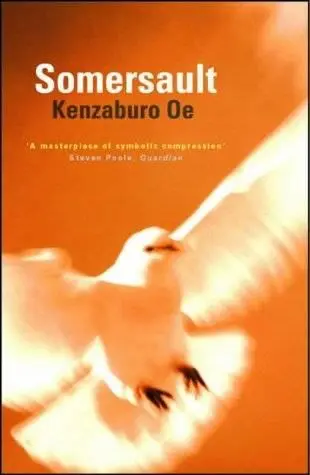
- Название:Somersault
- Автор:
- Жанр:
- Год:неизвестен
- ISBN:нет данных
- Рейтинг книги:4 / 5. Голосов: 1
-
Избранное:Добавить в избранное
- Отзывы:
-
Ваша оценка:
Somersault: краткое содержание, описание и аннотация
Предлагаем к чтению аннотацию, описание, краткое содержание или предисловие (зависит от того, что написал сам автор книги «Somersault»). Если вы не нашли необходимую информацию о книге — напишите в комментариях, мы постараемся отыскать её.
From Publishers Weekly
Nobelist Oe's giant new novel is inspired by the Aum Shinrikyo cult, which released sarin gas in Tokyo 's subway system in 1995. Ten years before the novel begins, Patron and Guide, the elderly leaders of Oe's fictional cult, discover, to their horror, that a militant faction of the organization is planning to seize a nuclear power plant. They dissolve the cult very publicly, on TV, in an act known as the Somersault. Ten years later, Patron decides to restart the fragmented movement, after the militant wing kidnaps and murders Guide, moving the headquarters of the church from Tokyo to the country town of Shikoku. Patron's idea is that he is really a fool Christ; in the end, however, he can't escape his followers' more violent expectations. Oe divides the story between Patron and his inner circle, which consists of his public relations man, Ogi, who is not a believer; his secretary, Dancer, an assertive, desirable young woman; his chauffeur, Ikuo; and Ikuo's lover, Kizu, who replaces Guide as co-leader of the cult. Kizu is a middle-aged artist, troubled by the reoccurrence of colon cancer. Like a Thomas Mann character, he discovers homoerotic passion in the throes of illness. Oe's Dostoyevskian themes should fill his story with thunder, but the pace is slow, and Patron doesn't have the depth of a Myshkin or a Karamazov-he seems anything but charismatic. It is Kizu and Ikuo's story that rises above room temperature, Kizu's sharp, painterly intelligence contrasting with Ikuo's rather sinister ardor. Oe has attempted to create a sprawling masterpiece, but American readers might decide there's more sprawl than masterpiece here.
Somersault — читать онлайн бесплатно полную книгу (весь текст) целиком
Ниже представлен текст книги, разбитый по страницам. Система сохранения места последней прочитанной страницы, позволяет с удобством читать онлайн бесплатно книгу «Somersault», без необходимости каждый раз заново искать на чём Вы остановились. Поставьте закладку, и сможете в любой момент перейти на страницу, на которой закончили чтение.
Интервал:
Закладка:
Every time Dr. Ino visited Kizu-as follow-up care after his routine gallbladder operation-he asked him when and how he'd started to suspect that his cancer was recurring. Kizu told him he'd grown aware that his physi- cal condition was getting worse over the past three or four years but had put it down to his body's slowing down as it aged. After he'd talked with a re- nowned diagnostician he no longer doubted-on an emotional level-that his cancer was back, and so he'd returned to his native land.
As if this weren't enough, Dr. Ino prepared a questionnaire for Kizu.
What tests did the doctor in Tokyo run before he concluded it was cancer?
What words did he use to explain his findings, and how did you react?
After you were told you had cancer, didn't you refuse not just an opera- tion but also radiation treatment and anticancer medicine because, in the back of your mind, you had doubts about whether you really had cancer or not?
If you did have doubts, what prompted them?
Or, on a more positive note, did you think maybe the diagnosis of cancer was a misdiagnosis?
If so, what did you base this on?
Why didn't you discuss these doubts with your present attending physi- cian, who also happens to be a friend of yours?
Most of the questions were irrelevant because Kizu had never had any doubts. Still, Dr. Ino read the entire list of questions aloud. Some of them were relevant, however. When asked: Thinking that you had cancer and that death was not far off, did you put your affairs in order? Kizu just answered truthfully.
The final questions were different from the others, which made them all the more interesting: When you told your friends and colleagues that you had cancer, was there a change in their attitude toward you and in your attitude to- ward them? Did your attitude change toward yourself.
Kizu had done his best to respond honestly. And afterward, as he lay alone in bed, he mentally reviewed his responses.
What kind of examinations had the doctor in Tokyo done to arrive at the conclusion that he had terminal cancer? What Kizu remembered-it was only six months ago but the details were so fuzzy it seemed a lifetime, which only irritated Dr. Ino, and the more Kizu tried to recall the vaguer it all be- came-was that when the doctor in Tokyo questioned him about his condi- tion before examining him, Kizu reported his bloody stool, but this didn't cause the doctor's mood to sour. They'd taken X-rays in Tokyo and done a CT scan and ultrasound. And drew blood. With the bad experience he had before with a fiberscope, Kizu didn't feel much like having it done again. But he couldn't recall whether the doctor asked him if he wanted to go through that procedure. Perhaps by this time the doctor wasn't under any illusions?
Whether you're talking about the stomach or the intestines, if the patient's the type who doesn't like examinations, what's the point of making him suf- fer only to discover cancer in yet another part of his body?
After he was told he had cancer, the most important person he talked to about it had to be Ikuo, and this had been the spark that led to a deepening of their sexual relationship, a private preserve he wasn't about to get into.
Instead he had told Dr. Ino how Patron had told him that as long as Kizu had life within him he would clarify his own mission as a religious leader, and how after Kizu accepted his role Dr. Koga began to show greater inter- est in him. Further, he talked about how everyone here in this area knew he was a terminal cancer patient, but it didn't seem to make people any more or less interested in him and he was able to lead a happy life and get along well with others.
After all these questions, Dr. Ino had asked him this: In weekly maga- zines and on TV shows you often see reports of how patients everyone has given up on were cured by such folk medicine as Chinese chi therapy or eat- ing mushrooms from South America, right? Do you understand your own cure as the effects of Patron's mystical powers?
"When Patron's longtime companion fell ill," Kizu had replied, "not just Patron but everyone around him hoped he could save him through some mystical forces. But it didn't happen. So I don't believe Patron has mystical healing powers. However, while I was drawing the wound in Patron's side, what members of the church call the Sacred Wound, I felt a tremendous life force welling up within me, so powerful I wondered whether I'd be able to get through the session all right. The second time I was drawing was when I collapsed, but the terrible pain I felt came from that tremendous life force.
"As I usually do when I'm drawing, and as I sketched Patron with his side exposed, my eyes and hands functioned to connect up the inner and outer worlds of my model, and it was as if I suddenly got plugged into Patron's soul.
This touched off a kind of uncontrollable life force that welled up in me, a force was so overwhelming that I thought, If this is a display of Patron's mystical healing power, it might very well lead to that thud I was talking about and kill me. But I accepted that.
"After my first operation, my cancer-assuming for the moment that what I don't have now I did have then-having lain dormant until then, started to be active again, and who knows but maybe this too was due to the stimulus I got from encountering Patron. At least that's the way I'd like to think of it.
"When it was discovered I had a relapse of my cancer-and I was told there was no chance of recovery-I surprised myself by how industrious I became. I got deeply into things I'd never done before, gave up the teaching position I'd held for years in America, and moved here to the woods of Shikoku. Understand that I wasn't thinking of my relapse of cancer as a nega- tive thing. I knew I'd die before too long, but that didn't frighten me or make me feel regretful. I recognized that the basis tor my life had changed. Isn't that what happens? I didn't see it as a terrible end to my life."
"Now that you know youdon't have terminal cancer, " Dr. Ino ventured, "do things seem new to you in any way?"
"The symptoms I noticed myself haven't changed," Kizu said, "except that the dull pain I had for a long while is gone. I don't feel the overflowing life force that filled me while I was drawing Patron. I don't think this is just postoperation weakness.
"If there is something new, it's a sense of anxiety. I came here with Ikuo, who wanted to be with Patron. To me, Patron is a special person, of course, but so is Ikuo. Wasn't it the knowledge that I had cancer and didn't have long to live that led me to be with them without worrying in the slightest? On an unconscious level, wasn't I hoping I'd spend the short time left to me for their sake, without thinking about anything else? With my crisis past, how can an unexceptional person like me possibly associate with the likes of them? Frankly speaking, it frightens me."
Once more a faint smile came to Dr. Ino's face, and Kizu was left feel- ing there was something he didn't get, something that had nothing to do with the young physician's usual high spirits but reflected an ulterior motive at work.
A week after this conversation, on the day before Kizu was to be released from the hospital, a special scoop appeared in a weekly magazine-the maga- zine itself wasn't to be found in Matsuyama so they were relying only on the ads in the newspapers-that was based on the exclusive account of his attend- ing physician. The headline ran: RELIGIOUS LEADER WITH SACRED WOUND CURES TERMINAL CANCER WITH HIS HEALING POWER! CANCER THROUGHOUT THE BODY EXPELLED IN ONE LUMP!
3
Kizu left the hospital accompanied by Ms. Asuka, with Ikuo doing the driving. A minivan was to follow them with his belongings, with Mayumi at the wheel until they reached the mountain pass, after which Gii was to take over driving. Several members of the Fireflies were with them.
Читать дальшеИнтервал:
Закладка:
Похожие книги на «Somersault»
Представляем Вашему вниманию похожие книги на «Somersault» списком для выбора. Мы отобрали схожую по названию и смыслу литературу в надежде предоставить читателям больше вариантов отыскать новые, интересные, ещё непрочитанные произведения.




Обсуждение, отзывы о книге «Somersault» и просто собственные мнения читателей. Оставьте ваши комментарии, напишите, что Вы думаете о произведении, его смысле или главных героях. Укажите что конкретно понравилось, а что нет, и почему Вы так считаете.