Kenzaburo Oe - Somersault
Здесь есть возможность читать онлайн «Kenzaburo Oe - Somersault» весь текст электронной книги совершенно бесплатно (целиком полную версию без сокращений). В некоторых случаях можно слушать аудио, скачать через торрент в формате fb2 и присутствует краткое содержание. Жанр: Современная проза, на английском языке. Описание произведения, (предисловие) а так же отзывы посетителей доступны на портале библиотеки ЛибКат.
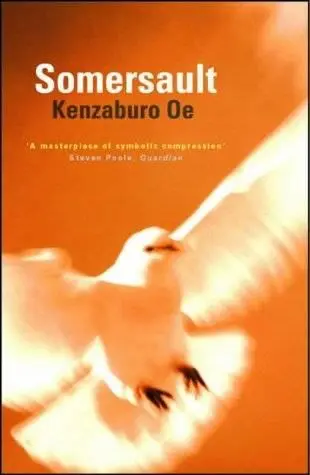
- Название:Somersault
- Автор:
- Жанр:
- Год:неизвестен
- ISBN:нет данных
- Рейтинг книги:4 / 5. Голосов: 1
-
Избранное:Добавить в избранное
- Отзывы:
-
Ваша оценка:
Somersault: краткое содержание, описание и аннотация
Предлагаем к чтению аннотацию, описание, краткое содержание или предисловие (зависит от того, что написал сам автор книги «Somersault»). Если вы не нашли необходимую информацию о книге — напишите в комментариях, мы постараемся отыскать её.
From Publishers Weekly
Nobelist Oe's giant new novel is inspired by the Aum Shinrikyo cult, which released sarin gas in Tokyo 's subway system in 1995. Ten years before the novel begins, Patron and Guide, the elderly leaders of Oe's fictional cult, discover, to their horror, that a militant faction of the organization is planning to seize a nuclear power plant. They dissolve the cult very publicly, on TV, in an act known as the Somersault. Ten years later, Patron decides to restart the fragmented movement, after the militant wing kidnaps and murders Guide, moving the headquarters of the church from Tokyo to the country town of Shikoku. Patron's idea is that he is really a fool Christ; in the end, however, he can't escape his followers' more violent expectations. Oe divides the story between Patron and his inner circle, which consists of his public relations man, Ogi, who is not a believer; his secretary, Dancer, an assertive, desirable young woman; his chauffeur, Ikuo; and Ikuo's lover, Kizu, who replaces Guide as co-leader of the cult. Kizu is a middle-aged artist, troubled by the reoccurrence of colon cancer. Like a Thomas Mann character, he discovers homoerotic passion in the throes of illness. Oe's Dostoyevskian themes should fill his story with thunder, but the pace is slow, and Patron doesn't have the depth of a Myshkin or a Karamazov-he seems anything but charismatic. It is Kizu and Ikuo's story that rises above room temperature, Kizu's sharp, painterly intelligence contrasting with Ikuo's rather sinister ardor. Oe has attempted to create a sprawling masterpiece, but American readers might decide there's more sprawl than masterpiece here.
Somersault — читать онлайн бесплатно полную книгу (весь текст) целиком
Ниже представлен текст книги, разбитый по страницам. Система сохранения места последней прочитанной страницы, позволяет с удобством читать онлайн бесплатно книгу «Somersault», без необходимости каждый раз заново искать на чём Вы остановились. Поставьте закладку, и сможете в любой момент перейти на страницу, на которой закончили чтение.
Интервал:
Закладка:
"Yesterday, when Ikuo came to visit me, he told me what young Gii told him about having often seen people who've returned living together with nor- mal people. Right now I really feel, talking to you like this, that I am one of those people."
"I think that if the next thud, as you put it, had come, you really would have died," Dr. Koga said. "As your doctor I was trying to forestall this, but it was risky to take you all the way to Matsuyama. I took the risk partly be- cause Ikuo insisted but also because I believed you were going to pass away from cancer anyway before much longer. I was anxious, thinking we had to take you to Matsuyama, otherwise you'd die the way you were, though I know this isn't exactly logical… If you had died on the way-well, I figured that would be unfortunate but not the worst sort of death. I did still feel respon- sible, though, even if you'd passed away after we took you out of the ambu- lance and turned you over to the intensive care unit."
The sense of fear and confusion Kizu felt at that time was no longer near, though it was bound to overwhelm him again. He didn't feel like complain- ing to Dr. Koga, though, and confined himself to a sigh.
"It was all pretty strange the way it worked out," Kizu said.
"It was a miracle!" Dr. Koga exclaimed. "As your attending physician I've made one mistake after another. When you had your first bout of pain and bloody stool, I just went on the assumption that you had terminal cancer and should be given medication to alleviate the pain. But you recovered quickly, so I designed a program both to control your pain with medication and to allow you to recuperate at home. People your age are wary of being overly dependent on drugs, not to mention being pretty stoic, so you were a model patient.
"The thought didn't occur to me of trying to locate the origin of your pain. A complete cure was out of the question. That's the situation when you had this recurrence and all the terrible pain involved. I imagine Ikuo's told you all about this, but on the day you went into the hospital Patron used that as the impetus for launching this notion of the Church of the New Man. It had a tremendous impact on everybody-from those in the Hollow to those out at the farm.
"Patron says that the concept of the Church of the New Man is ex- pressed in the painting you were doing at the time of your collapse, so I went over to your studio to check it out. If only I'd seen it beforehand I would have definitely taken another look at the source of your pain. There's a power in that painting. I don't care how much technique and experience an artist might have, there's no way a person taking drugs to suppress the pain of terminal cancer could draw something with the kind of power I saw in that painting.
"In actual fact, it turns out you don't have terminal cancer at all. So where was the pain coming from? Well, now we know. Eight years ago you had the viscous matter they discovered in an X-ray cleaned out. The material that collected once again in your gallbladder was rather tenacious, and the gall- bladder was just about ready to burst. The young doctor at the Red Cross Hospital opened you up, removed it, and that was that.
'"The pain he had before was accompanied by jaundice, right?' the doctor asked me, 'so why didn't you suspect gallstones?' He treated me like some ignorant intern. I'd heard it was untreatable intestinal cancer. I asked the young doctor what he thought of the bloody stool. He said it's no longer a concern. And he was exactly right. The fiberscope showed no bleeding in your intestines and of course no sign of cancer. As far as we could see during the gallbladder operation, no cancer had spread to any other organs. 'Which isn't strange because there wasn't any cancer to begin with!' the young doc- tor said, in high spirits."
"So there really wasn't any cancer?" Kizu asked.
"The doctor who examined you in Tokyo is an outstanding physician with a great deal of experience. Terminal intestinal cancer isn't that hard to diagnose. It is a bit strange, though, that he didn't do a biopsy."
"Maybe that's because the physician who introduced me to him is a re- nowned diagnostician," Kizu said. "Patron once said he'd do something for my cancer. Do you think he really did what he said he would?"
"All my belief rests on him," Dr. Koga said. "Which doesn't hold true for you, Professor. I can't deny what you say, but it makes me wonder. Natu- rally, I'm happy that things have turned out as they have. Something both- ers me, though, about that high-spirited young doctor. 'The cancer identified by the former attending physician has completely disappeared-yet the pa- tient didn't follow up with any standard anticancer treatment. And he's liv- ing with the leader of a religious life. Can we ignore these facts?' That's what he said.
"Ambition might get the best of him and make him talk to the media, and then Patron will be drawn into the spotlight all over again. It's an un- pleasant thought, especially when we're in such a critical time for the church."
2
Over and over Kizu kept thinking about what it meant that the cancer he'd been aware of having invaded his entire body-though if asked how he was aware of this he could only give an uncertain, vague reply-had com- pletely vanished. The conclusion he arrived at was pure nonsense.
A fluid life force inside me, he thought, something I've never felt before, arose, moved through me, eradicated the focal point of the cancer deep in- side, gathered it all at a spot where it could be expelled from my body, and then discharged it very painfully as that bloody stool!
Before the first wave of pain hit, while he was sketching the feverish Patron, Kizu had felt a tremendous force poured into his body. He recalled this when he was in the hospital. And while he had been sketching Patron naked from the waist up, this came back even more forcefully, which is when he started feeling bad and this latest episode had occurred.
When the next wave of pain hit him, the cancer had gathered in one place and came out in the bloody stool! Kizu knew this was an audacious fantasy, yet his insides retained a firm memory that this fantasy had actually happened.
Kizu proceeded to tell his story to the "high-spirited young doctor," as Dr. Koga called him, who was named Dr. Ino.
"I'm not saying this is how it happened," Kizu said. "But if you think about it, the relationship between what happened to my body and the power I received from Patron can explain it."
The doctor's face was round and fat, but the skin looked dirty. A nasty- little-boy smile came to his lips and he rejected this suggestion out of hand.
"If the doctor tells you it's colon or rectal cancer, well, if you're going to have cancer those are good places to have it… At any rate, that's a sweet fan- tasy for a terminal cancer patient. I suggest you confirm this with Dr. Koga."
Kizu felt the smile of pity was directed toward him because of his chronic immaturity, and he accepted the doctor's designation of it as a fantasy. Still, he had to raise a mild protest at the way the young doctor treated Dr. Koga as an accomplice in the misdiagnosis.
"I'm overjoyed, of course, that I don't have cancer," Kizu said, "but my doctor in Tokyo was quite sure he'd discovered cancer, and Dr. Koga based his treatment on what the doctor passed along to him. Not noticing that the cancer has disappeared, though, perhaps is a slipup on his part as my attend- ing physician-"
"What? Cancer doesn't just disappear!" Dr. Ino said, his expression even more spirited. "If a sample of a person's cells are taken to a diagnostic lab and they discover cancer, then he's a cancer patient pure and simple. You'd re- signed yourself to being killed by those cancerous cells, and now, finding out that you aren't going to die, of course you feel great. But aren't you forget- ting how you suffered when you were told you had incurable cancer?"
Читать дальшеИнтервал:
Закладка:
Похожие книги на «Somersault»
Представляем Вашему вниманию похожие книги на «Somersault» списком для выбора. Мы отобрали схожую по названию и смыслу литературу в надежде предоставить читателям больше вариантов отыскать новые, интересные, ещё непрочитанные произведения.





Обсуждение, отзывы о книге «Somersault» и просто собственные мнения читателей. Оставьте ваши комментарии, напишите, что Вы думаете о произведении, его смысле или главных героях. Укажите что конкретно понравилось, а что нет, и почему Вы так считаете.