Alice McDermott - After This
Здесь есть возможность читать онлайн «Alice McDermott - After This» весь текст электронной книги совершенно бесплатно (целиком полную версию без сокращений). В некоторых случаях можно слушать аудио, скачать через торрент в формате fb2 и присутствует краткое содержание. Жанр: Современная проза, на английском языке. Описание произведения, (предисловие) а так же отзывы посетителей доступны на портале библиотеки ЛибКат.
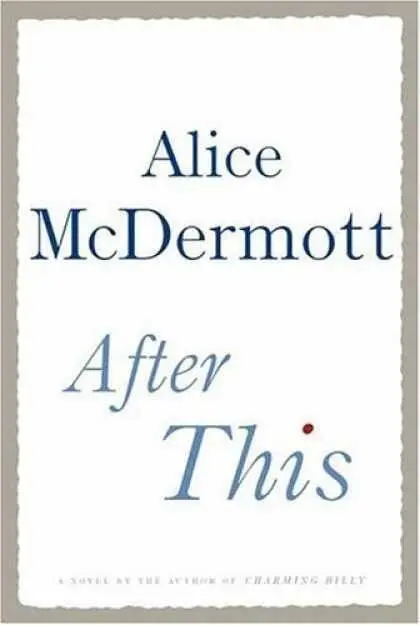
- Название:After This
- Автор:
- Жанр:
- Год:неизвестен
- ISBN:нет данных
- Рейтинг книги:4 / 5. Голосов: 1
-
Избранное:Добавить в избранное
- Отзывы:
-
Ваша оценка:
After This: краткое содержание, описание и аннотация
Предлагаем к чтению аннотацию, описание, краткое содержание или предисловие (зависит от того, что написал сам автор книги «After This»). Если вы не нашли необходимую информацию о книге — напишите в комментариях, мы постараемся отыскать её.
Most fictional family sagas contain a lot of what could be called plain reporting: answers to the questions (who? what? when? where? why?) that are the basic stuff of journalism. But in her family dramas, McDermott has largely refused to provide a helpful framework of dates, genealogies or factual background. Instead, she has focused on the shifting inner lives of her characters, confident that God – or the larger picture – will be found in the details.
The opening of her latest novel, "After This," demonstrates McDermott's technique at its most elliptical and effective. On a blustery April day in Midtown Manhattan, Mary (no last name given) leaves a church (almost certainly St. Patrick's Cathedral) after lighting a candle, as she has done throughout the war, even though the fighting is over. (Since the war in question is clearly World War II, the action must take place, at the earliest, in the spring of 1946). Mary has also prayed: "She was 30, with no husband in sight. A good job, an aging father, a bachelor brother, a few nice friends. At least, she had asked – so humbly, so earnestly, so seriously – let me be content." Outside the church, squinting in the sunlight, Mary meets a friend of her brother's, who unexpectedly asks her to dinner. "At a restaurant," he explains, when she seems confused. "The two of us." Mary agrees, they part, and she goes into Schrafft's for what's left of her lunch hour.
At the counter she exchanges small talk about the weather with a man seated next to her. "Reminds me of some days we had overseas," he says, standing up to pay his bill. Mary watches him walk away: "And here, of all things, was desire again. (She could have put the palm of her hand to the front of his white shirt.)" Mary returns to her office and later goes home to a walk-up apartment in an unnamed borough to prepare lamb chops for her father and brother before her dinner date, which passes pleasantly and ends with a chaste kiss. The next day, when she returns to Schrafft's, the man she met the day before is waiting outside. Reader, she marries him.
This sequence could stand alone as a classic short story in the Joycean, epiphanic mode: an accretion of humdrum moments that gather force and blossom into the transfiguration of a life. Yet such stories seldom cry out for a sequel – does anyone want to know what Gabriel and Gretta Conroy said to each other the morning after "The Dead" concludes? – and McDermott's deft, delicate beginning is a hard act to follow. Mary, so vivid in her first appearance, rapidly fades into careworn motherhood. Fewer than a dozen pages later, she and her husband, John Keane, are taking a rare break from Sunday Mass at a Long Island beach, deserted after the Labor Day weekend, with their three children. John seems stunned by his responsibilities; Mary's pregnancy will only add to them. A hurricane is beginning to churn up the Eastern Seaboard, and the stinging, wind-borne sand drives the family back home. That night, a tree in the Keanes' yard is blown over. The next morning, a neighbor with a chain saw, who also happens to be a registered nurse, appears just in time to help Mary deliver her baby.
Once this hectic episode concludes, McDermott's narrative turns episodic and digressive, and "After This" begins to resemble a photo album with many missing snapshots and pages. Here is John serving on the building committee of St. Gabriel's Parish, helping raise money for a new church and gym. Over there are Mary and her daughter standing in line to see Michelangelo's Pietà in the Vatican pavillion at the 1964 World's Fair. (McDermott, characteristically, omits the 1964 part, leaving that for her readers to deduce.) Here we see the neighbor's teenage daughter going into Manhattan for an abortion, accompanied by the older of the two Keane daughters, who reads "A Farewell to Arms" in the waiting room. And up ahead, Pauline, Mary's old friend from her office days and the Keane family's honorary spinster aunt, is injured in a fall. Strangely, Pauline's mishap and its aftereffects receive far more attention than the major tragedy that befalls Mary and John, registered almost subliminally and barely referred to again.
Each of the Keane children shines briefly before disappearing. Shy, awkward Jacob drops out of St. John's after a year of poor grades and draws an unlucky lottery number for the Vietnam draft. Michael, charming and irreverent, spends most of his time at his upstate college in a seedy saloon. Annie, the bookish child (inspired by one of Pauline's visits to escape into a Faulkner novel while thinking about "the odor of aging female flesh"), goes to study in England and changes her plans because of a young man she meets on a bus. Clare, devoted youngest child and just as devoted Catholic, nonetheless finds a way to break her parents' hearts.
This assembly of splintered stories suggests that McDermott, like Virginia Woolf in "The Waves," has come to care less about her individual characters than about the unseen forces – fate, the zeitgeist, the inexorable progress of time – that shape and trace the patterns of their lives. With no warning or explanation, she provides capsule previews of the deaths of two family members that are jarring not just because they deflate suspense but because they suggest that it's futile to invest much interest in these characters.
Late in the novel, Clare Keane, having finally found a boyfriend during the long summer vacation, returns to her Catholic high school displaying new aplomb and self-confidence: "Of course of course, the teachers, even the nuns told each other, indulgent and naïve. Those who had been at the school when Annie was a student said, with a shrug, Life goes on." And that seems to be the burden and the message of "After This." Life does, irrefutably, go on. But if that's all there is to say about the matter, why bother with art and stories, which defy the limits of birth and death by trying to immortalize the interesting things that happen in between? For all its page-by-page brilliance, "After This" leaves that question hanging.
After This — читать онлайн бесплатно полную книгу (весь текст) целиком
Ниже представлен текст книги, разбитый по страницам. Система сохранения места последней прочитанной страницы, позволяет с удобством читать онлайн бесплатно книгу «After This», без необходимости каждый раз заново искать на чём Вы остановились. Поставьте закладку, и сможете в любой момент перейти на страницу, на которой закончили чтение.
Интервал:
Закладка:
And then, to his great surprise, she began to sing. Her voice was sweet, lower than he would have expected, although surely he had heard her singing around the house a thousand times before. But now she was singing for him, much as she used to do when she was very small, her hands at her sides, her eyes half closed. The cotton skirt not too short, perhaps, but wrinkled from the hours she’d been sitting. The little-girl knees, although her body was growing lean. She sang and he was both enchanted and embarrassed by her earnestness. Both hopeful that neither of the boys would come upstairs (Jacob would only roll his eyes but Michael would sing along with her, mocking, howling the words, to run, where the brave dare not go ow ow ), and yet wishing that they would because there was something painful in it, watching her, another kind of pain altogether than what he’d been fighting these past two days. The boys had their lives off in the wider world, he thought, but girls, his daughters, they had lives far wider and far more inaccessible, right before his eyes.
The room was lit with the thick yellow light of a summer evening. The leg was numb and as certain as he was that he would find a way to heal it-or that the doctors would-he knew, too, that some part of his future had been retracted, foreshortened by the pain. That it had added, if only by a month or a year or two, to the time she would have to miss him.
She sang, she seemed to know all the words.
The lottery was held three weeks before Christmas, which made something biblical about the whole ordeal, or at least, Mary Keane said, medieval.
When all the days of the year had been called, she said to her husband, her mouth held crookedly-a grim joke in the face of what they could not change-”Maybe if the piano player had skipped practice that morning, Jacob would have had a different birthday.” He nodded; it was a joke, given its intimate circumstances, no one else could share, and even he, all these years later, felt himself blush. “Maybe if you’d married George,” he said.
And then he took Clare’s hand. She was bundled up against the cold. They were just going out for a breath of fresh air. At the foot of his driveway, pulling his garbage cans to the curb, Mr. Persichetti paused. Tony’s birth date, as it turned out, would have been a lucky one, if he hadn’t already enlisted and gone over and come back home again, hollowed-eyed and furious, after all he’d seen. “Hooked on drugs,” Mr. Persichetti said. He might have just learned the phrase.
Mr. Persichetti told Mr. Keane, “Shoot him in the foot. Break his legs before you let him go.”
Clare looked up at the two men. Her father gripped her hand and Mr. Persichetti stepped back and then forward, his face shadowy in the night.
“No, honey,” he said, touching her wool cap. “Don’t pay attention to me.” And then he glanced at her father, his eyes catching the dull streetlight. “I was there when you came into the world, you know,” he said, cheerfully, as if cheerfulness now could erase the terrible thing he had already said. She told him she knew. She had come too soon. She had come inconveniently. Pauline had only just put on her hat when the call came, on her way out to the movies.
“I was the very first person,” Mr. Persichetti said, “to welcome you into this crazy world of ours.”
And for the second time in that hour, John Keane felt a flush rise to his cheeks.
And your brother?” Mrs. Antonelli said because it was Michael Keane she remembered, all the hours he had cooled his heels on the leather couch before her desk, waiting to see Sister Rose, the principal. Jacob, sitting before her now, had left no mark on her memory-which was understandable enough, given the number of children who passed through St. Gabriel’s, a hundred graduates each year, six or seven hundred more since Jacob Keane had been an eighth grader. As secretary and (she liked to say) palace guard for Sister Rose, Mrs. Antonelli had far more contact with the troublemakers anyway. Michael Keane had been one of them. Jacob, clearly, had not.
“He’s upstate,” Jacob said. “College.”
He was a nice-looking boy-dark hair and dark brows, green eyes. But he was also slight, narrow-shouldered, not much bigger, perhaps, than he’d been when he left here. It was Mrs. Antonelli’s belief that God should have made all men tall and broad-out of fairness. Her own husband was six foot three. She thought of this as an accomplishment.
“Good for him,” she said, and then wondered at the contrast her words implied, for Jacob had just told her that he himself had left St. John’s and was now headed for the army. “And good for you, too,” she added. “For answering the call.”
Jacob smiled shyly. He wore blue jeans, which she did not approve of, and a tattersall dress shirt rolled at the sleeves, which was all right. “Thanks,” he said, politely, although they both understood he’d had no choice in the matter.
“And you’ll have the GI Bill when you get back,” Mrs. Antonelli said. “That’s how my husband put himself through Fordham.”
Jacob nodded slowly. “It’s a great thing,” he said, and then looked at her, his large green eyes and a girl’s dark lashes, nothing else to say.
Mrs. Antonelli glanced down at the work before her, but she had taken off her reading glasses when the boy came in (here to pick up his sister for a dentist appointment, although the mother had sent no note), so everything was a blur. From the room beyond came the sound of Sister Rose on the phone, speaking in the clipped rhythms of her professional voice. From down the hall came the drone of a class repeating its times tables. “I suppose it seems like just yesterday that you were here,” she said, making conversation.
The boy merely moved his head, as if uncertain himself whether he wanted to say yes or no.
The office was paneled in dark wood, and the light from the small window was yellow. There was a statue of the Holy Family in one corner, a flagpole bearing the white-and-gold diocesan flag in another. There was a crucifix and an oil painting of the pope on the wall behind Mrs. Antonelli’s desk, and the portrait of Our Lady of Perpetual Help from the old church on the wall behind Jacob’s head. There was the gently overpowering odor of Mrs. Antonelli’s perfume-a powdery scent that was neither fruit nor flower nor spice, like nothing in nature Jacob could think of-and despite the terrible familiarity of the office, the long halls of the school, the sound of the children reciting their lessons, it was this scent alone that brought him back to his years here, years of terror (he’d been a shy child and the nuns with their sweeping skirts and clicking beads had all but made him mute), years of grace (because he was also a good child, chosen above all others to carry messages from his teachers to Mrs. Antonelli’s desk). He briefly studied his hands. Mrs. Antonelli’s perfume brought him there again and put off all that was ahead of him not simply by a few hours but by years.
And then Clare was standing in the doorway, beside the eighth-grade boy who had been sent to fetch her. She wore her beanie, and her pigtails had already begun to fray. There were Band-Aids on both of her knees, above the navy blue kneesocks. She wore the school’s plaid jumper, a new one that still hung on her stiffly, and under the wide white sleeves of her uniform blouse her bare arms seemed as thin as sticks.
Jacob stood. The car keys were in his hand.
“Please tell your mother,” Mrs. Antonelli said, standing as well, “to remember to send a note in next time.”
Jacob nodded. “I will,” he said. And then, “Thank you.” And then, head down, “Sorry to disturb you.” He put his hand out to allow his sister to go before him through the door. “Nice to see you again,” he said.
Читать дальшеИнтервал:
Закладка:
Похожие книги на «After This»
Представляем Вашему вниманию похожие книги на «After This» списком для выбора. Мы отобрали схожую по названию и смыслу литературу в надежде предоставить читателям больше вариантов отыскать новые, интересные, ещё непрочитанные произведения.










Обсуждение, отзывы о книге «After This» и просто собственные мнения читателей. Оставьте ваши комментарии, напишите, что Вы думаете о произведении, его смысле или главных героях. Укажите что конкретно понравилось, а что нет, и почему Вы так считаете.