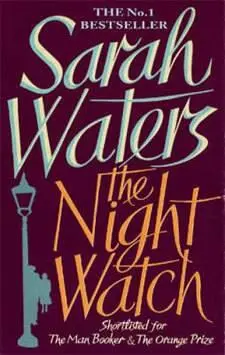
Sarah Waters - The Night Watch
Здесь есть возможность читать онлайн «Sarah Waters - The Night Watch» весь текст электронной книги совершенно бесплатно (целиком полную версию без сокращений). В некоторых случаях можно слушать аудио, скачать через торрент в формате fb2 и присутствует краткое содержание. Жанр: Современная проза, на английском языке. Описание произведения, (предисловие) а так же отзывы посетителей доступны на портале библиотеки ЛибКат.
- Название:The Night Watch
- Автор:
- Жанр:
- Год:неизвестен
- ISBN:нет данных
- Рейтинг книги:4 / 5. Голосов: 1
-
Избранное:Добавить в избранное
- Отзывы:
-
Ваша оценка:
The Night Watch: краткое содержание, описание и аннотация
Предлагаем к чтению аннотацию, описание, краткое содержание или предисловие (зависит от того, что написал сам автор книги «The Night Watch»). Если вы не нашли необходимую информацию о книге — напишите в комментариях, мы постараемся отыскать её.
The structure of The Night Watch is worth remarking upon as it begins at the end in 1947. The second section takes us back to 1944, and the third and final section is set in 1941. The decision to use this type of structure is brave, even foolhardy, because of the problems in pulling it off convincingly, but Waters’ subtlety and restraint in pulling back the layers reveals the extent of her authorial control.
This novel is essentially concerned with five main characters (Kay, Viv, Helen, Julia and Viv’s brother, Duncan) and their separate private lives. The connections between these people are also elemental to the narrative. Coincidence plays a significant role in the unfolding of past events as their lives are shown to overlap. This use of coincidence has been a feature of Waters’ previous novels, but this time she uses it casually, and as an extra element, rather than for the purposes of manipulating the plot out of hand as was deemed necessary in a melodrama such as Fingersmith.
The love stories of Kay, Viv and Helen are central and, as the narrative traces back to 1941, we learn how their present views of relationships have been shaped by these past events. As with her previous novels, Waters continues to use lesbian relationships as a main focus of the narrative, but shifts away to examine the affair between Viv and Reggie, and the horrific illegal abortion she undergoes to spare her father from further shame.
Repression becomes a touchstone as many of the characters keep a secret or carry a weight of shame. The converse of this theme of fear of discovery is the examination of bravery. This is most notable in the second and third sections which are, necessarily, concerned with the bombing of London. A re-evaluation of the definition of courage is undertaken and is perhaps most poignant in the prison scene, where Duncan ’s cell mate, conscientious objector Fraser, asks himself if he is ‘simply a – a bloody coward’ when he is overwhelmed by the fear of death. The deconstruction of received morality, of what is to be brave or selfish in this time of heightened emotions, is also examined when Helen considers the effect the war has had on her ethics: ‘In the first blitz, she’d tried to help everyone; she’d given money to people, sometimes, from her own purse. But the war made you careless. You started off, she thought sadly, imagining you’d be a kind of heroine. You end up thinking only of yourself.’
The reason for Duncan ’s imprisonment is one of the well-kept secrets of the novel and is only (partially) explained in the third section. This use of the hidden truth and the hints at the unspoken strengthen the evocation of the period, where loose lips could potentially sink ships, and walls had ears. When revelations are made, they are, more often than not, as subdued as the repressed tone permits and this allows the novel to maintain the same pace throughout.
Despite this steady pace, Waters still enables the readers to see how the war also had a liberating effect on women such as Kay. Her gallantry and masculine demeanour was of use during the bombings whilst she worked as an ambulance driver, but in the beginning of the novel, in 1947, it is clear that with the return to peace time her short hair and male clothing are once more worthy of ridicule.
As with all of Waters’ novels, The Night Watch has been praised by critics for the attention to detail and meticulous research. This work stretches beyond the limits of the previous three, though, and is certainly her most impressive to date. Her control in depicting the central characters gradually is in itself an indicator of skilful writing. As this is also combined with a believable and interested evocation of period and place, this novel must be recommended highly.
The Night Watch — читать онлайн бесплатно полную книгу (весь текст) целиком
Ниже представлен текст книги, разбитый по страницам. Система сохранения места последней прочитанной страницы, позволяет с удобством читать онлайн бесплатно книгу «The Night Watch», без необходимости каждый раз заново искать на чём Вы остановились. Поставьте закладку, и сможете в любой момент перейти на страницу, на которой закончили чтение.
Интервал:
Закладка:
'Here's your son coming, too,' she said, when she saw Mickey helping up the bleeding man. 'Partridge, are you ready with the girls? OK, everybody. Come now. Quickly, but softly.'
They trooped raggedly into the kitchen. The light made them wince and cover their eyes. And then the girls, of course, saw how filthy and cut about they were-and how dreadful their father looked, with the blood and the bandages on his face. They began to cry.
'Never mind,' their mother said, shaken. She was still shivering. 'Never mind. We're all right, aren't we? Phyllis, turn the key in the door. Bring the tea, Eileen. And cover up that tin of corned beef! Just to be on the safe- Oh, my Lord!' She had reached the door that led from the kitchen and seen the chaos that lay beyond. She couldn't believe it. She stood with her hand at her heart. 'Oh, my good Lord!'
The girls, behind her, let out screams.
Kay's feet slid about again, as she and the warden tried to manoeuvre the elderly lady over the rubble. Every step they took sent up a new cloud of dust, feathers, soot. But finally they got her to the edge of what was once the front garden. They found a couple of schoolboys swinging from the handles of the ambulance doors.
'Need any help, mister?' the boys said, to the warden or, perhaps, to Kay.
The warden answered them. 'No, we don't. You clear off back to your shelter, before you get your bloody heads blown off. Where are your mothers? What do you think those planes are, bumble-bees?'
'Is that old Mrs Parry? Is she dead?'
'Get out of it!'
'Oh, my Lord!' the woman was still saying, as she made her way through the wreckage of her flat.
The ambulance had four metal bunks, of the kind used in shelters. There was a dim light, but no form of heating, so Kay tucked another blanket around the elderly lady and fastened her into the bunk with a canvas belt, then put one of the hot-water bottles under her knees, and another next to her feet. Mickey brought the man. His eyes were gummed shut completely now, with blood and dust; she had to guide his arms and his legs as if he'd forgotten how to use them. His wife came after. She had started picking little things up: a single tartan slipper, a plant in a pot. 'How can I leave all this?' she said, when the warden tried to get her into Partridge's car so that she could be driven to the First Aid Post. She'd started crying. 'Won't you run and get Mr Grant, from out of his house across the road? He'll watch our things. Will you, Mr Andrews?'
'We can't let you bring it,' Partridge was saying, meanwhile, to the girl with the dog.
'I don't want to go, then!' cried the girl. She gripped the dog harder, making it squeal. Then she looked down at her feet. 'Oh, Mum, here's that picture you had from Uncle Patrick, all smashed to bits!'
'Let her take the dog, Partridge,' said Kay. 'What harm can it do?'
But it was Partridge's decision, not hers; and there wasn't time, anyway, to stay and debate it. She left them all arguing-just nodding to Mickey in the back of the van, closing the doors, then running round to the front and wiping off the windscreen: for in the twenty minutes or so that the vehicle had been sitting idle in the street it had got thickly coated with dust. She got in the cabin and started the engine.
'Andrews,' she called to the warden, as she began to turn, 'watch my tyres for me, will you?' A puncture now would be disastrous… He moved away from the woman and the girls and shone his torch about her wheels, then raised his hand to her.
She went cautiously at first, speeding up when the road grew clearer. They were supposed to keep to a steady sixteen miles per hour when carrying casualties-but she thought of the elderly lady with her broken ribs, and the bleeding man, and drove faster. Now and then, too, she'd lean closer to the windscreen to peer up into the sky. The drone of aeroplanes was still heavy, the thumping of the guns still loud, but the sound of the engine was loud, too, and she couldn't tell if she was driving into the worst of the action or leaving it behind.
In the wall of the cabin behind her head was a sliding glass panel: she was aware of Mickey, moving about in the back of the van. Keeping her eyes on the road ahead she turned slightly and called, 'All right?'
'Just about,' answered Mickey. 'The old lady's feeling the bumps, though.'
'I'll do what I can,' said Kay.
She peered at the surface of the road, trying desperately to avoid the breaks and potholes, until her eyes began to smart.
When she pulled up at the stretcher entrance of the hospital on the Horseferry Road, the reception nurse came running out to greet her, ducking her head as if it was raining. The ward sister, however, followed at an almost leisurely pace, apparently quite unperturbed by the flashes and the bangs.
'Can't keep away from us, Langrish?' she said, over a new burst of gun-fire. 'Well, and what do you have for us this time?'
She was large-bosomed and fair, and the wings of her cap curled into points: they always struck Kay as being like the Viking horns worn by certain opera singers. She sent for a trolley and a wheeled chair, chivvying the porters as though they were geese. And when the man who'd been cut about by glass came dazedly out of the van, she chivvied him, too: 'Quickly, please!'
Kay and Mickey lifted out the elderly lady and set her gently on the trolley. Mickey had pinned a label to her, saying where and when she'd been hurt. She was putting out her hand as if frightened, and Kay took hold of her fingers. 'Don't worry, now. You'll be all right.'
Then they helped the man into the wheeled chair. He reached to pat Mickey's arm, saying, 'Thank you, son.' He'd caught a glimpse of her at the start and had thought her a boy, all this time…
'Poor bloke,' she said, when she and Kay had got back in the van. She was trying to wipe the worst of his blood from her hands. 'He'll be scarred like anything, won't he?'
Kay nodded. But the fact was, having handed the man and his mother over safely, she was already beginning to forget them. She was fixing her mind, instead, on her route back to Dolphin Square; and she was conscious, too, of the continuing row of aeroplanes and guns. She leaned forward again, to peer at the sky. Mickey peered too, and, after a minute, wound down her window and stuck out her head.
'How's it look?' asked Kay.
'Not very clever. Just a couple of planes, but they're right overhead. They look like they're going round in a circle.'
'A circle with us in it?'
''Fraid so.'
Kay speeded up. Mickey's tin helmet bounced against the frame of the window; she raised her hand to steady it. 'The searchlight's got him, now,' she said. 'Now they've lost him. Now- Whoops.' She drew in her head, very quickly. 'Here's the guns again.'
Kay turned a corner, and looked up. She could make out now the beam of a searchlight and, in it, the shining body of a plane. As she watched, a line of shells rose towards the aircraft, apparently in silence-for though she could hear and feel the pounding of the guns, it was hard, somehow, to attach that clamour to the string of darting lights, or to the little puffs of smoke produced when the lights were extinguished… Soon, anyway, she was distracted, by falling shrapnel. It struck the roof and the bonnet of the van with a series of clatters-as if the bombers had brought their cutlery drawers with them, and were emptying them out.
But then there was a more substantial thud, and then another; and the road ahead, suddenly, was lit by a fierce white light. The plane was dropping incendiaries, and one had burst.
'Great,' said Mickey. 'What'll we do?'
Automatically Kay had slowed, and her foot was hovering over the brake. They were meant to keep going, whatever they passed. If you got involved in some new incident, it could prove fatal. But she found it hard, every time, simply to drive away from danger…
Читать дальшеИнтервал:
Закладка:
Похожие книги на «The Night Watch»
Представляем Вашему вниманию похожие книги на «The Night Watch» списком для выбора. Мы отобрали схожую по названию и смыслу литературу в надежде предоставить читателям больше вариантов отыскать новые, интересные, ещё непрочитанные произведения.







Обсуждение, отзывы о книге «The Night Watch» и просто собственные мнения читателей. Оставьте ваши комментарии, напишите, что Вы думаете о произведении, его смысле или главных героях. Укажите что конкретно понравилось, а что нет, и почему Вы так считаете.