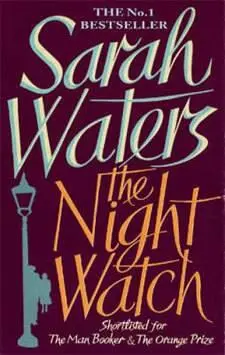
Sarah Waters - The Night Watch
Здесь есть возможность читать онлайн «Sarah Waters - The Night Watch» весь текст электронной книги совершенно бесплатно (целиком полную версию без сокращений). В некоторых случаях можно слушать аудио, скачать через торрент в формате fb2 и присутствует краткое содержание. Жанр: Современная проза, на английском языке. Описание произведения, (предисловие) а так же отзывы посетителей доступны на портале библиотеки ЛибКат.
- Название:The Night Watch
- Автор:
- Жанр:
- Год:неизвестен
- ISBN:нет данных
- Рейтинг книги:4 / 5. Голосов: 1
-
Избранное:Добавить в избранное
- Отзывы:
-
Ваша оценка:
The Night Watch: краткое содержание, описание и аннотация
Предлагаем к чтению аннотацию, описание, краткое содержание или предисловие (зависит от того, что написал сам автор книги «The Night Watch»). Если вы не нашли необходимую информацию о книге — напишите в комментариях, мы постараемся отыскать её.
The structure of The Night Watch is worth remarking upon as it begins at the end in 1947. The second section takes us back to 1944, and the third and final section is set in 1941. The decision to use this type of structure is brave, even foolhardy, because of the problems in pulling it off convincingly, but Waters’ subtlety and restraint in pulling back the layers reveals the extent of her authorial control.
This novel is essentially concerned with five main characters (Kay, Viv, Helen, Julia and Viv’s brother, Duncan) and their separate private lives. The connections between these people are also elemental to the narrative. Coincidence plays a significant role in the unfolding of past events as their lives are shown to overlap. This use of coincidence has been a feature of Waters’ previous novels, but this time she uses it casually, and as an extra element, rather than for the purposes of manipulating the plot out of hand as was deemed necessary in a melodrama such as Fingersmith.
The love stories of Kay, Viv and Helen are central and, as the narrative traces back to 1941, we learn how their present views of relationships have been shaped by these past events. As with her previous novels, Waters continues to use lesbian relationships as a main focus of the narrative, but shifts away to examine the affair between Viv and Reggie, and the horrific illegal abortion she undergoes to spare her father from further shame.
Repression becomes a touchstone as many of the characters keep a secret or carry a weight of shame. The converse of this theme of fear of discovery is the examination of bravery. This is most notable in the second and third sections which are, necessarily, concerned with the bombing of London. A re-evaluation of the definition of courage is undertaken and is perhaps most poignant in the prison scene, where Duncan ’s cell mate, conscientious objector Fraser, asks himself if he is ‘simply a – a bloody coward’ when he is overwhelmed by the fear of death. The deconstruction of received morality, of what is to be brave or selfish in this time of heightened emotions, is also examined when Helen considers the effect the war has had on her ethics: ‘In the first blitz, she’d tried to help everyone; she’d given money to people, sometimes, from her own purse. But the war made you careless. You started off, she thought sadly, imagining you’d be a kind of heroine. You end up thinking only of yourself.’
The reason for Duncan ’s imprisonment is one of the well-kept secrets of the novel and is only (partially) explained in the third section. This use of the hidden truth and the hints at the unspoken strengthen the evocation of the period, where loose lips could potentially sink ships, and walls had ears. When revelations are made, they are, more often than not, as subdued as the repressed tone permits and this allows the novel to maintain the same pace throughout.
Despite this steady pace, Waters still enables the readers to see how the war also had a liberating effect on women such as Kay. Her gallantry and masculine demeanour was of use during the bombings whilst she worked as an ambulance driver, but in the beginning of the novel, in 1947, it is clear that with the return to peace time her short hair and male clothing are once more worthy of ridicule.
As with all of Waters’ novels, The Night Watch has been praised by critics for the attention to detail and meticulous research. This work stretches beyond the limits of the previous three, though, and is certainly her most impressive to date. Her control in depicting the central characters gradually is in itself an indicator of skilful writing. As this is also combined with a believable and interested evocation of period and place, this novel must be recommended highly.
The Night Watch — читать онлайн бесплатно полную книгу (весь текст) целиком
Ниже представлен текст книги, разбитый по страницам. Система сохранения места последней прочитанной страницы, позволяет с удобством читать онлайн бесплатно книгу «The Night Watch», без необходимости каждый раз заново искать на чём Вы остановились. Поставьте закладку, и сможете в любой момент перейти на страницу, на которой закончили чтение.
Интервал:
Закладка:
By quarter past eight Duncan had begun to worry that Fraser might have come, have knocked, and gone away unheard. Mr Mundy had switched the wireless on, and the programme was rather noisy. So, on the pretext of getting himself a glass of water, he went out into the hall and stood quite still, cocking his head, listening for footsteps; he even, very softly, opened the front door and looked up and down the street. But there was no sign of Fraser… He went back into the parlour, leaving the door of it propped open. The radio programme changed, then changed again a half-hour later. The grandfather clock kept sending out its heavy, hollow chimes…
It took him until half-past nine to understand that Fraser wasn't going to come. The disappointment was dreadful-but then, he was used to disappointment; the first sting of it faded, turned instead into a settled blankness of heart. He put down his book, the table of hallmarks unlearnt. He was aware of Mr Mundy's gaze, but couldn't bring himself to meet it. And when Mr Mundy got up, came awkwardly to him, and lightly patted his shoulder and said, 'There. He's a busy chap, I expect. He'll have run into a couple of pals. That's what's happened, you mark my words!'-when Mr Mundy said that, he couldn't answer. He found he almost hated the feel of Mr Mundy's hand… Mr Mundy waited, then moved off. He went out to the kitchen. He let the parlour door close behind him, and Duncan suddenly felt the closeness and the airlessness of the dim, small, crowded room. He had a horrible sense of himself-falling, falling, as if down the narrow shaft of a well.
But the panic, like the disappointment, flared in him and died. Mr Mundy returned in time with a cup of cocoa: Duncan took it from his hands and meekly drank it. He carried the cup out to the kitchen and washed it himself, turning it over and over in the stream of cold water. The milk that was left in the pan he put down in a saucer on the floor, for the cat. He went out to the lavatory and, for a little while, just stood there in the yard, looking up at the sky.
When he went back into the parlour Mr Mundy was already going about shaking cushions, getting ready for bed. As Duncan watched, he started turning off the lamps. He moved from one lamp to the next. The parlour grew dark, the faces in the pictures on the walls, the ornaments on the mantelpiece, drawing back into shadow. It was just ten o'clock.
They went upstairs together, slowly, taking one step at a time. Mr Mundy kept his hand in the crook of Duncan 's elbow; and at the top he had to pause, still with his hand on Duncan 's arm, to get his breath back.
When he spoke, his voice was husky. He said, without looking at Duncan, 'You'll come in, son, in a minute, to say goodnight?'
Duncan didn't answer straight away. They stood in silence, and he felt Mr Mundy stiffen as if afraid… Then, 'Yes,' he said, very quietly. 'All right.'
Mr Mundy nodded, his shoulders drooping with relief. 'Thank you, son,' he said. He drew off his hand and made his slow, shuffling way along the landing to his bedroom. Duncan went into his own room and started to undress.
This room was small: a boy's room-the very room, in fact, in which Mr Mundy himself had used to sleep, when he was young and lived in this house with his parents and sister. The bed was a high Victorian one, with polished brass balls at each of its corners; Duncan had once unscrewed one of these and found a slip of paper inside it, marked in a smudged childish hand: Mabel Alice Mundy twenty dredful curses on you if you read this! The books in the bookcase were boys' adventure stories with broad, colourful spines. On the mantelpiece, set out as if to fight, were some badly-painted old lead soldiers… But Mr Mundy had put up shelves, too, for Duncan to display his own things, the things he'd bought in markets and antique shops. Duncan usually spent a moment, before he went to bed, looking over the pots and jars and ornaments, the teaspoons and tear-bottles-picking them up and delighting in them all over again; thinking about where they'd come from and who'd owned them before.
But he looked at it all, tonight, without much interest. He briefly picked up the bit of clay pipe he'd found on the beach by the riverside pub, that was all. He put his pyjamas on slowly, buttoning the jacket then tucking it tidily into the trousers. He cleaned his teeth, and combed his hair again-combing it differently this time, making it neat, putting a parting in it like a child's… He was very aware, as he did all this, of Mr Mundy waiting patiently in the room next door; he pictured him lying very still and straight, his head propped up on feather pillows, the blankets drawn up to his armpits, his hands neatly folded, but ready to pat the side of the bed, invitingly, when Duncan went in… It wasn't much. It was almost nothing. Duncan thought of other things. There was a picture, hanging over Mr Mundy's bed: a scene of an angel, safely leading children over a narrow, precipitous bridge. He'd look at that until it was over. He'd look at the complicated folds in the angel's gown; at the children's large, innocent-spiteful Victorian faces.
He put down his comb and picked up the bit of clay pipe again; and this time touched it to his mouth. It was chill and very smooth. He closed his eyes and moved it lightly across his lips, backwards and forwards-liking the feel of it, but made miserable by it too; aware of the uneasy stir of sensations it was calling up inside him. If only Fraser, he thought, had come! Perhaps, after all, he'd simply forgotten. It might be something as ordinary as that. If you were another sort of boy , he said bitterly to himself, you wouldn't have sat around here just waiting for him to turn up, you'd have gone out to find him . If you were a proper sort of boy you'd go out to his house right now -
He opened his eyes-and at once met his own gaze in the mirror. His hair was combed in its neat white parting, his pyjama jacket buttoned up to the chin; but he wasn't a boy. He wasn't ten years old. He wasn't even seventeen. He was twenty-four, and could do what he liked. He was twenty-four, and Mr Mundy-
Mr Mundy, he thought suddenly, could go to hell. Why shouldn't Duncan go out and get Fraser, if that's what he wanted? He knew the way to Fraser's street. He knew the very house Fraser lived in, because Fraser had taken him past the end of his road, once, and pointed it out to him!
He moved about very quickly now. He messed up the parting in his hair. He put on his trousers and his jacket-pulled them on right over his pyjamas, not wanting to waste even a minute by taking the pyjamas off. He put on his socks and his polished shoes, and as he stooped to tie his laces he realised that his hands were shaking; but he wasn't afraid. He felt almost giddy.
His shoes must have sounded loudly against the floor as he walked about. He heard the uneasy creaking of Mr Mundy's bed-and that made him move faster. He stepped out of his room and glanced just once across the landing to Mr Mundy's door; then he went quickly down the stairs.
The house was dark, but he knew his way through it as a blind man would-putting out his hand and finding door-knobs, anticipating steps and slippery rugs. He didn't go to the front door, because he knew that Mr Mundy's bedroom overlooked the street, and he wanted to go more secretly. For even in the midst of his excitement-even after having said to himself that Mr Mundy, for all he cared, could go to hell!-even after that, he thought it would be horrible to look back and see Mr Mundy at the window, watching him go.
So he went the back way, through to the kitchen and out, past the lavatory, to the end of the yard; and only when he got to the yard door did he remember that it was kept shut with a padlock. He knew where the key was, and might have run back for it; but he couldn't bear to go back now, not even as far as the scullery drawer. He dragged over a couple of crates and clambered up them, like a thief, to the top of the wall; he dropped to the other side, landing heavily, hurting his foot, hopping about.
Читать дальшеИнтервал:
Закладка:
Похожие книги на «The Night Watch»
Представляем Вашему вниманию похожие книги на «The Night Watch» списком для выбора. Мы отобрали схожую по названию и смыслу литературу в надежде предоставить читателям больше вариантов отыскать новые, интересные, ещё непрочитанные произведения.








Обсуждение, отзывы о книге «The Night Watch» и просто собственные мнения читателей. Оставьте ваши комментарии, напишите, что Вы думаете о произведении, его смысле или главных героях. Укажите что конкретно понравилось, а что нет, и почему Вы так считаете.