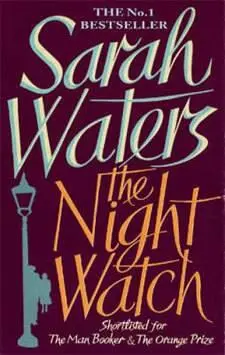
Sarah Waters - The Night Watch
Здесь есть возможность читать онлайн «Sarah Waters - The Night Watch» весь текст электронной книги совершенно бесплатно (целиком полную версию без сокращений). В некоторых случаях можно слушать аудио, скачать через торрент в формате fb2 и присутствует краткое содержание. Жанр: Современная проза, на английском языке. Описание произведения, (предисловие) а так же отзывы посетителей доступны на портале библиотеки ЛибКат.
- Название:The Night Watch
- Автор:
- Жанр:
- Год:неизвестен
- ISBN:нет данных
- Рейтинг книги:4 / 5. Голосов: 1
-
Избранное:Добавить в избранное
- Отзывы:
-
Ваша оценка:
The Night Watch: краткое содержание, описание и аннотация
Предлагаем к чтению аннотацию, описание, краткое содержание или предисловие (зависит от того, что написал сам автор книги «The Night Watch»). Если вы не нашли необходимую информацию о книге — напишите в комментариях, мы постараемся отыскать её.
The structure of The Night Watch is worth remarking upon as it begins at the end in 1947. The second section takes us back to 1944, and the third and final section is set in 1941. The decision to use this type of structure is brave, even foolhardy, because of the problems in pulling it off convincingly, but Waters’ subtlety and restraint in pulling back the layers reveals the extent of her authorial control.
This novel is essentially concerned with five main characters (Kay, Viv, Helen, Julia and Viv’s brother, Duncan) and their separate private lives. The connections between these people are also elemental to the narrative. Coincidence plays a significant role in the unfolding of past events as their lives are shown to overlap. This use of coincidence has been a feature of Waters’ previous novels, but this time she uses it casually, and as an extra element, rather than for the purposes of manipulating the plot out of hand as was deemed necessary in a melodrama such as Fingersmith.
The love stories of Kay, Viv and Helen are central and, as the narrative traces back to 1941, we learn how their present views of relationships have been shaped by these past events. As with her previous novels, Waters continues to use lesbian relationships as a main focus of the narrative, but shifts away to examine the affair between Viv and Reggie, and the horrific illegal abortion she undergoes to spare her father from further shame.
Repression becomes a touchstone as many of the characters keep a secret or carry a weight of shame. The converse of this theme of fear of discovery is the examination of bravery. This is most notable in the second and third sections which are, necessarily, concerned with the bombing of London. A re-evaluation of the definition of courage is undertaken and is perhaps most poignant in the prison scene, where Duncan ’s cell mate, conscientious objector Fraser, asks himself if he is ‘simply a – a bloody coward’ when he is overwhelmed by the fear of death. The deconstruction of received morality, of what is to be brave or selfish in this time of heightened emotions, is also examined when Helen considers the effect the war has had on her ethics: ‘In the first blitz, she’d tried to help everyone; she’d given money to people, sometimes, from her own purse. But the war made you careless. You started off, she thought sadly, imagining you’d be a kind of heroine. You end up thinking only of yourself.’
The reason for Duncan ’s imprisonment is one of the well-kept secrets of the novel and is only (partially) explained in the third section. This use of the hidden truth and the hints at the unspoken strengthen the evocation of the period, where loose lips could potentially sink ships, and walls had ears. When revelations are made, they are, more often than not, as subdued as the repressed tone permits and this allows the novel to maintain the same pace throughout.
Despite this steady pace, Waters still enables the readers to see how the war also had a liberating effect on women such as Kay. Her gallantry and masculine demeanour was of use during the bombings whilst she worked as an ambulance driver, but in the beginning of the novel, in 1947, it is clear that with the return to peace time her short hair and male clothing are once more worthy of ridicule.
As with all of Waters’ novels, The Night Watch has been praised by critics for the attention to detail and meticulous research. This work stretches beyond the limits of the previous three, though, and is certainly her most impressive to date. Her control in depicting the central characters gradually is in itself an indicator of skilful writing. As this is also combined with a believable and interested evocation of period and place, this novel must be recommended highly.
The Night Watch — читать онлайн бесплатно полную книгу (весь текст) целиком
Ниже представлен текст книги, разбитый по страницам. Система сохранения места последней прочитанной страницы, позволяет с удобством читать онлайн бесплатно книгу «The Night Watch», без необходимости каждый раз заново искать на чём Вы остановились. Поставьте закладку, и сможете в любой момент перейти на страницу, на которой закончили чтение.
Интервал:
Закладка:
Then she drew the lid off.
Inside the tin was a small parcel of cloth. Inside the parcel of cloth was a ring: a plain gold ring, quite aged, and marked with dents and little scratches. She took it up, held it for a second in the palm of her hand; then slipped it on her finger and covered her eyes.
At ten to six, when the men who ran the candle-making machines turned off the pumps, the sudden silence in the factory made your ears ring. It was like coming out of water. The girls at Duncan 's bench took it as a signal to start getting ready to go home: they got out their lipsticks and their compacts and things like that. The older women started rolling cigarettes. Len took a comb from his trouser pocket and ran it through his hair. He wore his hair a bit spivvily, swept back behind his ears. When he put the comb away he caught Duncan 's eye, and leaned forward.
'Have a guess what I'll be doing tonight,' he said, with a glance down the bench. He lowered his voice. 'I'm taking a girl to Wimbledon Common. She's stacked like this.' He gestured with his hands, then rolled his eyes and gave a whistle. 'Oh, mama! She's seventeen. She's got a sister, too. The sister's a looker, but got less up top… What do you think? You doing anything tonight?'
'Tonight?' said Duncan.
'Want to come along? The sister's a heart-throb, I'm telling you. What kind do you like? I know loads of girls. Big ones, little ones. I could fix you up, like that!' Len snapped his fingers.
Duncan didn't know what to say. He tried to picture a crowd of girls. But each one was like the little figure of wax that Len had made earlier, with curves and juts and waving hair, and a rough blank face. He shook his head, beginning to smile.
Len looked disgusted. 'You're missing out, I swear to God. This girl's a stunner. She's got a bloke, but he's in the army. She's used to doing it regular and she's feeling the pinch. I tell you, if the sister wasn't so friendly I'd be after her myself-'
He went on like that until the factory whistle sounded; then, 'Well, it's your funeral,' he said, getting to his feet. 'You think of me, that's all, at ten o'clock tonight!' He gave Duncan a wink of his brown gipsy eye, then hurried away-lurching a little from side to side, like a stout old lady; for his left leg was short, and fused at the knee.
The girls and the women went off quickly, too. They called goodbye as they went: 'Ta ta, Duncan!' 'So long, love!' 'See you Monday, Duncan!'
Duncan nodded. He couldn't bear the mood of the factory at this time of the day-the forced, wild jollity, the dash for the exit. Saturday nights were worst of all. Some people actually ran, to be first out through the gates. The men who had cycles made a sort of race of it: the yard, for ten or fifteen minutes, was like a sink with its plug pulled. He always found a reason to linger or dawdle. Tonight he got a broom, and swept up the parings of wax and the cuttings of wick from the floor beneath his stool. Then he walked very slowly to the locker-room and got his jacket; he visited the lavatory and combed his hair. When he went outside he'd taken so long, the yard was almost deserted: he stood for a moment on the step, getting used to the feel of space and the change of temperature. The Candle Room was kept cool because of the wax, but the evening was warm. The sun was sinking in the sky, and he had a vague, unhappy sense that time had passed-real time, proper time, not factory time-and he had missed out on it.
He had just put down his head and started to make his way across the yard when he heard his name called: 'Pearce! Hi, Pearce!' He looked up-his heart giving a thump inside his chest, because he'd already recognised the voice, but couldn't believe it. Robert Fraser was there, at the gate. He looked as though he'd just come running up. He was hatless, as Duncan was. His face was pink, and he was smoothing back his hair.
Duncan quickened his pace and went over to him. His heart was still lurching about. He said, 'What are you doing here? Have you been here all afternoon?'
'I came back,' said Fraser breathlessly. 'I thought I'd missed you! I heard the whistle go when I was still three streets away… You don't mind? After I'd gone this morning I thought how crazy it was, that you were here and- Well. Do you have an hour? I thought we could go for a drink. I know a pub, right on the river.'
'A pub?' said Duncan.
Fraser laughed, seeing his expression. 'Yes. Why not?'
Duncan hadn't been to a pub in ages, and the thought of going inside one now, with Fraser-of sitting at a table at Fraser's side, drinking beer, like an regular chap-was tremendously exciting, but alarming too. He was thinking, as well, of Mr Mundy, who would be waiting for him at home. He pictured the table set for tea: the knives and forks put neatly out, the salt and pepper, the mustard already mixed in its pot…
Fraser must have seen the look of indecision in his face. He said, as if disappointed, 'You've got other plans. Well, never mind. It was just a chance. Which way are you going? I could walk with you-'
'No,' said Duncan quickly. 'It's all right. If it's just for an hour-'
Fraser clapped him on the arm. 'Good man!'
He led Duncan south, towards Shepherd's Bush Green: the opposite direction to the one which Duncan would normally have taken. He walked loosely, easily, with his hands in his pockets and his shoulders back, and now and then he jerked his head to keep the hair out of his eyes. His hair seemed very fair with the evening sunlight on it; his face was still pink and lightly sweating. When they'd picked their way through the worst of the traffic he got out a handkerchief and wiped his forehead and the back of his neck, saying, 'I need a drink! I need several drinks, in fact. I've been out at Ealing since two o'clock, putting together a humorous piece on pig farming. My photographer spent more than an hour trying to coax a whimsical expression out of a sow. I tell you, Pearce, the next time I see a pig it had better be on a plate and have sage and onion coming out of its ears…'
He kept talking as they walked. He told Duncan about some of the other writing jobs he'd recently been sent on: a beautiful baby competition; a haunted house. Duncan listened just closely enough to be able to nod and laugh when he was meant to. The rest of the time he was looking Fraser over, getting used to the amazing sight of him on a street, in ordinary clothes… But Fraser must have been doing something similar, for after a while he stopped talking and caught Duncan 's eye, looking almost rueful.
'This is bloody queer, isn't it? I keep expecting Chase or Garnish to appear and start barking at us. “Keep in!” “Fall Back!” “Stand to your doors!” I saw Eric Wainwright last year. You remember him? He saw me, too, I know he did-but cut me dead. He was in Piccadilly, with some awful tart of a girl. I ran into that prig Dennis Watling, too, a couple of months ago, at a political meeting. He was going on about prison at the top of his voice-as if he'd spent twelve years there, instead of twelve months. I think he was sorry to see me turn up. I think he thought I stole his thunder…'
They were passing through Hammersmith now, crossing cheerless residential streets; soon, however, at Fraser's direction, they made a turn. The feel of the area began to change. The houses were replaced, here and there, by bigger buildings, warehouses and works; the air smelt sourer-dark and vinegary. The dirt surface of the road fell away, exposing cobbles, and the cobbles were slippery, as if with grease. Duncan didn't know this area at all. Fraser stepped on, in his confident way, and he had to hurry to keep up. He suddenly felt almost nervous. What on earth am I doing here? he thought. He looked at Fraser and saw a stranger. The preposterous idea came to him that Fraser might be mad; that he might have lured Duncan here and be meaning to kill him. He didn't know why Fraser would want to do such a thing, but his mind ran on with the idea, extravagantly. He pictured his own body, strangled or stabbed. He wondered who might find it. He thought of his father and Viv, being visited by policemen; being told that he had been found in this queer place, and never knowing why…
Читать дальшеИнтервал:
Закладка:
Похожие книги на «The Night Watch»
Представляем Вашему вниманию похожие книги на «The Night Watch» списком для выбора. Мы отобрали схожую по названию и смыслу литературу в надежде предоставить читателям больше вариантов отыскать новые, интересные, ещё непрочитанные произведения.








Обсуждение, отзывы о книге «The Night Watch» и просто собственные мнения читателей. Оставьте ваши комментарии, напишите, что Вы думаете о произведении, его смысле или главных героях. Укажите что конкретно понравилось, а что нет, и почему Вы так считаете.