Alan Judd - A Breed of Heroes
Здесь есть возможность читать онлайн «Alan Judd - A Breed of Heroes» весь текст электронной книги совершенно бесплатно (целиком полную версию без сокращений). В некоторых случаях можно слушать аудио, скачать через торрент в формате fb2 и присутствует краткое содержание. Год выпуска: 2011, ISBN: 2011, Издательство: Simon & Schuster UK, Жанр: Современная проза, на английском языке. Описание произведения, (предисловие) а так же отзывы посетителей доступны на портале библиотеки ЛибКат.
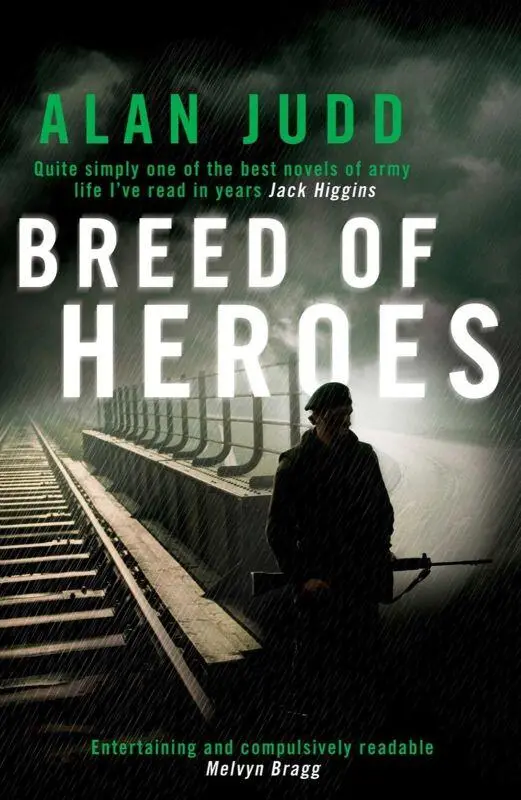
- Название:A Breed of Heroes
- Автор:
- Издательство:Simon & Schuster UK
- Жанр:
- Год:2011
- ISBN:9781847397720
- Рейтинг книги:3 / 5. Голосов: 1
-
Избранное:Добавить в избранное
- Отзывы:
-
Ваша оценка:
A Breed of Heroes: краткое содержание, описание и аннотация
Предлагаем к чтению аннотацию, описание, краткое содержание или предисловие (зависит от того, что написал сам автор книги «A Breed of Heroes»). Если вы не нашли необходимую информацию о книге — напишите в комментариях, мы постараемся отыскать её.
Alan Judd tells Thoroughgood’s tale with verve, compassion and humour. The result is an exceptionally fine novel which blends bitter human incident with army farce.
A Breed of Heroes — читать онлайн бесплатно полную книгу (весь текст) целиком
Ниже представлен текст книги, разбитый по страницам. Система сохранения места последней прочитанной страницы, позволяет с удобством читать онлайн бесплатно книгу «A Breed of Heroes», без необходимости каждый раз заново искать на чём Вы остановились. Поставьте закладку, и сможете в любой момент перейти на страницу, на которой закончили чтение.
Интервал:
Закладка:
Charles read Beazely’s paper last. He was reassured by the report on the front page and Beazely was on the way to having some of his lost credibility restored to him when Charles reached the centre-page spread. There was a large photograph of himself cowering beneath the Pig at the crossroads, captioned, ‘Lieutenant Charles Thoroughgood, 41, takes no chances as grenades pepper the streets’. It was a press agency photograph and had beneath it an article by ‘Our Special Correspondent’ in which Charles read some of his own and many of Van Horne’s words, fortunately without their being attributed to either. Beazely had added the punctuation and a few imaginative flights of his own.
The only other surprise was a leader in a staunchly Unionist paper calling for more shooting, more units like AAC(A) and, strangely, for stricter enforcement of the law relating to road fund licences. It was the adjutant who later pointed out that cars in Republican areas were never taxed.
There was more trouble that afternoon up in the new estate. The fact that it began about an hour after lunch, as convenient a time as any, was due to the CO’s having started it. That morning he had returned from his O Group later than usual, and had stomped straight up to his room, still without speaking to anyone. The adjutant was summoned a while later and Charles feared that it might have something to do with himself, especially as the adjutant was tight-lipped afterwards. Later, though, the ops officer and Nigel Beale were summoned and Charles began to relax. Over lunch there was a great deal of important secretiveness amongst those in the know, except for the adjutant who looked as disinterested and weary as usual by then. Anthony Hamilton-Smith was either oblivious to any secret or was particularly good at keeping it, whilst Tony Watch was aggressively but unsuccessfully curious. Nigel Beale exuded a passionate furtiveness and communicated with the ops officer in cryptic monosyllables. It was all spoilt by the CO who was brisk and talkative when he came to lunch and informed everyone that he had got clearance from Brigade to do a search of selected houses in the new estate before dusk. There was information — doubtful, according to Brigade, who couldn’t see beyond the ends of their noses, but white-hot, according to the CO — that a large quantity of gelignite had been moved in to the area in preparation for a series of bombings. Swearing all present to eternal secrecy, he said that this was the result of a decision taken by the Provisional IRA leadership at a conference in a Dublin hotel to increase terrorism and to decrease rioting. Apparently they thought that terrorism was more likely to drive the British from Ulster and would convince the Ulster people that to live in an Ireland united by the Provisional IRA was what they really wanted. Eternal secrecy was vital in order that the Eire government should not be embarrassed by the suspicion that it harboured terrorists.
Elements from throughout the battalion were involved in the search and they entered the new estate in an impressive convoy, to the accompaniment of banging dustbins. There was also the usual shouting and jeering. It was some time since Charles had been into the estate and he would not have thought deterioration possible, but before his eyes the worst had clearly got worse. Unbroken windows and unsmashed paving stones were now so unusual that they caught the eye and prompted speculation. Garden fences had long been pulled down but a few tatty privet hedges remained. Many of the houses had tiles missing and cracks in their walls. Dirty, unhappy-looking children swarmed like flies and mangy dogs started up everywhere. Because of the very high unemployment a large number of men were at home and, it being afternoon, most of them were up.
Grilles were up on the Land-Rovers. The CO sat in the front with his map-case open. ‘There is nothing that pleases me more,’ he said, ‘than to ride at the head of a convoy of military vehicles. If only we were going to war instead of searching these wretched people’s homes. My God, we’d better find something, you know, or we’ll look pretty stupid.’
‘It’s bound to stir them up if we don’t,’ said Nigel Beale.
‘It’ll stir them up if we do. Anything we do annoys them. If you were to walk round here tonight and give every man a pound he’d go and drink it and then throw the empty bottle at you. And if we didn’t do anything they’d hoard enough explosive to blow themselves and the rest of Belfast sky-high. Maybe that’s the answer, I don’t know.’
Once well into the estate the convoy split up and different bits went to different houses. Charles went with the CO to one of the white-hot certainties, the home of a well-known Republican family. The thought that because he was leaving the Army he would never come back to Belfast, made him pay more attention to what he saw. It might, after all, be the last search they would do. He hoped it would. He was too English not to feel apologetic about such an invasion of privacy. The house in this case was a tattered semi-detached with a larger than usual garden, which was no more than a patch of earth and scrub excreted upon by dogs and children. They surrounded the house and entered by the front door, which had had a hole kicked in the bottom and didn’t close properly. There were at least a dozen occupants of all ages and both sexes. Some protested vigorously and loudly to the pale young soldiers who concentrated on their first duty of entering every room and counting the people, before trying to get them all into one room downstairs. Meanwhile, a shouting and chanting crowd had gathered outside but were kept at a distance by the escort. The accompanying RUC men were older and more accustomed to abuse, and they went about their work with none of the nervous hurry of the young soldiers. An indefinable stench, a combination of many smells, old and new, pervaded the house. On entering, the CO turned to Nigel Beale and said in an undertone, ‘This is where the stuff is, you know. I’m sure of it. If it’s anywhere in this estate, it’s here.’
Soldiers with mine-detectors were ordered to search the garden. After taking a couple of steps into the hall Charles had attempted to linger on the doorstep, but was summoned inside by the CO to deal with complaints. The house had been searched many times before and after their initial hostility most of the people settled into a sullen resentment. Their names were taken and it turned out that they were all family, or so they said. There was a likeness running through them all, but it was more a likeness of expression and manner than of anything physical. A plump, unhealthily pale and prematurely old man who sat quietly in the corner said, when his name was taken, ‘Youse searched this house seventeen times since 1969 and never found nothing. When youse gonna stop?’
‘When you tell us where the gear is,’ said the soldier.
‘There’s no gear here. I don’t know where no gear is.’
‘Then we won’t be long, will we?’
Charles knew better than to invite complaints, since everyone would have complained at the house being searched at all. However, he was picked upon by two teenage girls with lank dark hair and hard, expressionless faces. They had probably chosen him because he was the only one standing around doing nothing. ‘Some of your soldiers have made a mess of our toilet,’ one of them said.
‘What have they done?’
‘Come up and see.’
He followed them upstairs and they showed him into the bathroom. There were smears and deposits around the toilet in such positions as to suggest wild, uncontrolled and aerobatic excretions. It was only his involuntary recoil on entering that saved him from the indignity of being locked in, as they tried to push him forward and close the door behind him. He pushed back and they ran downstairs, laughing loudly and humourlessly. He followed them, conscious of the stares of the soldiers who wondered what had happened. For some time he hung around awkwardly in the hall as searchers came and went. Then the obese lady of the house offered cups of tea to him and several others. It was a suspicious gesture but they felt obliged to accept it. The cups were presented to them on a tin tray with a packet of biscuits. As they raised their cups to their lips each one gave off a powerful smell of urine. Charles replaced his without a word, but he heard later from two soldiers who had eaten them that the biscuits were all right.
Читать дальшеИнтервал:
Закладка:
Похожие книги на «A Breed of Heroes»
Представляем Вашему вниманию похожие книги на «A Breed of Heroes» списком для выбора. Мы отобрали схожую по названию и смыслу литературу в надежде предоставить читателям больше вариантов отыскать новые, интересные, ещё непрочитанные произведения.







Обсуждение, отзывы о книге «A Breed of Heroes» и просто собственные мнения читателей. Оставьте ваши комментарии, напишите, что Вы думаете о произведении, его смысле или главных героях. Укажите что конкретно понравилось, а что нет, и почему Вы так считаете.