Alan Judd - A Breed of Heroes
Здесь есть возможность читать онлайн «Alan Judd - A Breed of Heroes» весь текст электронной книги совершенно бесплатно (целиком полную версию без сокращений). В некоторых случаях можно слушать аудио, скачать через торрент в формате fb2 и присутствует краткое содержание. Год выпуска: 2011, ISBN: 2011, Издательство: Simon & Schuster UK, Жанр: Современная проза, на английском языке. Описание произведения, (предисловие) а так же отзывы посетителей доступны на портале библиотеки ЛибКат.
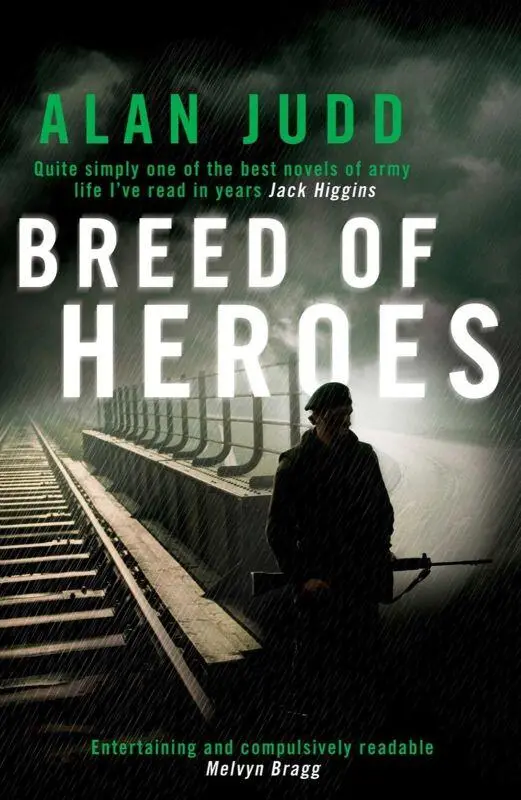
- Название:A Breed of Heroes
- Автор:
- Издательство:Simon & Schuster UK
- Жанр:
- Год:2011
- ISBN:9781847397720
- Рейтинг книги:3 / 5. Голосов: 1
-
Избранное:Добавить в избранное
- Отзывы:
-
Ваша оценка:
A Breed of Heroes: краткое содержание, описание и аннотация
Предлагаем к чтению аннотацию, описание, краткое содержание или предисловие (зависит от того, что написал сам автор книги «A Breed of Heroes»). Если вы не нашли необходимую информацию о книге — напишите в комментариях, мы постараемся отыскать её.
Alan Judd tells Thoroughgood’s tale with verve, compassion and humour. The result is an exceptionally fine novel which blends bitter human incident with army farce.
A Breed of Heroes — читать онлайн бесплатно полную книгу (весь текст) целиком
Ниже представлен текст книги, разбитый по страницам. Система сохранения места последней прочитанной страницы, позволяет с удобством читать онлайн бесплатно книгу «A Breed of Heroes», без необходимости каждый раз заново искать на чём Вы остановились. Поставьте закладку, и сможете в любой момент перейти на страницу, на которой закончили чтение.
Интервал:
Закладка:
‘Anyway,’ continued Tony Watch. ‘What makes you think it was the Provisionals that organised it? How d’you know it wasn’t the Stickies?’
‘The who?’ Nigel’s mouth was still full and his cheeks bulged.
‘The Stickies,’ repeated Tony irritably.
Nigel swallowed. ‘Who the hell are they when they’re at home?’
‘The Stickies? Don’t you know who the Stickies are?’ Tony’s plump face showed a mixture of triumph and genuine surprise. ‘The Stickies are the official IRA. I thought everyone knew that. It’s common knowledge.’
‘Not to me it isn’t.’
‘The CO knows.’
‘I’ve never heard of it.’
‘Well, don’t look at me. You’re supposed to be the Intelligence officer. Go and ask the first Ackie you meet. He’ll tell you who the Stickies are.’
‘Sounds bloody unlikely to me,’ said Nigel. He looked disgruntled and uncertain.
Without a word to anyone, Anthony got up from the table, walked over to the hat rack, put on a black beret, taking care to adjust it neatly with the badge in line with the left eye and the brim an inch above the eyebrow, returned to the table, sat down and continued calmly with his breakfast. Nigel and Tony forgot their argument for a while and stared at him, but neither ventured to say anything. Charles was careful not to stare but could not help glancing several times, surreptitiously. Anthony ate solemnly and silently, as though wearing a beret was as much a part of the breakfast ritual as food. He supposed it was Anthony’s way of indicating his disapproval of the conversation and admired him for it, though without following the logic of the act. He decided to postpone opening his letters until he had finished eating. He did not want Anthony to feel obliged to get up and put on his overcoat.
Nigel Beale was less sensitive, being one of those people who do not seek to enquire after the causes of odd behaviour in others. What interested him was the problem in hand. He put his knife and fork down and pushed his plate away. ‘So why are they called Stickies?’ he asked Tony. ‘If they are, that is.’
‘I don’t know,’ said Tony. ‘Go and ask them. Or get Charles here to ask the press for you. They’ll know.’
Anthony put his cup into his saucer with a noise as decisive as an auctioneer’s hammer. ‘Stickies,’ he said with chilling precision, ‘is the name by which the official IRA have been known since one Easter a few years ago when they departed from Republican tradition by sticking their Easter lilies to themselves rather than pinning them. As an Intelligence officer you should know the regimental history and traditions of your enemy.’ He sipped his tea, almost demurely, and then looked again at Nigel. ‘And as an officer you should also know that talking at breakfast is not a habit that is encouraged in the British Army, especially talking shop. It’s unfortunate that it’s allowed at all. In some regiments it is not, while in my father’s regiment, the wearing of head-dress at a meal indicated that the wearer did not wish to be spoken to. Indeed, it was considered polite not to speak in his presence. That is a custom we would do well to adopt.’ Anthony then got up and took his tea to an armchair, where he sat and sipped calmly, still wearing his beret.
Tony Watch raised his eyebrows and smiled at Charles. Nigel Beale looked as though he were about to reply, played for a few moments with his teaspoon, then got up and walked out without looking at anyone. Tony soon left and Charles went and sat with his coffee and letters in the armchair opposite Anthony. The silence continued for some moments until Anthony looked up. ‘Charles.’
To his surprise, a slight smile played upon Anthony’s features. ‘Yes, Anthony?’
‘I think I may have started a regimental tradition.’
‘I hope you have, Anthony,’ said Charles, sincerely.
Still smiling, Anthony took off his beret. His triumph seemed to have made him light-hearted and almost loquacious, for the time of day. ‘Should shut young Beale up for a bit,’ he said. ‘I’m very pleased he left when he did, though. This beret ain’t mine. Tight at the band. Must belong to some pin-head. Thought I was in danger of passing out and spoiling the effect. Mine’s upstairs.’
Charles laughed. ‘It did the job anyway.’
Anthony stood and stretched. ‘Just goes to show,’ he said, mysteriously. He put the beret back on its peg on his way out of the Mess. ‘Have a good day, old boy.’
‘And you, Anthony.’ Charles turned at last to his letters. There was a postcard from Janet, posted in York, where she had been for the weekend. She did not say with whom. One of the other letters was from Regimental Headquarters asking for subscriptions and the other was from the Retirements Board saying that he could be released from the Army on repayment of one thousand pounds. The earliest date was the day after the battalion’s return from Ireland, by which time he would have to have paid the money. He was not entitled to terminal leave nor to the normal gratuity. A copy of the letter was being sent to the CO.
Charles had had no idea that it could be so easy. Pessimism had set in after he had sent his letter and the recent busyness had pushed to the back of his mind all thoughts about resignation, but now the knowledge that he could be out of the Army in two months shook the sleep out of him and made even his present surroundings seem almost pleasant. He rose from the table and poured himself another coffee with the delight in detail of one who sees for the first time. His boots, his beret, his heavy wool jersey could all be viewed now with affection, rather than sickening familiarity, because he would be leaving them. It was clear that his main task now was to stay alive, complete and uninjured. He thought about this as though it were a holy vow and resolved to consider how best to eliminate those activities that offered the most danger.
There was, of course, a problem about the money. The very most he could raise by selling everything saleable, including the old Rover (if it still was saleable) and his mess kit and blues (if Regimental Headquarters still bought such things), was a little over five hundred pounds. He could think of no job he wanted and would be in no position to borrow from the bank. He thought briefly of Janet, who had money of her own, but felt this would be ignoble. He was then a little annoyed because he had considered himself above thinking such things were ignoble — it was the kind of reaction he associated more with the CO than with himself — but he then had to admit that the real reason was that he did not like to commit himself to her any more than he had.
These intriguing speculations were ended by the arrival of the CO. Charles nervously expected a reaction to the letter from the Retirements Board but the CO ate his breakfast quickly, saying nothing to anyone, called sharply for his vehicles and drove off to the Brigade O Group. When he had gone one of the mess orderlies brought in the newspapers, from the state of which it was clear that someone had read them hurriedly. It appeared that the CO had had them sent up to his room the moment they appeared. Charles was apprehensive but they turned out on the whole not to be as bad as he had feared. The riot and subsequent shootings were headlined throughout and there were lots of fuzzy, confusing pictures. There were a few quotations from the CO’s outburst, which came over surprisingly well, and no one had taken up McColm’s point about high-powered weapons except the Irish Times man. The Gazette carried essentially the same stories as the others but with the addition of extensive coverage of the views of local residents. It claimed that soldiers had broken into houses on the pretext of searching for wanted men but that their real purpose had been to vandalise. The damage in the house that the CO had inspected was accurately listed, although McColm had neglected to mention that the holes in the walls had been caused by a bullet and not by the soldiers. Inside there was a short feature entitled, ‘The Man who lets God decide’. It said that the CO had been beside himself with rage at the press conference and asked whether such a man could be trusted to remain cool in more dangerous situations. It questioned the use of high-powered weapons in built-up areas and cited the CO as one who shifted the responsibility for such decisions to a suspiciously Unionist God, using the Queen of England as his authority. Surprisingly, none of the papers speculated about the cause of the riot, which remained unknown.
Читать дальшеИнтервал:
Закладка:
Похожие книги на «A Breed of Heroes»
Представляем Вашему вниманию похожие книги на «A Breed of Heroes» списком для выбора. Мы отобрали схожую по названию и смыслу литературу в надежде предоставить читателям больше вариантов отыскать новые, интересные, ещё непрочитанные произведения.




Обсуждение, отзывы о книге «A Breed of Heroes» и просто собственные мнения читателей. Оставьте ваши комментарии, напишите, что Вы думаете о произведении, его смысле или главных героях. Укажите что конкретно понравилось, а что нет, и почему Вы так считаете.