Tracy Chevalier - Remarkable Creatures
Здесь есть возможность читать онлайн «Tracy Chevalier - Remarkable Creatures» — ознакомительный отрывок электронной книги совершенно бесплатно, а после прочтения отрывка купить полную версию. В некоторых случаях можно слушать аудио, скачать через торрент в формате fb2 и присутствует краткое содержание. Жанр: Современная проза, на английском языке. Описание произведения, (предисловие) а так же отзывы посетителей доступны на портале библиотеки ЛибКат.
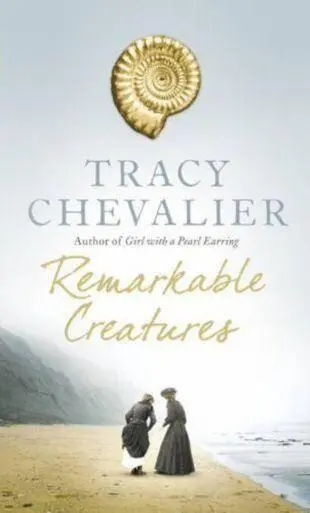
- Название:Remarkable Creatures
- Автор:
- Жанр:
- Год:неизвестен
- ISBN:нет данных
- Рейтинг книги:4 / 5. Голосов: 1
-
Избранное:Добавить в избранное
- Отзывы:
-
Ваша оценка:
Remarkable Creatures: краткое содержание, описание и аннотация
Предлагаем к чтению аннотацию, описание, краткое содержание или предисловие (зависит от того, что написал сам автор книги «Remarkable Creatures»). Если вы не нашли необходимую информацию о книге — напишите в комментариях, мы постараемся отыскать её.
Remarkable Creatures — читать онлайн ознакомительный отрывок
Ниже представлен текст книги, разбитый по страницам. Система сохранения места последней прочитанной страницы, позволяет с удобством читать онлайн бесплатно книгу «Remarkable Creatures», без необходимости каждый раз заново искать на чём Вы остановились. Поставьте закладку, и сможете в любой момент перейти на страницу, на которой закончили чтение.
Интервал:
Закладка:
“Who’s that downstairs?” she demanded now, hearing Mr Buckland’s voice. “You get tuppence off him to see it?”
I shook my head. “Mr Buckland’s not the tuppence type.”
“Course he is. You don’t let anyone see that thing without paying. Penny for the poor, tuppence for the rich.”
“You ask him, then.”
Mam frowned. “I will.” Handing me the paddle she used to stir the linens, she wiped her hands on her apron and headed downstairs. I poked at the washing, happy enough for a little break from Mr Buckland’s questions-though it would have been funny to see Mam try to cope with him. She was fine with some of the other gentlemen. Henry De La Beche, for instance, she bossed about like another son. But William Buckland defeated even my mam. She come up a time later, exhausted from his constant chatter, and without tuppence. She shook her head. “Your pa used to tell me when that man come to the workshop, he’d give up getting any work done and settle back for a sleep while Mr Buckland went on. Now, he wants you back down to tell him about the cleaning and what we’re going to do with it. Tell him we want a good price, and don’t want being cheated by a gentleman again!”
When I come in Mr Buckland was leaving by the door that led onto Cockmoile Square. “Oh, Mary, I’ll just be a moment. I’m fetching Doctor Carpenter here to see this. And a few others this afternoon who I’m sure will be most interested in it.”
“Just as long as it’s not Lord Henley!” I called after him.
“Why not Lord Henley?”
I explained about the first croc, with its monocle, waistcoat and straightened tail as Miss Philpot had described it. “That idiot!” Mr Buckland cried. “He should have sold it to Oxford or the British Museum rather than to Bullock’s. I’m sure I could have convinced either to take it. I shall do so with this one.”
Without asking, Mr Buckland took over the selling of the croc from Mam and Miss Elizabeth. Before Mam could stop him he’d written enthusiastic letters to possible buyers. She were cross at first, but not once he’d found us a rich gentleman in Bristol who paid us forty pounds for it-the museums having said no. That made up for all that Mam and me had to put up with from Mr Buckland. For he was about all summer, fired with the idea of crocodiles entombed in the cliffs and ledges, waiting to be freed. While we had ours in the workshop, he was in and out all day as if the room were his, bringing with him gentlemen who poked about, measuring and sketching and discussing my croc. I noticed during all the talk, Mr Buckland never once called it a crocodile. He was like Miss Elizabeth that way. It made me begin to accept it were something else-though until we knew what that was, I would still call it a crocodile.
One day when it were just Mr Buckland and me in the workshop, he asked if he could clean a bit of the croc himself. He was always keen to try out new things. I surrendered my brushes and blade, for I couldn’t say no to him, but I feared he would do real damage. He didn’t, but that was because he kept stopping and examining and talking about the croc till I wanted to scream. We needed to eat; we needed to pay the rent. We still had debts of Pa’s to pay, and the thought of ending up in the workhouse never left us. We couldn’t spend the time talking. We needed to sell the croc.
Finally I managed to interrupt him. “Sir,” I said, “let me do the work and you do the talking, or this creature will never be ready.”
“You’re quite right, Mary, of course you are.” Mr Buckland handed me the blade, then sat back to watch me scrape along one of the ribs, freeing and brushing away the limestone that clung to it. Slowly a clear line emerged, and because I went at it carefully, the rib weren’t nicked or scored, but smooth and whole. For once he was quiet, and that made me ask the question I’d been wanting to for several days now. “Sir,” I said, “is this one of the creatures Noah brought on his ark?”
Mr Buckland looked startled. “Well, now, Mary, why do you ask that?”
He didn’t go chatting on as he normally would, and his waiting for me to speak made me shy. I concentrated on the rib. “Dunno, sir, I just thought…”
“What did you think?”
Maybe he had forgotten I weren’t one of his students, but just a girl working to live. Still, for a moment I acted the student. “Miss Philpot showed me pictures of crocodiles drawn by Cruver-Cuver-the Frenchman who does all those studies of animals.”
“Georges Cuvier?”
“Yes, him. So we compared his drawings to this and found it were different in so many ways. Its snout is long and pointed like a dolphin’s, while a croc’s is blunt. And it’s got paddles instead of claws, and they’re turned outward rather than forward the way a croc’s legs are. And of course, that big eye. No crocodile has eyes like that. So Miss Philpot and I wondered what it could be if it’s not a croc. Then I heard you and a gentleman you brought here the other day, Reverend Conybeare. You was talking about the Flood-” actually they’d used the words “deluge” and “diluvian”, and I’d had to ask Miss Elizabeth what they meant “- and it made me wonder: if this ain’t a crocodile, which Noah would’ve had on the ark, then what is it? Did God make something that was on the ark we don’t know about? So that’s why I’m asking, sir.”
Mr Buckland was silent for longer than I thought he could ever manage. I begun to worry he didn’t understand what I meant, that I was too uneducated to make sense to an Oxford scholar. So I asked again, a slightly different question. “Why would God make creatures that don’t exist any more?”
Mr Buckland looked at me with his big eyes, and I saw there a flickering worry.
“You are not the only person to ask this question, Mary,” he said. “Many learned men are discussing it. Cuvier himself believes there is such a thing as the extinction of certain animals, in which they die away completely. I am not so sure of that, however. I cannot see why God would want to kill off what He has created.” Then he brightened, and the worry left his eyes. “My friend the Reverend Conybeare says that while the Scriptures tell us that God created Heaven and Earth, they don’t describe how He did it. That is open to interpretation. And that is why I’m here-to study this remarkable creature, and find more of them to study, and through careful contemplation arrive at an answer. Geology is always to be used in the service of religion, to study the wonders of God’s creation and marvel at His genius.” He ran a hand over the croc’s spine. “God in His infinite wisdom has peppered this world with mysteries for men to solve. This is one of them, and I am hon-?floured to take on the task.”
His words sounded fine, but he had given no answer. Perhaps there was no answer. I thought for a moment. “Sir, do you think the world was created in six days, the way the Bible says?”
Mr Buckland waggled his head-not a yes or a no. “It has been suggested that ‘day’ is a word that should not be interpreted literally. If one thinks instead of each day as an epoch during which God created and perfected different parts of Heaven and Earth, then some of the tensions between geology and the Bible disappear. After five epochs, during which all of the layering of rock and the fossilisation of animals occurred, then man was created. That is why there are no human fossils, you see. And once there were people, on the sixth ‘day’, the Flood came, and when it subsided, it left the world as we see it today, in all its grandeur.”
“Where did all the water go?”
Mr Buckland paused, and I saw again that flicker of uncertainty in his eyes. “Back into the clouds from whence the rain came,” he replied.
Читать дальшеИнтервал:
Закладка:
Похожие книги на «Remarkable Creatures»
Представляем Вашему вниманию похожие книги на «Remarkable Creatures» списком для выбора. Мы отобрали схожую по названию и смыслу литературу в надежде предоставить читателям больше вариантов отыскать новые, интересные, ещё непрочитанные произведения.
Обсуждение, отзывы о книге «Remarkable Creatures» и просто собственные мнения читателей. Оставьте ваши комментарии, напишите, что Вы думаете о произведении, его смысле или главных героях. Укажите что конкретно понравилось, а что нет, и почему Вы так считаете.