Iain Banks - Walking on Glass
Здесь есть возможность читать онлайн «Iain Banks - Walking on Glass» весь текст электронной книги совершенно бесплатно (целиком полную версию без сокращений). В некоторых случаях можно слушать аудио, скачать через торрент в формате fb2 и присутствует краткое содержание. Год выпуска: 1985, ISBN: 1985, Издательство: ABACUS FICTION, Жанр: Современная проза, на английском языке. Описание произведения, (предисловие) а так же отзывы посетителей доступны на портале библиотеки ЛибКат.
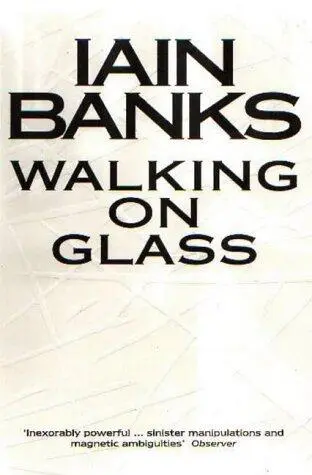
- Название:Walking on Glass
- Автор:
- Издательство:ABACUS FICTION
- Жанр:
- Год:1985
- ISBN:0-349-10178-7
- Рейтинг книги:4 / 5. Голосов: 1
-
Избранное:Добавить в избранное
- Отзывы:
-
Ваша оценка:
Walking on Glass: краткое содержание, описание и аннотация
Предлагаем к чтению аннотацию, описание, краткое содержание или предисловие (зависит от того, что написал сам автор книги «Walking on Glass»). Если вы не нашли необходимую информацию о книге — напишите в комментариях, мы постараемся отыскать её.
Park, Grout, Quiss - no trio could be further apart. But their separate courses are set for collision...
"A feast of horrors, variously spiced with incest, conspiracy, and cheerful descriptions of torture... fine writing" The Times
"The author's powerful imagination is displayed again here every bit as vividly as in his debut" Financial Times
"Establishes beyond doubt that lain Banks is a novelist of remarkable talents" Daily Telegraph
Walking on Glass — читать онлайн бесплатно полную книгу (весь текст) целиком
Ниже представлен текст книги, разбитый по страницам. Система сохранения места последней прочитанной страницы, позволяет с удобством читать онлайн бесплатно книгу «Walking on Glass», без необходимости каждый раз заново искать на чём Вы остановились. Поставьте закладку, и сможете в любой момент перейти на страницу, на которой закончили чтение.
Интервал:
Закладка:
It was most frustrating. He was still in the process of trying to get his contacts in the attendants to talk about this new aspect of the castle's mystery. So far they had been quite unforthcoming, despite all his cajoling and threats. They were frightened, no doubt about that.
He wondered just how immutable the castle's society really was. Might it be possible, for example, for them - him - to carry out a coup ? After all, what god-given right did the seneschal have to run the place? How had he come to power? Just how closely did the two sides in the Wars supervise the castle?
Whatever the answers, at least it gave him something else to think about apart from the games. There might be another way out. There just might; never assume things were set and certain. That was a lesson he'd learned long ago. Even traditions change.
Maybe this run-down heap was approaching some sort of catastrophe curve-edge, some change. Once, no doubt, it had been all its architects had intended, perhaps full of people, intact, not crumbling, fortress as well as prison... but now Quiss felt its pervasive air of decay, tottering senility made it - if he could find the right key, or weapon - easy prey. The seneschal was only slightly impressive; nobody else was at all. He - along with the woman - was the most important person in the place, he was sure. It was all for them, it revolved around them, only really made sense if they were here, and that itself was a kind of power (as well as a comfort - he liked to feel he was, as he had been in the Wars, part of an elite).
Ajayi sat, wondering whether to wait for the small waiter to return before she went on reading her book. It was a strange story about a man, a warrior, from an island near one of the planet's poles; he was called Grettir, as far as she could make out from the translation she was reading. He was very brave except for being afraid of the dark. She wanted to go on reading, no matter what the response was to their riddle-answer. Either way she couldn't imagine anything happening for a while.
They were both sitting there, quiet, absorbed, a few minutes later when, from the bright, air-shimmering depths of the games room a small voice said,
"Sowwy..."
PART FOUR
PENTON STREET
Outside the Belvedere pub, in Penton Street, a table stood on the pavement, guarding the pub's open cellar doors. They must be expecting a delivery from the brewers, Graham thought. The table, wood and formica, standing over the two opened traps of the cellar, reminded him of the chair in the corridor of the School, just before he left.
He was almost at the top of the low, building-disguised hill now; the road had all but flattened out. A few cars went along Penton Street, but it was quiet after the bustle of Pentonville Road, which he had just crossed. He looked over to the far side of the street, at some shops, a cafe. The area seemed unable to make up its collective mind whether it was run-down or not.
A copy of that day's Sun newspaper tried to wrap itself round Graham's feet, caught in a sudden dusty gust of wind. He stepped out of it and let it flatten against some roadside railings. He smiled, recalling Slater's apoplectic reaction to Sun readers. The best time, Graham thought, was when - only a few weeks ago - they had been sitting in Hyde Park. Slater had decided that as they were all going to be around during the summer anyway, they should arrange days out, and had therefore organised a Saturday afternoon picnic, having made up his mind on the Friday that the following day would be hot and sunny, which it was.
Slater had invited Graham, Sara, and a young man Graham assumed was Slater's latest conquest, a short, muscled ex-soldier called Ed. Ed had short fair hair and wore cut-off jeans as shorts, and a green Army T-shirt. He sat on the grass slowly reading a Stephen King novel.
They had talked, at Slater's instigation, about what they would do if they won a million pounds. Sara refused to play; ask her if she ever did win, she said. Ed thought carefully, and said he'd buy a big car, and a pub somewhere in the country. Slater didn't know what else he'd do, but he'd had this great idea for using at least some of the money; go to the American South, hire a crop-dusting plane and a willing pilot, fill the tanks with a mixture of chilli sauce and indelible black ink, then fly over the biggest Ku Klux Klan march of the year. That would make their eyes water; paint the mothers! Yippee!
Graham said he would use the money to create an ultimate work of art... it would be a map of London, with every single street and house shown, and on it would be traced - in black ink, funnily enough - the path, the route that each individual person in London took that day, whether by train, tube, bus, car, helicopter, plane, wheelchair, boat, or on foot.
Sara laughed, but not unkindly. Ed thought it would be difficult to arrange. Slater pronounced the idea boring, and said that it would be boring even if the map was coloured and/or you used different-coloured inks for the trails, and anyway, his was a much better idea all round. Graham thought Slater sounded a bit drunk, and didn't reply-he just sat with a knowing smile on his face, and grinned briefly at Sara, who smiled back.
She wore a light summer dress with a high, elegant neck, and a big white hat. She had on white shoes with round toes and rather old-fashionedly large clumpy heels, and silk or silk-look stockings, or tights, which Graham thought were unnecessary on such a warm day. She leant against a tree, looking beautiful. When she put her head back, and put her arm behind her neck, he kept glancing, quickly, ashamed, at the dark length of curled hair in the exposed armpit.
Slater, in white trousers and striped blazer, complete with battered boater (real straw, Graham noticed), sat cross-legged on the grass holding a plastic cup full of champagne (he'd told Graham and Sara each to bring some food: he'd bring a Magnum).
From money, they had gone on to politics:
"Edward," Slater said. "You can- not be serious!"
Ed shrugged and lay back in the grass, one arm propping up his cropped head as he read the paperback gripped, spine broken, in his other fist. "I reckon she's done all right," he said. He had a vaguely East London accent. Slater bounced the heel of his free hand off his forehead.
"My God ! The stupidity of the English working class never ceases to amaze me! What do those murderous, money-grabbing, self-seeking... bastards have to do to you before you start getting angry? Good grief! What are you waiting for? Repeal of the Factory Safety Act? Compulsory redundancy for all trade unionists? The death penalty for cleaning windows for gain while claiming the dole? I mean, tell me!"
"Don" be daft," Ed shrugged. "It isn" her fault; it's the recession, isn" it? Bleedin" Labour couldn't do no better; just nationalise everything, wouldn" they?"
"Edward," Slater sighed, "I think there's a place on the Editorial Board of The Economist just waiting for you."
"Well, you can come out with all these smart answers," Ed said, still reading, or at least looking at the paperback, "but most people just don" see things the way you do."
"Yes," Slater said, hissing. "Well, there's an open sewer at the bottom of Chancery Lane you can blame for that."
Ed looked puzzled. He looked round at Slater. "What's that, then?"
"Oh, good grief," Slater said. He collapsed back in the grass melodramatically, but left his hand holding the champagne sticking up. "Bingo!" he gasped.
The general election was in a few days. Slater couldn't believe that people really were going to vote the Conservatives back in. Graham wasn't so sure it was such a bad thing, but he kept this private; Slater would have exploded. Graham agreed slightly with Ed; he didn't think anybody could do very much about the economic situation of the country. Certainly he thought the Tories spent too much on arms, especially nuclear weapons, and maybe they should spend more on things like the Health Service, but he admired Mrs Thatcher a little, and she had had a famous victory in the Falklands. He knew it was all rubbish, but he had felt a sort of grudging pride when the Army marched into Port Stanley. Ed didn't seem bothered about letting Slater know what he thought; Graham wasn't sure whether to admire him or feel sorry for him.
Читать дальшеИнтервал:
Закладка:
Похожие книги на «Walking on Glass»
Представляем Вашему вниманию похожие книги на «Walking on Glass» списком для выбора. Мы отобрали схожую по названию и смыслу литературу в надежде предоставить читателям больше вариантов отыскать новые, интересные, ещё непрочитанные произведения.









Обсуждение, отзывы о книге «Walking on Glass» и просто собственные мнения читателей. Оставьте ваши комментарии, напишите, что Вы думаете о произведении, его смысле или главных героях. Укажите что конкретно понравилось, а что нет, и почему Вы так считаете.